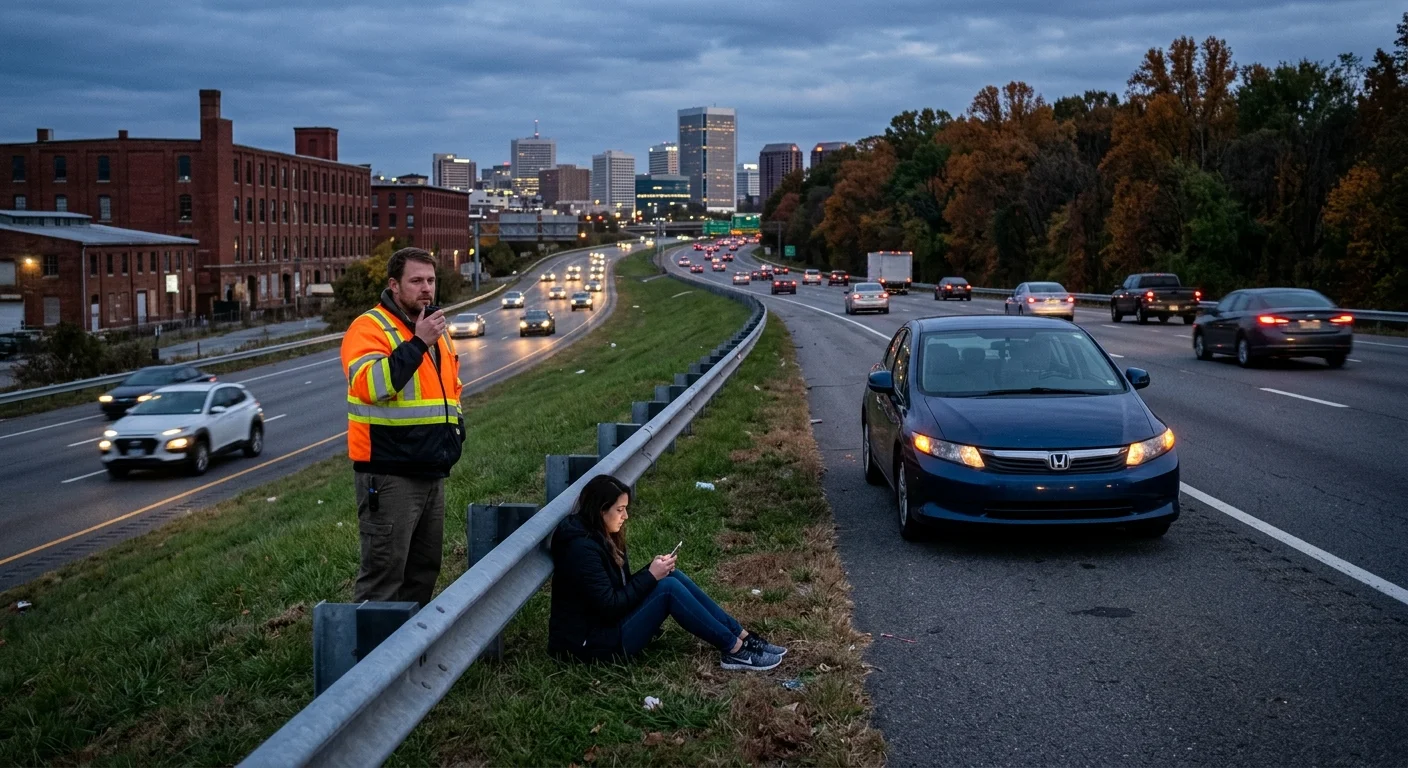
When you search “tow truck near me Richmond VA,” have four details ready: your location, vehicle, what happened, and destination. Mention access problems, then ask the operator to confirm the complete charge, including mileage, before you agree.
Tow truck near me Richmond VA: pin down your exact location
Start with the road, direction of travel, and nearest visible landmark. A dropped phone pin helps, but it shouldn’t be the only detail you provide. The operator needs to approach from the correct direction.
On an interstate, share the route and whether you’re traveling north, south, east, or west. Give the nearest exit or mile marker if you can see one. Also say whether the car is on the right shoulder, left shoulder, median, ramp, or still in a travel lane.
That distinction matters around the I-95 and I-64 downtown overlap. At the Bryan Park interchange, several routes and ramps meet within a compact area. “Near Bryan Park” leaves too much room for confusion. “Southbound I-95 after the Bryan Park interchange, on the right shoulder” gives the operator a clearer starting point.
On local streets, name the closest intersection and nearby business. In a parking deck, give the garage name, level, entrance, and clearance information. Mention locked gates, access codes, narrow alleys, or parking controls before the operator accepts the job.
If you’re unsure of the road name, check your map and 511 Virginia for nearby routes or incidents. Don’t guess your jurisdiction. A Richmond mailing address may place you in the city, Henrico, or Chesterfield.
These details help us match your emergency towing request with an independent operator who can assess the location.
Describe the vehicle and what stopped it
Give the vehicle’s year, make, model, color, and plate. Say whether it’s a sedan, pickup, motorcycle, van, SUV, RV, or vehicle with a trailer. Mention anything attached to it, including a loaded trailer or exterior rack.
Next, describe what you can observe. Tell the operator whether the engine starts, the transmission shifts, and the wheels roll. Mention a flat tire, dead battery, collision damage, overheating, smoke, leaking fluid, broken steering, or a vehicle stuck off the pavement. If the keys are missing or locked inside, say that too.
Be clear about the vehicle’s position. A car sitting normally in a parking space is different from one against a curb, inside a low garage, down an embankment, or blocked by another vehicle. Describe the surface as pavement, gravel, mud, grass, or standing water.
You don’t need to diagnose the failure. Simple observations are more useful than a guess. “The engine cranks but doesn’t start” gives the operator better information than “something electrical broke.”
Some problems may need roadside help instead of transport. If the main issue appears to be a battery, tire, or fuel problem, mention that when requesting roadside assistance. The independent operator can decide whether to accept that work or discuss towing.
Before ending your message, repeat the vehicle description and location. That short check can prevent a mix-up in a crowded lot or along a busy Richmond corridor.
Say where you want the vehicle taken
Have a destination address ready before requesting the tow. It might be a repair shop, dealership, home, body shop, or another location that has agreed to receive the vehicle. Give the full street address, not only the business name.
Contact the destination before authorizing transport when possible. Confirm that it can receive the vehicle and ask where it should be left. If the business will be closed, find out whether it has an approved after-hours drop process.
Richmond trips can cross several jurisdictions quickly. A pickup in The Fan and a destination in Chesterfield may cross the James River. A breakdown near Short Pump could require a trip farther into Henrico or back toward downtown. The exact endpoints help the operator discuss routing and mileage.
Mention destination access details as well. Tell the operator about gates, parking decks, narrow streets, loading areas, or instructions from the repair shop. If someone must meet the operator, provide that person’s name when arranging the job.
If you haven’t selected a repair facility, say so plainly. Ask what destination details must be settled before the operator can accept the tow. Don’t assume the vehicle can be left at a closed business without permission.
Your destination can affect the total charge. Changing it after the vehicle is loaded may also change the distance. Settle the intended address while discussing the job and price.
Ask the operator to confirm the full charge
Ask the independent operator how the total will be calculated before agreeing. Provide the same pickup, vehicle, condition, and destination details you’ve already prepared. An incomplete description can produce a price discussion based on the wrong job.
Ask whether the amount includes the hookup, loaded mileage, applicable after-hours charges, special recovery work, tolls, and destination-related costs. If the car may enter storage, ask how those charges work and when retrieval is available.
Quick Tow Richmond is a referral service. We don’t perform the tow, set the operator’s total, or bill the driver. The independent operator contracts with you and bills you directly. Confirm the full amount and payment terms with that operator.
Legal towing ceilings shouldn’t be mistaken for a roadside quote. Virginia Code § 46.2-1233.1 sets a $210 maximum hookup and initial towing fee for a passenger car removed without consent from private property. Localities may set lower limits. That rule doesn’t establish the price of a voluntary emergency tow you request.
Our guide to towing costs in Richmond explains the difference between regulated nonconsent fees and operator pricing. Use those legal limits as context, not as a promised total.
Before authorizing the job, repeat the pickup and destination. Then ask the operator to confirm whether mileage is included. Keep any written price information and request an itemized record of the charges.
Stay safe near I-95, I-64 and I-295
Interstate breakdowns need precise scene information. Tell the operator whether your vehicle is fully on the shoulder, partly in a lane, near a ramp, or beside a guardrail. Report injuries, smoke, leaking fluid, or immediate roadway danger at once.
The I-95 and I-64 overlap through Richmond runs from the Bryan Park area toward the James River. A VDOT study described it as one of the region’s highest-crash, heavily congested corridors. Don’t reduce your location to “downtown interstate.” Include the route, direction, exit, and shoulder.
VDOT’s Safety Service Patrol covers Richmond-area portions of I-95, I-64, and I-295. Its free services can include tire changes, jump starts, fuel delivery, radiator water, and help arranging a tow. The patrol doesn’t perform mechanical repairs or operate as your tow company.
If a patrol, police, fire, or medical unit is managing the scene, follow its directions. Tell the independent tow operator about lane closures or access instructions. A route shown on a map may not reflect how responders are controlling traffic.
For a longer checklist, read what to do after breaking down on I-95. Immediate danger or injuries come before arranging a private tow. Contact emergency services first when the situation requires them.
Keep your phone available after leaving a message. If the vehicle’s position changes or authorities move you to another location, update Quick Tow Richmond so the referral details remain accurate.
When to call us
Call when your vehicle can’t continue, has collision damage, or needs transport beyond roadside help. Our recorded line takes calls 24/7, plays a recording notice, and takes details for matching callers with independent licensed towing operators who contract and bill directly. Call us at (804) 701-6752.