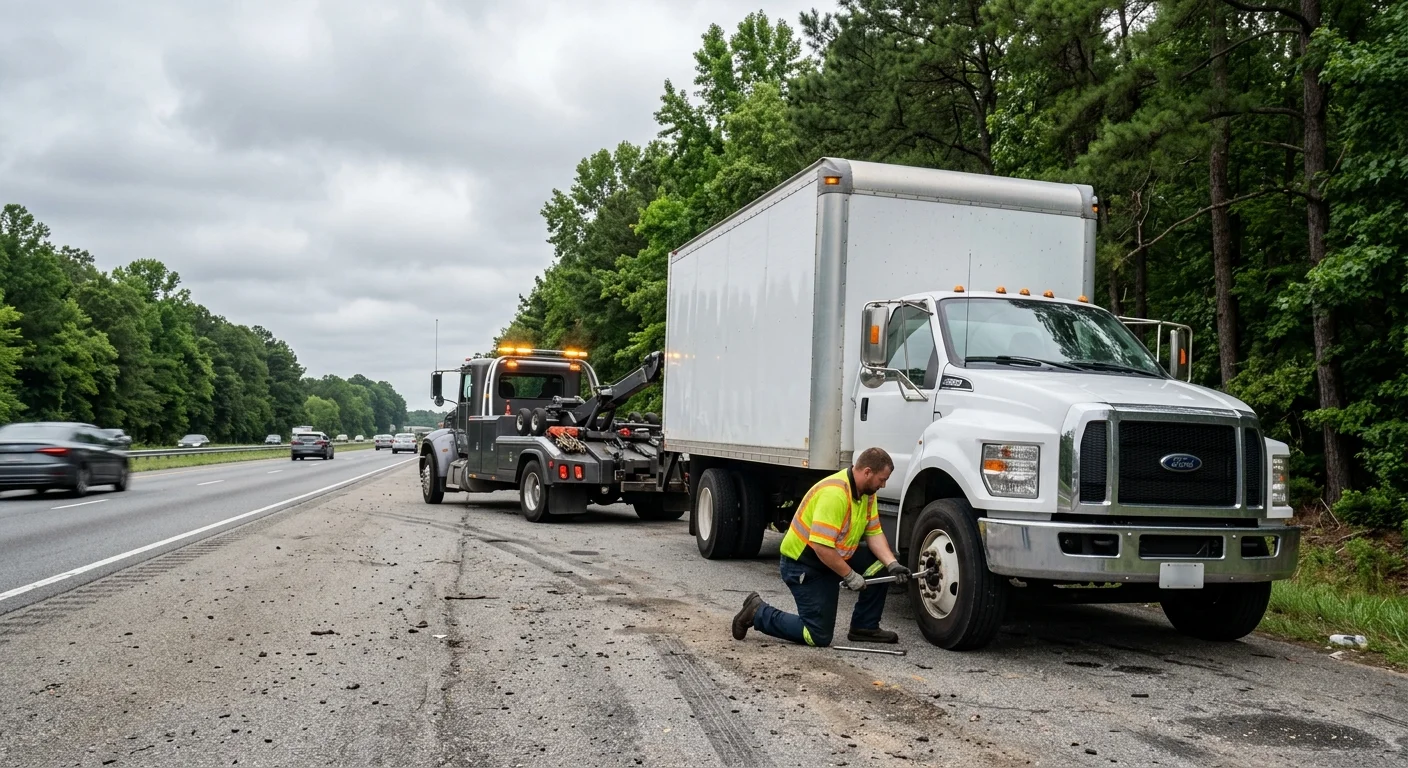
A disabled box truck near Chester needs a precise location and clear description before any referral. If you’re searching for heavy duty towing Chester VA, identify your I-95 direction, nearest interchange, truck configuration, load condition, visible damage, and chosen destination. Quick Tow Richmond can then match you with an independent operator, who decides whether to accept the job and bills you directly.
Heavy duty towing Chester VA starts with location and configuration
Begin with the details the driver can verify without entering traffic. State whether the truck is northbound or southbound on I-95. Include the nearest interchange, mile marker, ramp, bridge, or recognizable roadside feature.
Describe where the vehicle stopped. It might be on the right shoulder, left shoulder, exit ramp, or another area outside the travel lanes. Tell the operator if any part of the truck remains near moving traffic. If the location is uncertain, 511 Virginia provides current traffic and incident information.
Next, describe the vehicle itself. “Box truck” can refer to several configurations. Give the make and model if known. Note whether the cargo body is separate from the cab, how many axles you can see, and whether a trailer is attached. Share the drivetrain only if you know it from the vehicle records.
Don’t guess a weight class, overall height, or loaded weight. Read those details from registration, fleet paperwork, or shipping documents when available. If the paperwork doesn’t confirm something, say that it isn’t confirmed.
These details help the operator evaluate the request without relying on a broad vehicle label. They don’t guarantee that any particular recovery vehicle or method will be used. The independent operator makes that decision after reviewing the truck’s condition and position.
Our heavy-duty towing referral page explains how to start that conversation. Keep the vehicle details nearby when the operator contacts you.
Describe the load, trailer, and visible damage
The operator needs to know what the box truck is carrying. Name the cargo in plain terms, such as packaged goods, furniture, tools, or empty containers. If shipping documents list a weight, provide the stated figure. Don’t estimate a number that isn’t documented.
Report the load’s current condition. Mention any visible shift, fallen items, open doors, damaged restraints, liquid, smoke, or unusual odor. If the cargo has markings or handling instructions, read them exactly. Don’t interpret a label you don’t recognize.
An attached trailer needs its own description. State the trailer type, whether it appears loaded, and whether its connection to the truck looks normal. Mention visible damage around the hitch, landing gear, wheels, or trailer body. The operator can then decide what further questions must be answered.
Describe truck damage from an observable position. Useful details include flat or missing tires, wheels sitting at an unusual angle, leaking fluid, damaged steering parts, body contact with the pavement, or collision damage. Don’t crawl beneath the truck to improve the description. If you can’t inspect an area without exposure to traffic, report that it couldn’t be checked.
Photos may help when they can be taken from a protected position. Capture the truck’s overall stance, visible damage, cargo body, and surrounding shoulder. Avoid making promises about cargo transfer, repair, or recovery methods. Those items must be discussed directly with the operator.
If the truck is disabled after a collision or remains exposed to traffic, start with emergency services. Our emergency towing page covers the information to gather once immediate hazards are being handled.
Locate the truck precisely on I-95 near Chester
“I-95 near Chester” still covers more road than an operator can search efficiently. Give the travel direction first. Then name the last interchange passed and the next one ahead, if both are known.
Route 10 is a useful Chester reference point. VDOT identifies Route 10 at mile 61 as the southern end of its published overnight Safety Service Patrol route through the Richmond area. Tell the operator whether the truck is north or south of that interchange.
Direction also matters beyond Chester. A southbound truck may be heading toward the Tri-Cities and Petersburg. A northbound truck is approaching Richmond and the I-95 connections farther into the metro. Don’t rely only on a business name or general neighborhood.
A map pin can help, but pair it with spoken details. State whether the truck is before or after the nearest exit. Mention whether it’s on the interstate, an entrance ramp, an exit ramp, or an adjoining road. Confirm that the pin marks the disabled truck rather than the driver’s current location elsewhere.
VDOT’s Safety Service Patrol provides free incident assistance on I-95. Its published services include tire changes, fuel delivery, jump starts, radiator water, scene support, and help arranging a tow. SSP doesn’t perform mechanical repairs or operate as a towing company.
The patrol also isn’t a requested commercial dispatch. A box truck that needs transport still requires an operator willing to take the job. If you’re working through the immediate roadside decisions, read our guide for a breakdown on I-95 near Richmond.
Set the destination before the referral
Choose where the truck should go before an operator accepts the request. A vague instruction such as “the nearest shop” leaves an important decision unresolved. Get a complete street address and confirm it with whoever controls the vehicle.
The destination may be a fleet yard, repair facility, business property, or another approved location. Contact the receiving site first. Ask whether it will accept the truck, cargo, and trailer in their current condition. Also confirm where the operator should enter and who can receive the vehicle.
A loaded commercial truck may involve more than one decision-maker. The driver, fleet manager, business owner, shipper, or insurer may have different instructions. Settle that question before dispatch when possible. Quick Tow Richmond can’t choose a repair facility or authorize a destination for the vehicle owner.
Tell the operator if the preferred destination changes. Distance is one factor that can move the total charge. A northbound destination toward Richmond and a southbound destination toward the Tri-Cities are different trips, even when the breakdown happened at the same Chester location.
If the first destination can’t receive the vehicle, ask the operator how a second movement would be handled before authorizing it. Don’t assume the original agreement covers another trip.
Longer routes need an especially clear mileage discussion. Our guide to long-distance towing prices around Richmond explains why the full destination matters before service begins. The independent operator still sets and collects the actual charge.
Get the full charge before authorizing service
Ask the operator for the full total before agreeing to the tow. Confirm whether that total includes all mileage to the chosen destination. Don’t treat Quick Tow Richmond’s referral as the operator’s quote.
Provide the same facts to each person involved. That includes the truck configuration, exact highway position, cargo condition, visible damage, attached trailer, and destination. Missing information can change the scope once the operator reaches the scene.
If the operator can’t state a final total before seeing the truck, ask what remains unknown. Find out how added work would be explained and approved. Keep the conversation focused on the specific truck rather than a general box-truck rate.
Ask which parts of the job affect the quoted amount. Distance, vehicle configuration, road position, damage, load condition, and destination can all change the work being considered. Confirm whether storage, waiting, a destination change, or another movement would create a separate charge.
Write down the operator’s name, the quoted total, the destination, and the time of the agreement. Save any text or written quote the operator provides. After service, compare the bill with the work you authorized and ask about any line you don’t recognize.
Don’t apply passenger-car towing ceilings to a commercial box-truck request. Virginia’s statewide nonconsensual towing ceiling in Va. Code § 46.2-1233.1 is written for passenger cars. It isn’t a published rate for this commercial service.
Quick Tow Richmond doesn’t perform the tow or set the operator’s price. We refer the request to an independent operator. That operator accepts the job, discusses the total, performs the service, and bills the driver or vehicle owner directly.
When to call us
A disabled box truck needs a licensed towing pro when it can’t leave I-95 under its own power, has visible running-gear damage, or carries a load that affects the recovery plan. Quick Tow Richmond’s recorded line is available 24/7, and a notice plays before your message is recorded and transcribed for referral. Call us at (804) 701-6752.