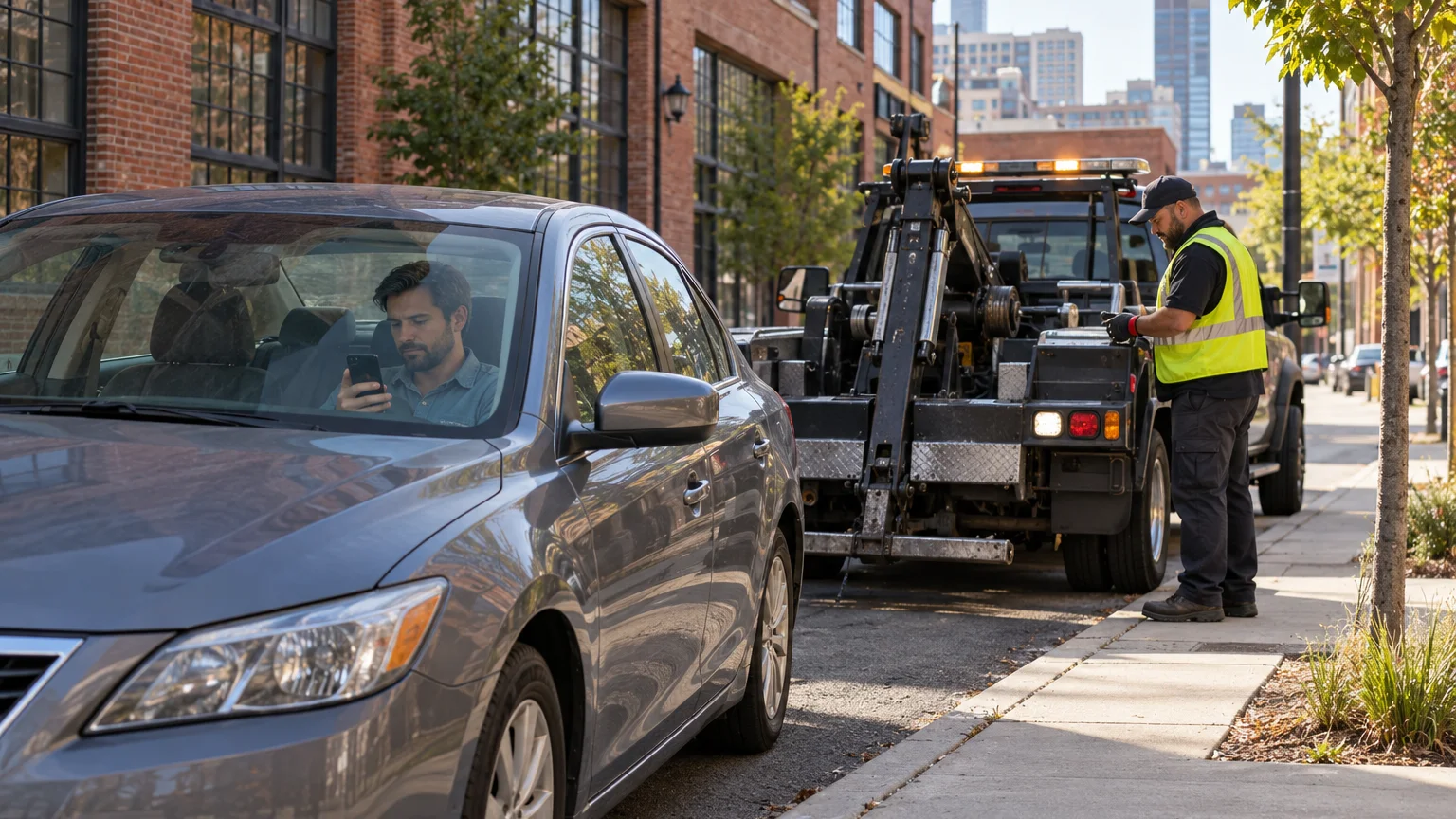
For on demand towing in Scott’s Addition, decide whether you need an immediate or scheduled pickup. Then share your exact location, the vehicle’s condition, its destination, and any access limits. On demand means arranging service when you need it, but it doesn’t promise instant arrival.
Quick Tow Richmond refers each request to an independent licensed operator. That operator handles the tow, contracts with you, and bills you directly. Giving complete details before dispatch helps both sides confirm the requested job.
Share the exact pickup point for on demand towing
Start with more than a Scott’s Addition address. Give the operator the vehicle’s precise position and the easiest way to approach it.
A map pin is useful, but add written directions. Say whether the car is at the curb, inside a lot, behind a building, or within a garage. Include the nearest entrance when a property has several access points. If you’re meeting the operator, describe where you’ll wait.
Street addresses don’t always identify the side holding the vehicle. State which side of the street you’re on. Mention the direction the car faces and whether another vehicle blocks it. If the car is around a corner from the listed address, say that before dispatch.
For a scheduled pickup, confirm where the vehicle will be parked at the agreed time. Don’t move it into a different lot or garage without updating the operator. If another person will release the car, provide that person’s name and confirm they have the keys.
An immediate pickup needs the same detail. The difference is timing, not the information required. Our emergency towing referral page explains how to request help when the vehicle can’t remain where it is.
Keep your phone available after leaving your message. Quick Tow’s recorded line takes calls around the clock, but no live dispatcher answers it. The line doesn’t support a promised callback or arrival time.
Explain whether the vehicle rolls and steers
Describe what the vehicle can and can’t do. Don’t stop at “it won’t start.” The operator needs to know whether it rolls, steers, shifts, and has working keys.
Report any locked wheel, damaged tire, low clearance, collision damage, or missing key. Say whether the parking brake releases. If the dashboard powers on but the engine doesn’t start, include that distinction. Don’t try to diagnose the underlying failure unless you already know it.
Tell the operator if the vehicle is electric, a motorcycle, an SUV, or a light truck. Share any modifications that affect ground clearance. If cargo changes the vehicle’s condition, mention it before accepting service.
This information helps the independent operator decide what equipment fits the requested pickup. You can ask whether flatbed towing is appropriate for the vehicle. Don’t reserve a particular method based only on a photo or a guess.
A vehicle trapped between other parked cars may present a different loading problem. Our guide to a wheel-lift pickup in a tight parking lot explains what details to share. The operator still decides whether that method fits the actual vehicle and space.
Take clear photos if requested. Show the whole vehicle, each damaged wheel, and the surrounding access. Don’t stand in moving traffic to get them. If conditions aren’t safe, describe what you can see from a protected position.
Choose the destination before the operator leaves
Pick the destination before the vehicle gets loaded. A repair shop, home, dealership, storage location, or another approved property may each require different instructions.
Confirm that someone at the destination expects the vehicle. Ask where it should be placed and whether the receiving property has access restrictions. If the destination will be closed, confirm whether it accepts unattended drop-offs. Don’t assume the operator can leave a vehicle without permission.
For a scheduled tow, contact the destination before choosing the pickup time. Ask whether it needs the keys, your contact information, or other paperwork. Those requirements come from the receiving business, not Quick Tow Richmond.
If you haven’t selected a shop, you can still prepare likely options. Compare the distance, operating hours, and vehicle acceptance rules yourself. Quick Tow doesn’t choose a repair facility or guarantee that a destination will accept the car.
Changing the destination after dispatch may change the mileage and total charge. Tell the operator as soon as your plan changes. Ask for an updated total before agreeing to the new destination.
You may also choose to move the car home while deciding what comes next. Our guide to choosing a nearby shop or your home can help frame that decision. The right destination is the one that has authorized the drop-off and fits your next step.
Describe parking and loading access
Scott’s Addition pickups can begin at a curb, lot, garage, alley, or loading area. Describe the space around the car before the operator heads out.
Start with overhead clearance when the vehicle is under a structure. Report posted clearance exactly as shown. Mention gates, access codes, locked entrances, steep ramps, sharp turns, and narrow lanes. If a building manager controls access, arrange that access before pickup.
Tell the operator what sits directly in front of and behind the vehicle. Include walls, posts, dumpsters, landscaping, and other parked cars. Don’t promise that nearby vehicles will move unless you’ve confirmed it with their owners.
If the car occupies a restricted curb or loading space, share that detail. The operator needs the actual setting, even when it complicates the pickup. Don’t move or enter the vehicle when doing so would be unsafe.
Private garages and managed lots may have their own access procedures. Confirm permission with the property owner or manager. Quick Tow Richmond can’t authorize entry or override a property’s rules.
For scheduled service, choose a time when the vehicle and access point will be available. Confirm that gates, doors, and attendants follow the same schedule. If conditions change before pickup, contact the operator with the new information.
A short preparation check can prevent missing details. Review our guide on what to have ready for a Richmond tow before placing the request. Keep your keys, vehicle description, destination, and access instructions together.
Confirm the complete charge before accepting service
Ask the independent operator for the complete quoted total before accepting the tow. Quick Tow Richmond doesn’t set the operator’s price, collect the towing payment, or bill for the job.
Give the operator the vehicle type, pickup point, destination, and expected mileage. Explain whether the vehicle rolls and whether access is restricted. Ask what the total includes and what could change it.
Confirm these points in plain language:
- The hookup charge
- Included and additional mileage
- Any equipment-related charge
- Waiting or access charges that may apply
- The effect of changing the destination
- The accepted payment methods
- When payment is due
Don’t confuse a requested tow with a nonconsensual private-property tow. Richmond caps the hookup fee at $195 for vehicles under 10,000 pounds removed from private property without the owner’s permission at the property owner’s request. Virginia’s statewide ceiling for that kind of passenger-car tow is $210 under Va. Code § 46.2-1233.1.
Those figures are legal ceilings for nonconsensual towing. They aren’t quotes for voluntary on-demand service. Ask the operator what your requested tow will cost, including mileage, before agreeing.
Virginia law also requires towing operators to display their fees and accept specified standard payment methods. The broader rules appear in Title 46.2, Chapter 12. Request an itemized receipt after payment and keep it with your service records.
When to call us
Call when you need immediate or scheduled towing in Scott’s Addition and have the pickup details ready. Our recorded line takes calls 24/7, and a notice plays before your message is recorded and transcribed. Call us at (804) 701-6752.