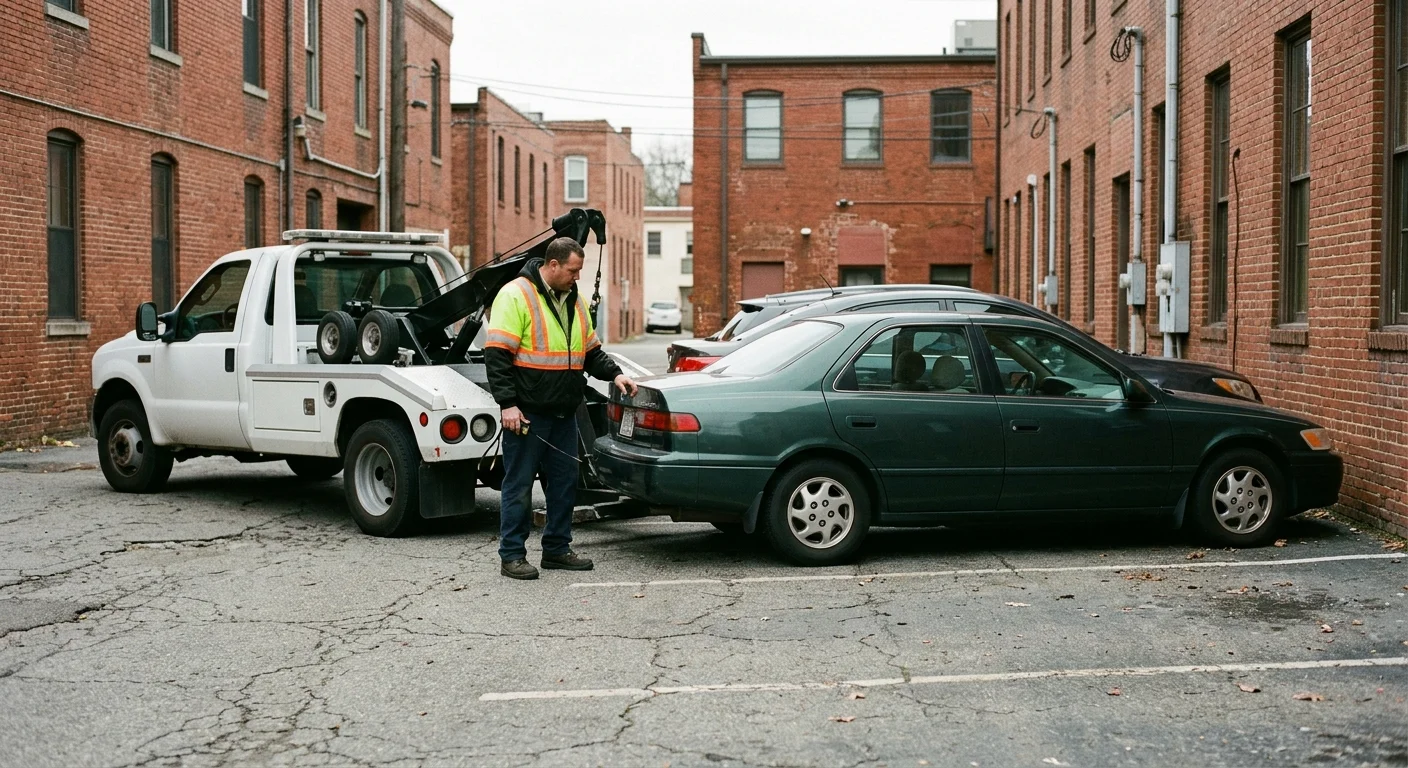
Wheel lift towing in a tight parking lot is an access call. The operator we dispatch has to reach one end of your car, lift two wheels, and leave without clipping a bumper. If that path is open, wheel-lift towing can work on a surface lot; if the aisle is boxed in, they may stage a flatbed at the street and pull the car to it.
Why wheel lift towing in a tight parking lot changes the plan
A packed surface lot changes the truck, because the truck has to fit the aisle. A rollback needs a longer, clearer run to load the whole car. A wheel-lift picks up one end and lets the other two wheels trail. That shorter pickup is why operators use it in The Fan, Shockoe Bottom, Scott’s Addition, and the older garden-style apartment rows in Chesterfield.
The path still has to exist. The truck has to enter from the street, square up to your bumper, and leave the same way. A light pole, a cart corral, a landscape island, or two compact cars on either side can close that path. Inner rows at Short Pump do this. So do the small private lots off West Broad, and the evening stalls around VCU. VCU’s 28,831 students pack The Fan and Monroe Park lots at move-in, and those rows stay tight well after classes start.
Name the locality. A surface lot in Petersburg is a different layout from a Short Pump big-box field. Henrico apartment loops run long and narrow. Downtown Richmond lots sit against brick and one-way alleys. Those details decide which truck rolls.
VDOT’s Safety Service Patrol covers I-95, I-64, and I-295. It’s free help on those roads. It doesn’t work a shopping-center aisle, and it isn’t a tow company. Once you’re already in the lot, you’re arranging a private pickup. If the I-95/I-64 overlap is backing onto downtown streets, check 511 Virginia so the operator knows the approach.
Walk the aisle if you can stay with the car. Look at the turn in from the street. Look at whether a truck can back down the row. That walk is the plan.
Report which wheels can roll and steer
The operator needs a true picture of what will roll. Say which wheels turn when you turn the steering wheel. Say which wheels are locked, flat, or jammed against a curb. Say whether the car moves in neutral, or stays stuck in park.
Skip a drivetrain guess. All-wheel, four-wheel, front-wheel, and rear-wheel cars follow the book for that car. The owner’s manual is the source. If you don’t know the drivetrain, say so. The operator can read the badging on scene.
Keys matter. A steering column that stays locked keeps the front wheels from tracking. A transmission that stays in park keeps the drive wheels from rolling. A seized brake holds one corner. Report those in plain words. “It’s in park and I have the fob” is useful. “The front left is against the curb and won’t turn” is useful.
If the car sat after a crash, say that. A bent wheel or a collapsed corner is a recovery problem. Keep this call about the stall and the rolling gear when that is the whole story. Aftermarket wheels that hang past the fender, a doughnut spare, and a lowered stance all change how a cradle meets the tire. Say those things in the same message as the lot photos.
Send photos of the pickup area
Photos beat a verbal map. Stand at the bumper the truck would lift and shoot the aisle both ways. Shoot the stall from the driver’s side and the passenger side. Include poles, islands, and the cars that box you in. Then walk to the lot entrance and shoot the turn in from the street.
A short video of that walk shows the truck’s path. Keep close-ups for the tires and the bumper. If it’s dark, light the obstacles.
Name the place in the message. “Second row on the west side, behind the brick offices on West Broad” is usable. “A lot in Richmond” leaves the operator guessing. The Fan, Midlothian Turnpike, and a Chesterfield apartment loop all read differently from a cab.
If the lot will fill, say so. Evening stalls in Shockoe and weekend lots near Richmond Raceway change while you wait. You can’t hold a space open. You can warn them the aisle is already tight.
Shoot overhead only if a tree limb or a sign hangs into the aisle. This page is about surface lots, so width is the usual limiter. A low branch over the only way out is still worth one frame. Leave the car where it sits, hazards on if they still work, and let the operator pick the approach.
Check the owner’s manual for towing guidance
Open the owner’s manual to the towing or recovery pages. That section is written for your car. It may name a method, a towed end, or a speed and distance limit. Read it to the operator, or send a photo of the page.
If the book names a flatbed, say that in the first message. Factory text beats a preference for a smaller truck. If the book is silent, say that too. Silence tells the operator they’re working from the car in front of them.
Your manual is still the manual. The operator still has to match it to this lot. A forum post, a clip, or a memory from another state doesn’t override the page in the glove box.
If the paper book is gone, check the visor sleeve and the manufacturer’s site on your phone. A PDF of the towing page is enough. Your job is to surface a factory warning. Some manuals also mention a steering lock, a parking pawl, or a max distance on a lifted axle. If those lines are there, send them with the lot photos.
For the method split, read wheel-lift or flatbed towing.
Confirm the equipment before dispatch
Before anyone rolls, confirm the tool. Ask whether the operator is bringing a wheel-lift or a rollback. Describe the lot as a surface lot. If the car is under a structure, switch to our Chesterfield parking-deck towing guide. Height runs that job. Width runs this one.
Quick Tow Richmond is a referral line. We match you with an independent licensed operator who owns the truck and bills you. We hold no tow yard and no fleet. The operator decides, from the facts you send, which equipment can make the pickup. Give the year, make, and model with the photos. A mid-size sedan in a compact stall is a different fit from a long pickup in the same stall. The equipment check is that conversation, held before the truck leaves.
Our published standard light-duty hookup fee is $105. That figure is our published rate. The statewide ceiling on a nonconsensual private-property hookup is $210, and Richmond caps that same hookup at $195. A tow you request is billed by the operator. Ask for the full total, with mileage included, before you agree. Extra handling and a switch in equipment can move that total.
If the first truck can’t fit, the next step is a different truck. Confirm the equipment, then wait for that truck.
When to call us
If your car is stuck in a packed surface lot and you need it moved, we connect you with an independent licensed operator. The line takes calls 24/7, a recording notice plays, and you leave the lot details, the photos, and which wheels will roll. Call us at (804) 701-6752.