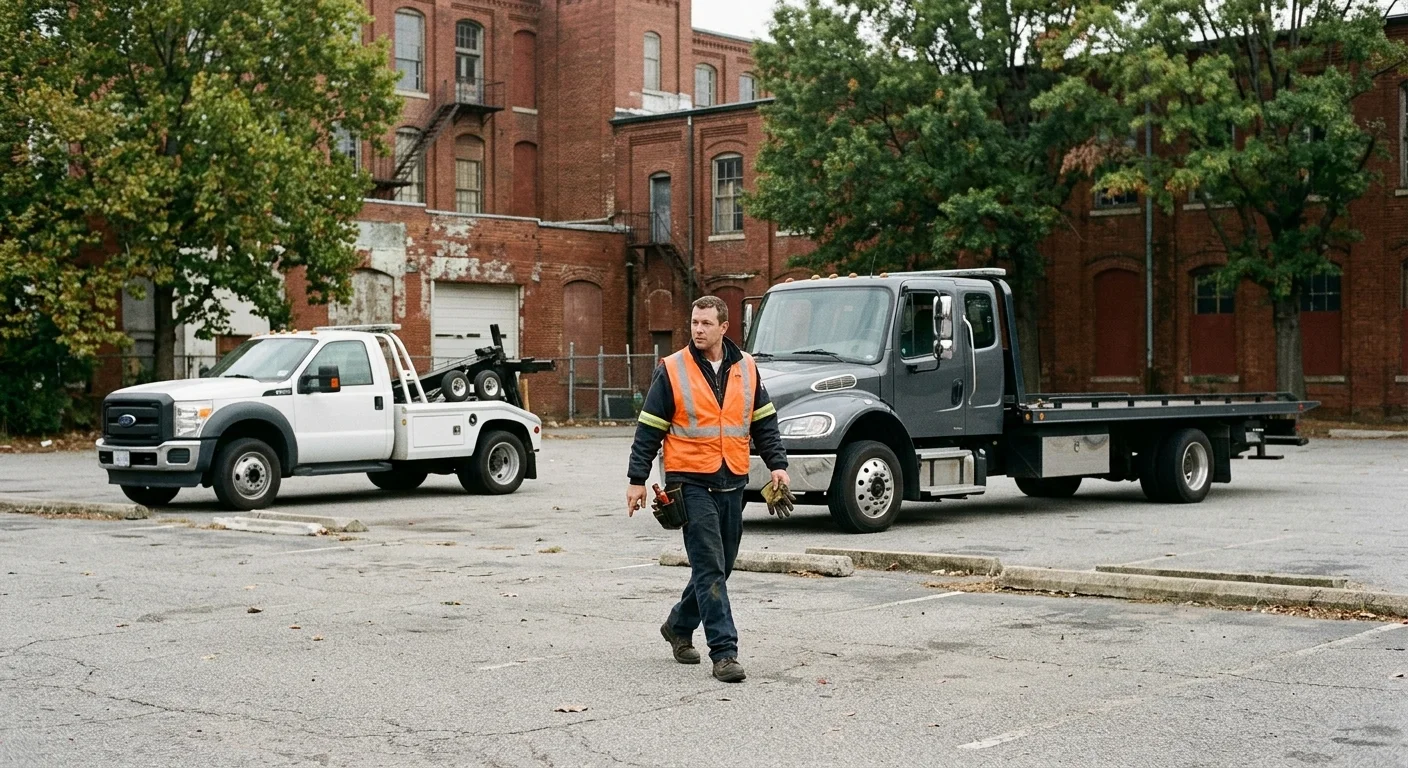
Your car is disabled, but the truck choice still matters. In the wheel lift vs flatbed towing decision, a wheel lift supports one end while the other wheels stay on the road, while a flatbed carries the vehicle on its deck. Neither is always right, because condition, manual guidance, and pickup space decide.
How each towing method carries a vehicle: wheel lift vs flatbed towing
A wheel-lift setup raises the vehicle at one axle. In its basic configuration, the wheels at the opposite axle remain on the pavement. The operator secures the raised end before moving the vehicle.
A flatbed carries the vehicle on a truck-mounted deck. Once loaded and secured, the car’s wheels don’t roll along the road. That difference is the heart of the comparison.
The right method depends on more than personal preference. An operator needs to know what can roll, what can’t, and what the manufacturer allows. Access around the vehicle matters too.
A disabled sedan in an open lot along West Broad Street presents one loading plan. The same sedan inside a downtown parking deck may present another. An operator must consider the entrance, turns, ceiling, ramps, and space around the car.
Our wheel-lift towing service page explains how we connect drivers with operators offering that method. Our flatbed towing service page covers requests where the vehicle needs deck transport.
Truck type alone doesn’t settle whether a plan fits your car. Equipment designs vary, and vehicle instructions vary by model. Give the operator accurate details before dispatch. That lets the operator compare the available truck with the car, location, and destination.
Why vehicle condition changes the choice
Start with what happened to the car. A vehicle that still rolls and steers presents a different job from one with a damaged wheel, locked steering, or collision damage.
You don’t need to diagnose the problem. Describe what you can see and what the car does. Tell the operator if it starts, shifts, rolls, or steers. Mention warning messages, visible leaks, damaged body panels, and any wheel that appears out of position.
Keys also matter to the loading conversation. Say whether you have them and whether the vehicle recognizes them. If the battery is dead, report that too. Don’t assume the truck arriving can solve an issue that wasn’t mentioned.
Richmond weather can complicate the picture. A vehicle exposed to high water near Shockoe Bottom needs an honest condition report. Tell the operator where the water reached and whether the car has been moved since. The operator can then consider that information before selecting equipment.
Older and specialty vehicles deserve the same careful description. Modified suspension, low bodywork, an unusual transmission, or a car that hasn’t moved recently can affect the plan. Our guide to classic car towing in Richmond explains what details to gather for an older vehicle.
Neither method creates a blanket damage guarantee. Ask the operator to explain the loading plan before work begins. If the car’s condition changes while you wait, update the referral line or operator before arrival.
Check drivetrain guidance in the owner’s manual
The owner’s manual is the best starting point for model-specific towing instructions. Look under towing, roadside assistance, vehicle transport, or emergency procedures. Use the manual for your exact model year and configuration.
Don’t choose solely from a general label such as front-wheel drive, rear-wheel drive, or all-wheel drive. Vehicles sharing a drivetrain label can still have different manufacturer instructions. The trim, transmission, current damage, and available vehicle settings may change the recommendation.
If the printed manual isn’t in the glove box, check the manufacturer’s official support site. Tell the operator the exact year, make, model, and trim. Read any relevant manual language directly instead of summarizing from memory.
Electric vehicles can include preparation steps or transport settings that don’t apply to other cars. Those settings don’t replace the manufacturer’s towing directions. Our article on whether Teslas can be towed normally explains why the exact vehicle guidance matters.
Share any dashboard message you see. A photo can help when the wording is hard to repeat. Don’t clear the message before recording it.
If the manual specifies a transport method, tell the operator before dispatch. If you can’t locate reliable instructions, say that plainly. The operator can review the vehicle details and explain the proposed approach. You should understand which wheels will be supported, which may remain on the road, and how the car will be loaded.
How tight access affects the loading plan
Richmond pickup locations range from open roadside lots to enclosed decks. The truck that can reach the vehicle and set up properly may determine the practical option.
Parking decks need a detailed access report. Note the posted clearance, entrance location, garage level, ramp turns, and direction of travel. Mention gates, ticket arms, columns, speed humps, or parked vehicles close to the disabled car. A photo of the approach can show more than a general description.
A wheel-lift truck may be considered when a deck offers limited setup space. That doesn’t make it automatically suitable for the vehicle. The car’s condition and manual still govern the recommendation.
A flatbed needs room for the operator to position the truck and load the vehicle onto its deck. The required space depends on the actual truck and location. Don’t guess whether it will fit. Give the operator the posted clearance and visible layout.
Street pickups bring different constraints. The Fan has limited parking, so a disabled car may sit close to other vehicles. Narrow neighborhood streets can leave little room around the front or rear axle. State which direction the car faces and whether another vehicle blocks either end.
An interstate shoulder near the I-95/I-64 downtown overlap requires a different plan. Check 511 Virginia for current traffic and incident information. VDOT’s Safety Service Patrol provides incident assistance on I-95, I-64, and I-295. It isn’t a tow company, but patrol staff can help a driver arrange a tow.
Questions to ask before dispatch
The question “which tow truck does my car need” becomes easier when both sides exchange specific information. Have these details ready before agreeing to the job:
- Where is the vehicle exactly? Give the street, lot, garage level, or highway direction.
- Where should it go? Mention access limits at the destination too.
- What happened before it stopped moving?
- Does the vehicle start, shift, steer, and roll?
- Are any wheels, tires, suspension parts, or body panels visibly damaged?
- Do you have the keys?
- What does the owner’s manual say about towing or transport?
- Is the vehicle blocked by a wall, gate, column, curb, or another car?
- What truck and loading method does the operator propose?
- Will any wheels remain on the road during transport?
- What is the full total, including mileage, before you agree?
When comparing wheel-lift towing or flatbed service, ask why the proposed method fits your exact car. A clear answer should connect the recommendation to the vehicle’s condition, manufacturer guidance, and pickup access.
Quick Tow Richmond is a referral service. We don’t own wheel-lift trucks, flatbeds, or an impound yard. We match callers with independent licensed tow operators, who contract with and bill the driver directly.
Our recorded line takes calls around the clock. A recording notice plays before you leave your message, which is recorded and transcribed. Include the vehicle details, exact location, destination, and any access problems. That information helps us look for an operator suited to the request.
When to call us
Call when your car can’t move normally, the manual specifies a transport method, or the pickup area limits truck access. We’ll connect you with an independent licensed towing pro who can review the vehicle and loading plan. Call us at (804) 701-6752.