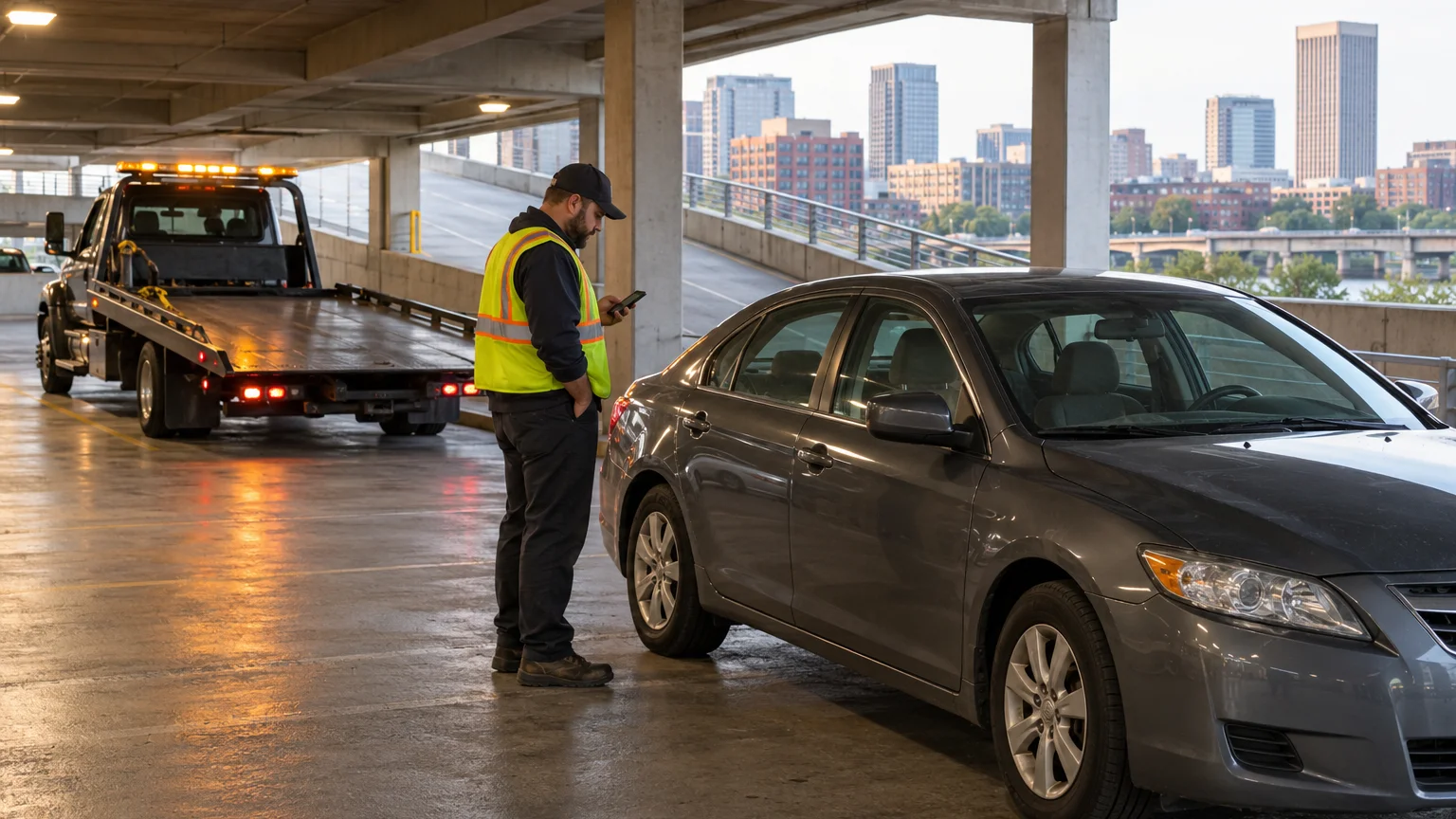
A request for a tow truck Downtown Richmond VA starts with the deck, not only the disabled car. Give the operator the entrance, vehicle level, posted access limits, and exit route before dispatch. Those details help the operator assess whether the vehicle can be reached and removed from the structure.
Downtown creates a different access problem than an open roadside shoulder. Concrete columns, ramps, turns, gates, and nearby vehicles can affect the approach. A clear description saves the operator from evaluating the wrong entrance or preparing for an open-lot pickup.
Share the garage entrance and vehicle level for a tow truck Downtown Richmond VA request
Start with the exact entrance you used. A street name alone may not identify the correct way into a large structure. Describe the entrance beside the gate, ticket machine, office, loading area, or another visible feature.
Tell the operator where the car sits inside the deck. Include the posted level, nearby stairwell, elevator marker, ramp, or parking section. If the deck uses colors or letters, share those markers exactly as posted.
A location pin can help outside the structure. It may not show the vehicle’s precise position within concrete levels. Written directions from the entrance give the operator more useful context.
Mention anything affecting entry. That includes a closed gate, ticket requirement, resident access control, or instructions from parking staff. Don’t promise that someone will open a restricted entrance. Give the operator the information you have and explain what remains uncertain.
Downtown Richmond sits beside the dense I-95 and I-64 core. VDOT describes their overlap, from the Bryan Park interchange toward the James River, as heavily congested with high crash activity. Check 511 Virginia before choosing a route into or out of downtown.
The street approach matters, but the vehicle’s position inside matters more. Stay available near the agreed entrance if you can do so safely and legally. That gives the independent operator a clear starting point for assessing the job.
Photograph posted access limits
Photograph every posted access restriction you can see. Capture the entrance sign, gate, ceiling marker, ramp warning, and any directional notice affecting larger vehicles. Make sure the entire sign appears in the frame.
Read the wording aloud when you leave your message. Photos can be dark, blurred, or hard to interpret on a small screen. A short written summary helps the operator understand what you saw.
Don’t estimate a clearance measurement. Use only the figure printed at that specific entrance. Another side of the building may have different access, but don’t assume it does. Ask parking staff whether another authorized entrance exists.
Show the space around the car too. Photograph the nearby columns, turns, parked vehicles, ceiling features, and path toward the ramp. Avoid photographing people or personal information when it isn’t necessary.
These details help an operator compare possible loading approaches. Wheel-lift towing and flatbed towing are different service requests, but the operator must decide what suits the actual vehicle and structure.
A parking-deck stall in the downtown core isn’t interchangeable with one in Chesterfield. The building access and exit path must be assessed at the scene. Our guide to a Chesterfield parking-deck tow covers that separate setting.
Keep the photographs until the job is complete. If access changes or a different entrance is suggested, the operator can compare the new route with the original information.
Describe whether the car rolls and steers
Tell the operator exactly what the car can and can’t do. Start with whether it starts, shifts, rolls, steers, and releases from park. Don’t force any control that feels stuck or damaged.
Mention each wheel that appears affected. A flat tire, damaged wheel, locked wheel, or steering problem changes the situation the operator must inspect. Describe what you observed without diagnosing the mechanical cause.
Share the vehicle’s year, make, model, and drivetrain if you know them. If you don’t know the drivetrain, say that plainly. The operator can assess the vehicle without an uncertain guess.
Also mention its position. Is it centered in a marked space, close to a column, facing a wall, or sitting on a ramp? Note whether another parked vehicle blocks a direct approach. These facts help describe the available working area.
Keys are another practical detail. Tell the operator whether you have them and whether the car recognizes them. If the battery is dead, explain which locks or controls still work. Don’t promise that a jump start will solve the underlying problem.
The service method shouldn’t be chosen from a generic label alone. Read our comparison of wheel-lift or flatbed towing for the basic distinction, then let the dispatched operator assess the deck and vehicle.
A precise condition report is more useful than saying the car is simply “broken down.” It gives the operator a clearer picture before reaching the parking level.
Let the operator assess the loading method
A parking-deck recovery needs an on-site assessment. The operator must consider the car’s condition, its position, the surrounding structure, and the route out. A photograph helps, but it doesn’t replace seeing the full space.
Don’t move the car just to make the tow appear easier. If the vehicle rolls unexpectedly, has damaged steering, or won’t stay in gear, wait for the operator’s instructions. Keep bystanders away from the immediate work area.
Avoid choosing equipment based only on what worked during a previous tow. A method used in an open parking lot may not suit a concrete deck. The entrance, turns, ramps, and exit all matter.
Parking staff may also control parts of the process. They may need to address a gate, ticket, access credential, or temporary obstruction. Ask what they can authorize, then pass their answer to the operator. Don’t represent yourself as having permission you haven’t received.
If the initial plan can’t be completed safely within the structure, let the operator explain the available alternatives. That may require a different approach or more coordination with the property. Don’t pressure the operator to continue with a method they’ve rejected after inspection.
Quick Tow Richmond is a referral service. We match callers with independent operators who contract with and bill the driver directly. We don’t perform the recovery, own the towing vehicle, or decide which loading method the operator uses.
The useful goal is a workable removal plan, not a preferred truck type. Clear information lets the operator make that decision from the actual conditions.
Confirm the exit plan and destination
Before loading begins, confirm how the vehicle will leave the deck. The nearest entrance may not be the approved exit. Gates, one-way ramps, ticket controls, and street access can affect the route.
Ask parking staff whether a disabled vehicle needs any special checkout step. Confirm who can open a controlled gate and what happens if the operator must use another exit. Pass those instructions directly to the operator.
Choose the tow destination before agreeing to the job. It may be a repair shop, dealership, home, or another lawful location. Confirm that the destination will accept the vehicle when it arrives. Don’t assume a closed business can receive it.
Ask the independent operator for the full total before authorizing the tow. Explain the deck location, vehicle condition, destination, and expected route. Ask whether mileage and any applicable charges are included in that total.
The brand doesn’t set the operator’s final price. The operator contracts with you and bills you directly. A complete description gives the operator a better basis for discussing the job before you agree.
If the car was removed while you were away, that’s a different problem. The City of Richmond recommends checking its towed-vehicle information before reporting the vehicle stolen. That lookup applies to finding a vehicle already towed, not arranging help for a disabled car still inside a deck.
Keep the destination address and contact name ready. Confirm both with the operator before the vehicle leaves downtown.
When to call us
Call when a disabled car can’t leave a Downtown Richmond deck and needs assessment by a licensed towing pro. Our recorded line takes calls 24/7, and a recording notice plays before your message. Call us at (804) 701-6752.