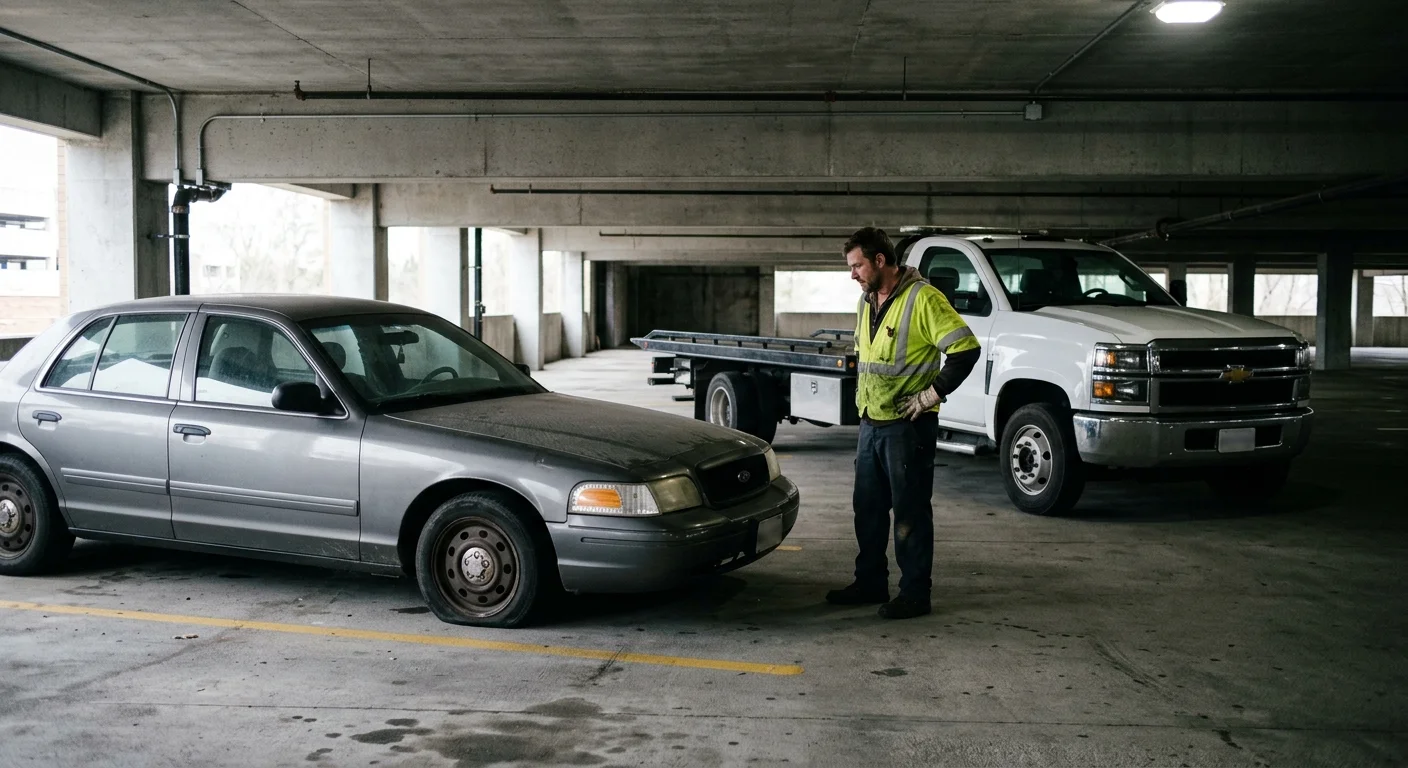
A disabled car inside a parking deck needs an access plan. For Chesterfield towing in a garage, report the level, entrance, posted clearance, wheel position, and intended destination. Those details help an operator assess the site and choose suitable equipment.
Chesterfield towing: report the garage level and entrance first
Start with the name or address of the property. Then give the level exactly as the deck marks it. Include the nearest stairwell, elevator, row, or section marker. A vehicle described as “on the second level” may still be difficult to locate inside a large structure.
Tell the operator which entrance you used. Some decks have separate entry and exit lanes. Others have gates, ramps, reserved areas, or controlled access. Report whether a ticket, access card, property employee, or resident must open the gate. Don’t assume the recovery vehicle can follow your original path.
Read the posted clearance information without changing or rounding it. A photo of the entrance sign is better than a number recalled from memory. Also photograph the lane beyond the entrance. Include any visible pipes, signs, gate arms, low sections, tight curves, or steep transitions.
Chesterfield County covers more than one road pattern. A deck in Midlothian won’t have the same approach as one near Route 10 in Chester. Give the exact property location instead of saying only “Chesterfield.” Mention the entrance street and any lane restrictions you can see.
If you can reach property management or security, ask about towing access. They may identify the entrance normally used by service vehicles. Keep their contact information ready. The operator can then confirm access before arriving, instead of discovering a closed gate or unsuitable path at the deck.
Why overhead space changes the truck choice
The disabled car entered the structure, but a recovery vehicle has a different profile. The posted clearance is therefore one part of the decision. The operator also needs to understand the space around the car and the route back outside.
Photograph the clearance sign at the actual entrance. Then show the ceiling above the disabled vehicle. Include the ramp leading to that level and the path toward the exit. A wide photo gives more context than a close view of the car alone.
Don’t promise that a particular truck will fit. Don’t rely on a clearance figure found on an old listing or map. Deck conditions, access controls, and the vehicle’s position must be checked for the current job. The independent operator makes the final equipment decision.
A wheel-lift towing option may be considered when overhead room affects access. That choice still depends on the car, its wheels, its position, and the available working area. The word “wheel-lift” isn’t a guarantee that every part of the route will work.
Move only if the car can be repositioned normally and the operator asks you to do so. Otherwise, leave it where it stopped. Describe the situation accurately and wait for instructions. Good information gives the operator a clearer starting point without turning the customer into the recovery planner.
When a wheel-lift or flatbed may fit
A parking-deck tow isn’t decided by vehicle size alone. The operator must consider the entrance, ramps, ceiling, loading area, wheel condition, and exit path together. Your vehicle’s make, model, and year also help identify the right approach.
Wheel-lift towing may be assessed when deck access limits the available working space. Tell the operator whether the front or rear of the car faces the driving lane. Note how much open space appears around each end. Photos taken from both sides can show more than a phone description.
Flatbed towing may also be considered, but the operator must confirm that the deck provides suitable access and working room. A flatbed request made without those details can’t establish whether that equipment fits the site. Ask for an assessment, not a guarantee.
The vehicle itself may influence the choice. Share any towing instructions available for that model. Report visible damage, flat tires, missing wheels, or parts touching the floor. If the car was involved in a collision, say so before equipment is selected.
Our guide to wheel-lift or flatbed towing explains the general comparison. A parking deck adds another layer because the full path matters. The equipment must be assessed for the parked position, the route through the structure, and the final exit.
Describe wheel position and vehicle condition
Begin with what you can see. Say whether the wheels point straight or toward a wall, curb, column, or parked vehicle. Report any flat tire, missing wheel, bent-looking component, or wheel that won’t roll. Don’t diagnose the cause if you don’t know it.
Tell the operator whether the keys are available. Also explain whether the steering responds and whether the transmission can be shifted normally. If you haven’t tested something, say that it’s unknown. Clear uncertainty is more useful than a confident guess.
A vehicle without keys can require a different plan. Read whether a tow truck can move a car without keys before assuming the job can’t be done. The operator still needs the vehicle details and deck layout before choosing equipment.
Photograph all four wheels when possible. Take another image showing the car’s distance from nearby walls, columns, curbs, and vehicles. If one side is difficult to reach, include that in your message. Don’t move another person’s vehicle to create space.
Report visible fluid on the floor, loose bodywork, collision damage, or anything hanging beneath the car. Tell the operator if the vehicle sits on a ramp or blocks an active lane. These observations help describe the job without making claims about the mechanical problem.
Finally, explain what happened just before the car stopped. A no-start condition, locked steering, tire failure, or collision creates different questions. Stick to what you observed. The operator can ask for more detail before accepting the recovery.
Confirm the exit plan and destination
The route out deserves the same attention as the entrance. Identify whether the posted exit follows a different lane or level. Mention gates, payment stations, restricted doors, and visible overhead changes. If property staff direct service vehicles elsewhere, pass that instruction to the operator.
Confirm where the car should go before the recovery starts. Give the complete destination address. Check whether the repair shop, home, dealership, or storage location can receive the vehicle. Don’t leave the destination as “the nearest shop” unless you’ve agreed on a specific place.
Ask the operator to confirm both locations: the exact parking position and the delivery address. Then request the full total, including mileage, before agreeing. Quick Tow Richmond doesn’t set the independent operator’s final price. The operator contracts with and bills the driver directly.
If this isn’t a driver-requested recovery, explain that immediately. A private-property removal or county-directed tow follows a different process. Chesterfield Police maintains a list of approved towing companies for county-directed tows, and those vehicles go to the company serving that rotation. Quick Tow doesn’t control that assignment.
Virginia’s towing and storage laws cover operator conduct and towing records. They don’t answer whether a specific parking deck can accommodate particular equipment. That decision still depends on the current site, the vehicle, and the operator’s assessment.
Keep your phone available after leaving a recorded message. Have the property contact, vehicle details, photos, pickup point, and destination together. That gives the matched operator a concise picture of the job.
When to call us
A parking-deck recovery needs a licensed towing pro when the car can’t leave under its own power or access affects equipment choice. Quick Tow Richmond connects callers with independent licensed operators through a recorded line that takes calls 24/7; a notice plays before each message is recorded and transcribed. Call us at (804) 701-6752.