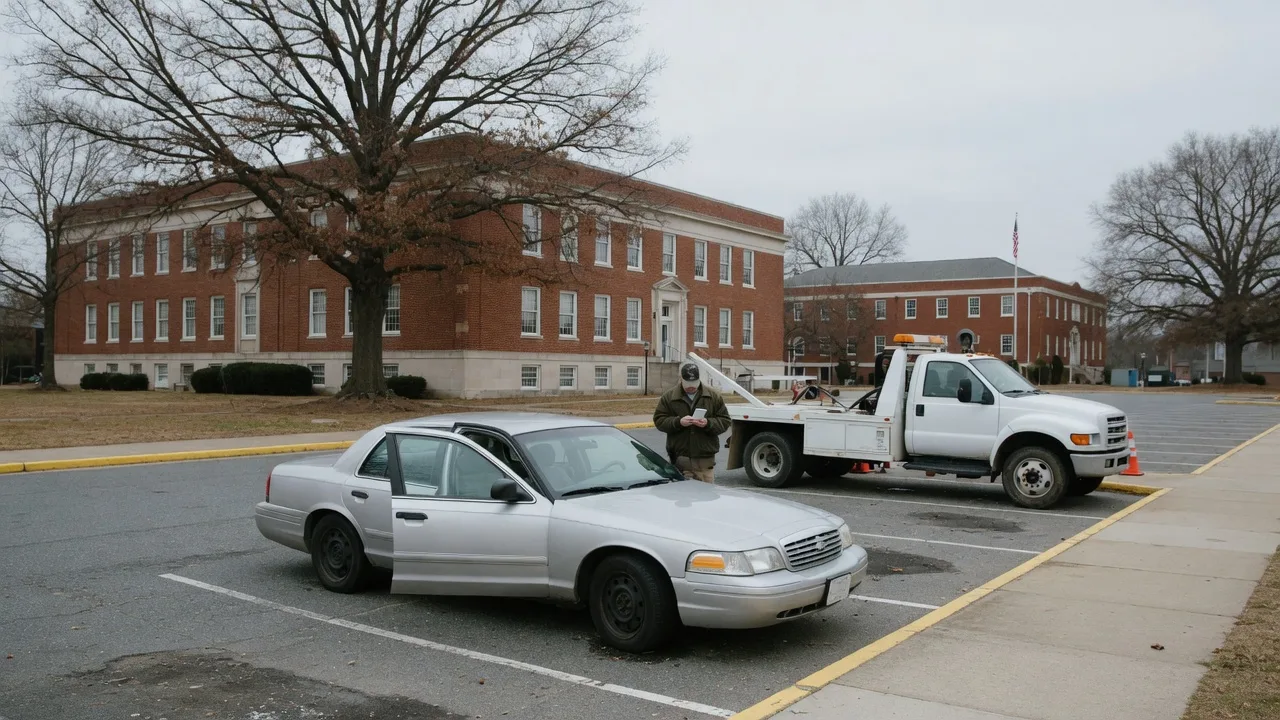
A stall next to the county complex on SR-10 is a village pickup, not a downtown Richmond job with the name swapped. For towing near Chesterfield Courthouse, give the road and the lot entrance, say whether the car rolls, name a drop-off that will take it, and hear the full charge before anyone hooks it. Quick Tow Richmond takes those details on a recorded line 24/7 and matches you with independent licensed operators who bill you directly.
Give your exact location near the courthouse village
Chesterfield Courthouse is the county seat south of the James, on SR-10. Employee and visitor lots around the complex generate their own calls. The SR-10 and SR-288 interchange feeds suburban growth traffic through the same village. A pin that only says Chesterfield can send a truck to Midlothian, Chester, or a parking deck closer to the river.
Start with Chesterfield Courthouse, then the road, then a landmark you can see. On SR-10, say which direction you were heading and which curb you’re on. In a courthouse lot, name the entrance and the building you parked for. On SR-288, give northbound or southbound and the last interchange you passed. Drop a pin and read it back.
This is not I-95. VDOT’s Safety Service Patrol covers I-95, I-64, and I-295 around Richmond, not the courthouse lots. Check 511 Virginia if you stalled on SR-288 and need current incident detail. On highways with four or more lanes, Va. Code § 46.2-861.1 is Virginia’s move-over rule for stopped vehicles with flashing lights.
Leave the pin slowly on our recorded line. A recording notice plays first. Virginia is a one-party consent state for recording a call under Va. Code § 19.2-62. The notice is voluntary disclosure.
Describe whether the car rolls and steers
Tell the operator the year, make, and model, then what the car is doing in one sentence. A dead battery in a visitor stall is a different setup than a locked transmission on SR-10. A car that will not go into neutral needs different equipment than one that still rolls.
Say whether it steers. Say if you have the keys. Say if it’s all-wheel drive, lowered, or sitting on a wheel that will not turn. Those details decide a wheel-lift versus a flatbed. They also decide whether roadside assistance can finish the work where you sit, or whether you need emergency towing.
A jump, a spare tire, or a few gallons of fuel can end the stop without a hookup. A car that will not roll needs a tow. If the stall is in a parking deck closer to the James, that is a different access problem: towing out of a Chesterfield parking deck. If you’re in Chester on I-95 instead of the courthouse village, use passenger-car towing in Chester. This page is the SR-10 civic village.
Choose a Chesterfield destination before dispatch
Pick the drop-off before a truck is assigned. Mileage starts at the hook and ends where the car comes off. A courthouse-lot pickup to a house off SR-10 stays inside the village. The same pickup to a shop on Midlothian Turnpike, in Chester, or across the James into the city adds miles. Hear that mileage before you agree.
Shops close. A bay that takes cars at 2 p.m. may have a locked gate at 2 a.m. Call the shop and confirm it will accept a drop, or that it has a night key-drop the operator can use. Home is simpler only if a wrecker can enter the driveway. Tight courts and gated apartments off SR-10 change the job.
Towing coverage on an auto policy is an optional add-on in Virginia. If you plan to file, check the card in your wallet. The operator still needs a physical place to leave the car.
Ask what equipment the operator plans to send
County-complex lots and SR-288 highway-speed work are not the same truck. Wheel-lift covers most lot and roadside calls here. Flatbed is the better plan when the car will not roll, sits low, or needs to leave SR-288 quickly. Ask which one the operator intends to send, and why it fits this vehicle.
Do not treat Courthouse Towing as a competitor review on this page. The question is the stall in front of you: year, make, whether it rolls, and which entrance the truck should use.
Confirm the full charge before you agree
Ask for one total before you accept. That figure should include the hookup, mileage to the destination you named, and any winch or dolly work if the car will not roll. Then ask what would change it.
Quick Tow Richmond publishes a standard light-duty hookup fee of $105. That’s our published rate. The operator who runs the truck bills you. Miles, the vehicle, and how hard the car is to reach all move the total.
Keep that $105 apart from Virginia’s legal ceilings. For a passenger car towed without consent from private property, Va. Code § 46.2-1233.1 caps the hookup at $210. An after-hours or weekend surcharge of up to $30 is allowed on those nonconsent tows between 7:00 p.m. and 8:00 a.m., or on Saturdays, Sundays, or holidays, with a maximum of two such fees per vehicle. Storage is free for the first 24 hours on that kind of tow. A tow you request is priced by the operator.
Chesterfield Courthouse sits in Chesterfield County. Richmond’s private-property fee schedule in City Code § 27-302 applies in Richmond. Confirm the current total with the operator before the hook, and ask for an itemized receipt when you pay.
The city page for Chesterfield Courthouse towing covers the village. When the car will not move off SR-10, call (804) 701-6752 with the pin, the vehicle, and the drop-off.
Frequently asked questions
Is Chesterfield Courthouse the same call as Chester?
No. Chester sits on I-95, US-1, and SR-10. The courthouse village is the county seat on SR-10, with visitor lots and the SR-288 interchange. Name the village, not just the county.
Does VDOT’s patrol cover the courthouse lots?
The patrol works covered interstates. Courthouse lots and most of SR-10 are a private operator job.
Who sets the price on a tow I request?
The operator sets that total. Our published standard light-duty hookup is $105. Virginia’s $210 ceiling in § 46.2-1233.1 applies to nonconsent private-property tows. Ask for the full charge with mileage before you accept.