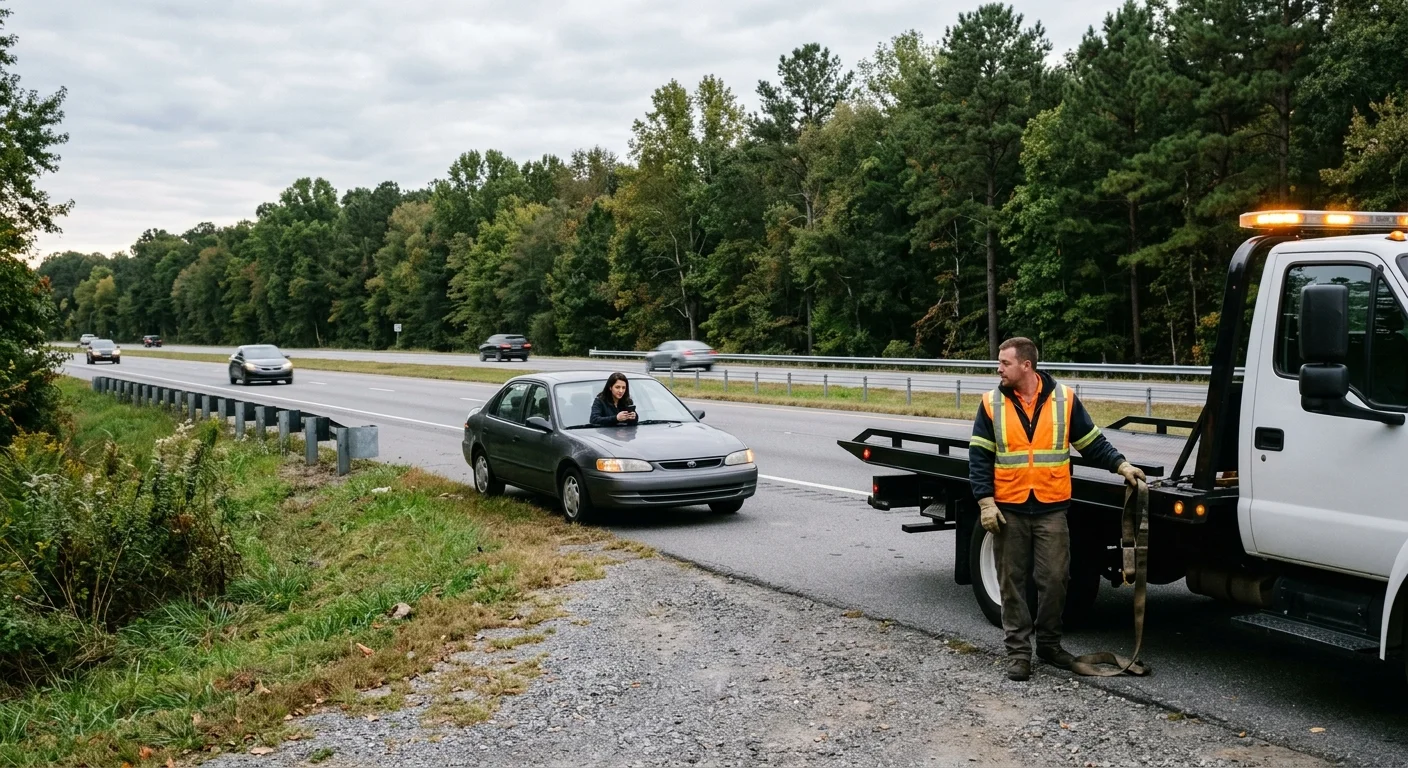
If you need tow truck Chester VA help after a passenger-car breakdown, share your exact location, describe the car’s condition, and choose a destination. Quick Tow Richmond takes calls through a recorded line and connects callers with independent operators. The operator contracts with you, sets the final charge, and bills you directly.
Pinpoint your location for tow truck Chester VA help
“Chester” alone doesn’t give an operator enough detail. A disabled car near I-95 and Route 10 presents a different pickup from one inside an apartment or business lot.
Start with the road name, direction of travel, and nearest visible marker. On I-95, say whether you’re traveling north or south. Include a mile marker when you can see one. If you’re near Route 10, explain whether you’ve passed it or haven’t reached it. Tell the operator whether the car is on the main roadway, a shoulder, or a ramp.
A phone location pin can help, but add written details too. Pins sometimes identify the opposite side of a divided road. Mention the shoulder side and anything that distinguishes your position. If you’re inside a large property, give the street address and the entrance closest to the car.
Also explain whether the car blocks a lane or sits beyond moving traffic. Report any immediate hazard so the operator understands the scene. If there’s a crash, injury, fire, or another urgent danger, contact emergency services first.
Quick Tow Richmond’s line records and transcribes messages after playing a recording notice. Leave your location slowly, then repeat the road and direction. Add your name, callback number, vehicle description, and intended destination. A complete message gives us the details needed to seek an appropriate referral without guessing where the car is.
Decide whether roadside help may be enough
A breakdown doesn’t always require moving the car. The right next step depends on what stopped it and where it sits.
VDOT Safety Service Patrol provides free roadside assistance on covered routes, including I-95, I-64, and I-295 around Richmond. Its services include tire changes, fuel delivery, jump starts, radiator water, and help arranging a tow. SSP doesn’t perform mechanical repairs or act as a towing company.
Daytime coverage runs from 5:00 a.m. to 9:00 p.m. VDOT also operates an overnight I-95 route from 9:00 p.m. to 5:00 a.m. That segment runs between the I-295 interchange at mile 84 and Route 10 in Chester at mile 61. Coverage details aren’t an arrival promise for any particular breakdown.
Check 511 Virginia for current traffic and incident information. That can help you describe congestion or a nearby closure without relying on an old map.
A flat tire, empty fuel tank, or battery problem may fit the services available through roadside help. A car that still can’t move will need a different plan. Review our roadside assistance options when the problem might be resolved where the car stopped. If it must leave the scene, request a referral for emergency towing.
Describe what stopped the car
Give the operator observations, not a guessed diagnosis. Say what happened immediately before the car stopped. Report whether the engine shut off, the starter made a sound, or a warning appeared. Mention smoke, an unusual smell, leaking fluid, or impact damage.
Next, describe the car’s current condition. Does it start and idle? Can it shift into neutral? Are the keys present? Do the steering and parking brake operate? Are all tires inflated? Can each wheel roll freely? Those details help the operator assess the pickup and decide what equipment may fit the job.
Tell the operator if the car left the pavement, struck something, or stopped against a curb. A sedan sitting normally in a parking space isn’t the same recovery as one with a damaged wheel. Don’t leave out all-wheel drive, low clearance, modifications, or collision damage.
Keep the vehicle class accurate too. This guide covers ordinary passenger cars. A commercial vehicle can require a different referral and different equipment information. Drivers dealing with a larger vehicle should read our guide to box-truck breakdowns on I-95 in Chester.
Avoid declaring that a certain tow method is required unless the operator confirms it. Provide the year, make, model, condition, and wheel position. Then let the operator select the appropriate approach. Clear details reduce the chance that the vehicle’s actual condition differs from the original description.
Choose the destination before dispatch
Choose where the car should go before agreeing to the tow. Common options include a repair shop, dealership, home, or another location you control. The useful destination is one that can receive the car when it arrives.
Call the repair facility and confirm its address. Ask whether it can accept the vehicle and how keys should be handled. If the building will be closed, confirm its after-hours drop procedure. Don’t assume an open parking area means the shop accepts unattended vehicles.
For auto towing in Chester, destination distance can change the total charge. A nearby home may shorten the first move, but it could require another tow later. A farther repair shop may add mileage while avoiding that second trip. Compare the whole plan before choosing.
Tell the operator if the destination has a tight entrance, parking structure, locked gate, or limited drop area. If delivery can’t be completed, ask where the vehicle would go and whether storage could apply. Confirm those terms directly with the operator.
Vehicle condition also matters. All-wheel drive, low ground clearance, electric drivetrains, and damaged steering should be disclosed before equipment is chosen. Our guide explains when a car may need flatbed towing in Chester. It can help you gather the right details, but the operator should make the equipment decision for the actual vehicle and scene.
Confirm the full charge with the operator
Quick Tow Richmond doesn’t set the independent operator’s final price. The operator contracts with you and bills you directly. Confirm the full charge before agreeing to service.
Start by repeating the pickup and destination. Ask whether the quoted total includes the hookup and all expected mileage. Then ask about after-hours charges, recovery work, storage, or a delivery attempt to a closed facility. If the car is off the pavement or can’t roll, make sure that condition is included in the discussion.
Ask for each expected charge to be identified separately. Confirm accepted payment methods and request an itemized receipt. Keep the operator’s name, company information, destination, and quoted terms with your vehicle records.
Don’t confuse a private-property towing ceiling with a requested breakdown-tow quote. Virginia Code § 46.2-1233.1 sets a $210 statewide ceiling for the hookup and initial towing of a passenger car removed without consent from private property. That figure doesn’t set the price for a tow you request after a breakdown.
The same distinction matters when searching for after hours towing in Chester. Ask the operator what changes because of the time, distance, vehicle condition, and destination. Don’t infer the full total from one fee or an unrelated legal cap.
When leaving a message with Quick Tow Richmond, provide the location, vehicle condition, and destination. Once you’re connected with an operator, confirm the complete charge with that operator before accepting the service.
When to call us
A passenger car that can’t be made road-ready with basic roadside help may need a licensed towing professional. Quick Tow Richmond connects callers with independent licensed operators, and our recorded line takes calls any time, day or night. Call us at (804) 701-6752.