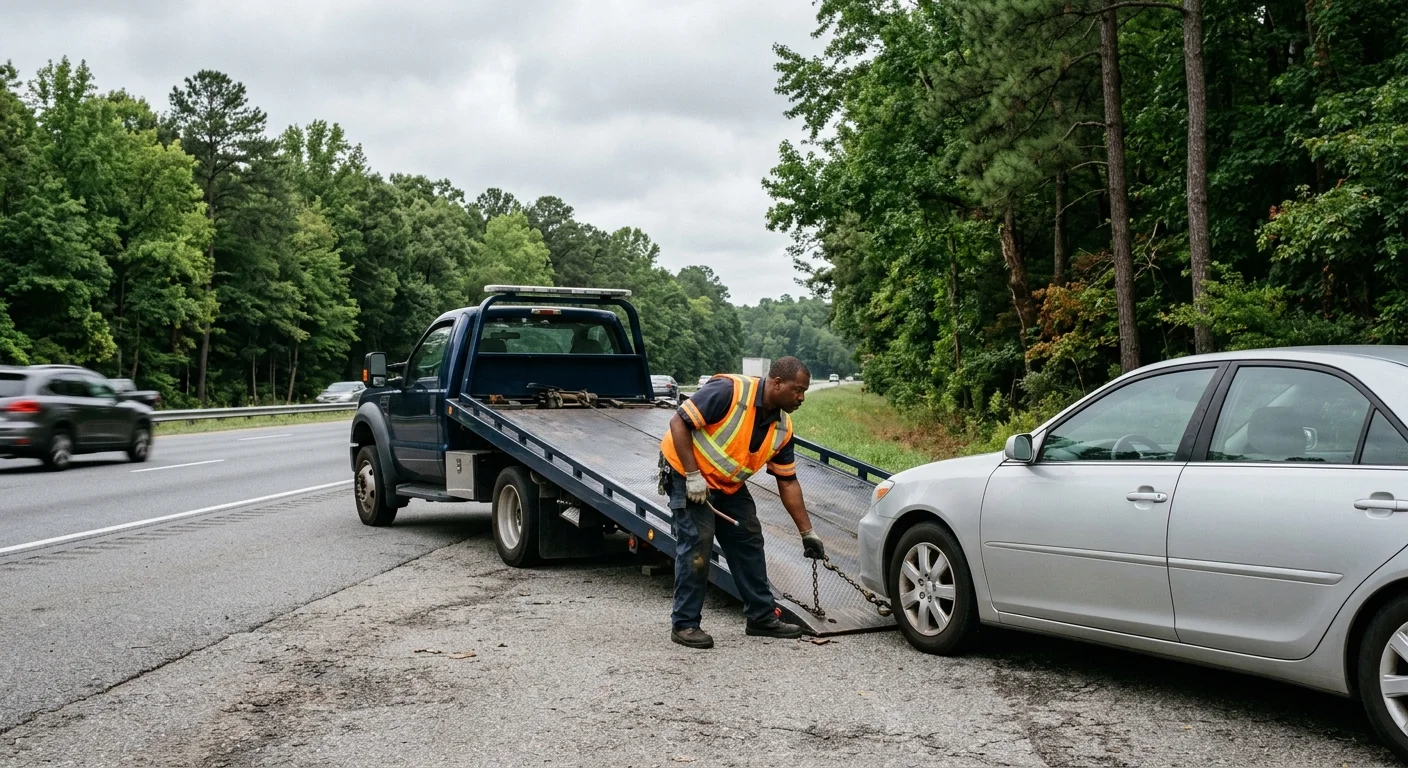
When you search for flatbed towing Chester VA, start with your car’s condition. Request a flatbed when damaged wheels, limited clearance, or vehicle instructions make another towing setup uncertain. An independent operator should make the final equipment choice after hearing the details.
Flatbed towing Chester VA starts with the vehicle’s condition
Describe what happened before discussing equipment. A parked car with a dead battery presents different concerns than a vehicle with visible collision damage. The operator needs the current condition, not just the reason you stopped.
Give the year, make, and model first. Then describe every problem you can see. Useful details include:
- Whether each tire is inflated and attached
- Whether any wheel sits at an unusual angle
- Whether bodywork touches the pavement or a tire
- Whether the steering appears stuck or damaged
- Whether the car can shift into neutral
- Whether there’s debris beneath or around the vehicle
Stick to observations. You don’t need to diagnose suspension or drivetrain damage beside the road. Saying, “The front wheel points inward,” gives the operator more value than guessing which part broke.
Clear photos may also help the operator assess the situation. Take them only from a safe place. Capture the wheels, front and rear clearance, visible damage, and the space around the car.
Ask about flatbed towing when these details raise concerns. The service request still needs confirmation from the operator who owns the equipment. Quick Tow Richmond refers your request. The independent operator handles the towing work and bills you directly.
What a flatbed changes about the tow
A flatbed request changes the equipment discussion before dispatch. It doesn’t mean every disabled car automatically needs that setup. It means the operator should review the vehicle’s condition and confirm what can handle it.
No verified local rule establishes one loading method for every vehicle. We also couldn’t confirm a universal model list, loading angle, or clearance measurement. Check the owner’s manual when it’s available, then ask the operator to confirm the correct process for your specific car.
Tell the operator if another towing company, repair shop, dealer, or vehicle manufacturer gave you instructions. Repeat those instructions clearly. Don’t shorten them to “flatbed only” unless that’s what the source actually said.
If the problem happened after a crash or left the car in an exposed location, explain that too. An emergency towing request should include nearby traffic, scattered vehicle parts, and whether the car blocks a travel lane. Those facts affect planning, even though they don’t establish a promised arrival time.
On I-95, VDOT Safety Service Patrol provides free roadside assistance and incident management. Its Richmond-area coverage includes I-95, I-64, and I-295. SSP isn’t a tow company and doesn’t perform mechanical repairs. It can help move a disabled vehicle from danger and help the driver arrange a tow.
How wheel damage or low clearance affects loading
Wheel condition deserves a careful description. The operator may need a different plan when a tire, wheel, or nearby body panel no longer sits normally. Don’t assume that “it still rolls” gives the full picture.
Look at each corner from a safe position. Tell the operator:
- Which wheel appears affected
- Whether the tire still holds air
- Whether the wheel touches the body
- Whether loose material hangs near the pavement
- Whether the car rests lower on one side
- Whether turning the steering wheel changes anything visible
Low clearance also needs context. Report whether the car normally sits low or dropped after the incident. Mention aftermarket bodywork if you know it’s present. You can also describe curbs, slopes, parking stops, or broken pavement around the vehicle.
Avoid giving an untested clearance measurement. No verified source in this site’s claims ledger establishes a universal minimum. The operator should assess the actual car, available space, and equipment before agreeing to the loading plan.
Older and specialty vehicles may bring model-specific instructions. Our guide to classic car towing in Richmond explains why clear preparation matters for those calls. Whatever you drive, share the model and visible condition before equipment is sent. That gives the operator a better basis for confirming the tow setup.
Pinpoint your location near Chester
“Chester” alone may not identify the disabled vehicle. Give the road, direction of travel, and a nearby fixed reference. On I-95, include the nearest mile marker when you can read it safely.
Route 10 is a useful Chester reference. VDOT identifies the Route 10 area around mile 61 as the southern end of an overnight Safety Service Patrol route on I-95. That route runs north toward the I-295 interchange at mile 84 in Hanover County.
For current incidents and road conditions, check 511 Virginia. Its map may help you describe congestion or a closure near your position. It doesn’t replace the location details the towing operator needs.
Say whether the vehicle is on an interstate shoulder, in a parking lot, or beside a building. Include the direction it faces and any access restrictions you can see. If you’re inside a large property, give the entrance you used and a nearby storefront or marked section.
Our guide for drivers who break down on I-95 near Richmond offers more corridor-specific preparation. Don’t walk along traffic lanes to search for a landmark. Use visible signs, your phone’s location display, or details you recorded before stopping.
Confirm the equipment and destination
Before agreeing to the tow, confirm the operator understands the whole request. A simple repeat-back can uncover a missing detail before equipment heads toward Chester.
Confirm these points directly:
- Your vehicle’s year, make, and model
- The condition of every damaged tire or wheel
- Any visible body or underside clearance issue
- Your exact pickup location
- The complete destination address
- The equipment the operator plans to send
- The full total, including any mileage charge
Quick Tow Richmond doesn’t own towing equipment or perform the tow. We take the request through a recorded line and refer it to an independent operator. That operator confirms equipment, contracts with you, and bills you directly.
Check the destination before authorizing transport. Make sure the repair shop, dealer, home, or storage location can receive the vehicle. If access depends on business hours, a gate, or specific instructions, confirm those details with the destination itself.
Ask the operator to explain anything that changed after the first conversation. New wheel damage, a different destination, or restricted access can alter the request. Get the full total again before agreeing if the job details change.
No verified source establishes one flatbed rule for every car in Chester. The dependable approach is simple: describe the vehicle precisely, identify the pickup point, and let the operator confirm suitable equipment.
When to call us
Call when wheel damage, visible body damage, low clearance, or vehicle instructions require a licensed towing pro to choose the equipment. Quick Tow Richmond records and transcribes messages after a notice, then refers requests to independent operators who perform the work and bill drivers directly. Call us at (804) 701-6752.