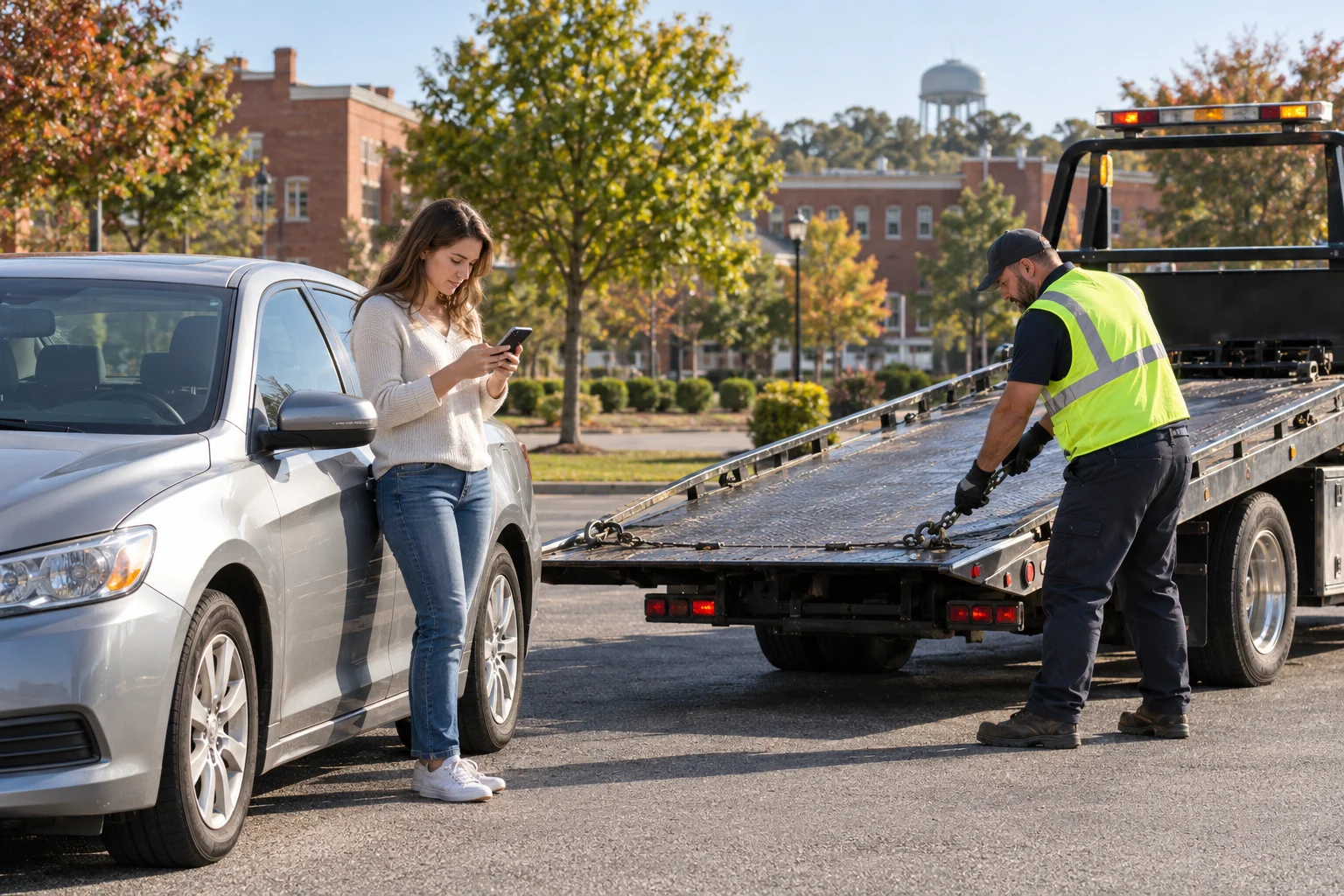
A breakdown in Colonial Heights can leave your car far from home or its regular mechanic. For long distance towing Colonial Heights VA, choose the destination first, confirm it can receive the vehicle, then request a complete charge that includes the planned mileage.
That sequence prevents a short-term decision from creating another problem. The best destination may be beyond the Tri-Cities, but it should have a clear purpose.
Long distance towing Colonial Heights VA: decide where the vehicle needs to go
Start with the place that can actually solve your problem. That could be your regular repair shop, your home, a dealership, or another secure location. Get the complete street address before requesting long-distance towing.
An unfamiliar driver may instinctively choose the closest repair shop. That can make sense when the shop can diagnose the problem. It’s less useful when the vehicle needs specialty work elsewhere. You could then need a second tow.
Call the destination and explain the vehicle’s condition. Ask whether the shop works on that make, model, and suspected problem. Confirm that someone has agreed to receive it. If the business is closed, ask whether it has a designated after-hours drop area.
Your plans after the tow matter too. A vehicle left near Richmond may be easier to reach if you’re staying in the metro. Taking it home may work better if you’re continuing south after a breakdown near Colonial Heights. Our guide to choosing whether to tow to a nearby shop or take the car home can help frame that choice.
For an interstate destination, write down the full address and a working destination contact. The related guide on how to arrange a long-distance tow across state lines covers the extra coordination such a trip may require.
Don’t send the vehicle toward a city name alone. A precise destination lets the operator review the actual trip before you agree.
Confirm access at the destination
A valid address doesn’t guarantee easy unloading. The operator needs a place where the vehicle can be delivered without guessing about gates, parking rules, or access.
Ask the receiving shop where a tow should enter. Some properties have separate customer and service entrances. Others use a locked gate outside business hours. You’ll need the correct instructions before the vehicle leaves Colonial Heights.
If the destination is your home, describe the final parking area. Mention a narrow driveway, gravel surface, low branches, steep grade, gate, or tight turn. If you live in an apartment community, confirm that management allows the vehicle to be left there. Don’t assume an open parking space authorizes delivery.
Someone may need to meet the operator with keys or access instructions. Decide who that person will be before dispatch. Share their name and phone number directly with the independent operator when arrangements are confirmed.
For a repair facility, ask these questions:
- Will the shop accept a vehicle that doesn’t run?
- Where should it be left if the office is closed?
- Does the shop need the keys placed somewhere specific?
- Who should receive the vehicle and authorize repairs?
- Is there enough room for the towing operator to unload?
These details become more important when the destination is outside the Tri-Cities. Returning to correct an access problem can be difficult once the operator has completed the trip.
Keep the destination contact available during delivery. If access changes, the operator needs instructions from someone authorized to make the decision.
Describe the car and whether it rolls
Give a clear description of the vehicle before an operator accepts the request. Start with the year, make, model, current location, and destination. Then explain exactly what happened.
Say whether the engine starts. Confirm whether the transmission can enter neutral. Tell the operator whether the steering works and whether every wheel turns. Mention a flat tire, damaged wheel, locked wheel, missing key, collision damage, low clearance, or fluid beneath the car.
Don’t reduce the problem to “it won’t run.” A car that starts but won’t shift presents a different loading situation from one with locked steering. A vehicle resting normally on four rolling wheels differs from one damaged near an axle.
Describe where the vehicle sits in Colonial Heights. A paved parking space, repair-shop lot, residential driveway, and interstate shoulder provide different access. Mention nearby barriers and the direction the car faces. If it’s in a garage or under a low structure, say so immediately.
The operator decides what equipment fits the vehicle and location. You can review flatbed towing as one possible service, then ask whether it suits your specific car. Don’t select equipment based only on the distance.
Take clear photos of the vehicle and its surroundings if the operator requests them. Useful views include each side, the wheel position, visible damage, and the approach to the car. Photos support a better loading assessment, but they don’t replace an accurate description.
Remove anything you’ll need during the trip. Keep your identification, medicine, travel documents, chargers, and house keys with you. Confirm separately what may remain inside before the vehicle is moved.
Ask how the complete charge is calculated
Long-distance towing charges weren’t confirmed as a single local mileage rate for Colonial Heights. The approved sources don’t establish one universal rate for a driver-requested trip. Ask the independent operator for the complete total before agreeing.
The quote should identify the pickup and destination addresses. Confirm whether the calculation uses loaded mileage, total travel, or another method. Ask what happens if the destination changes after dispatch.
Vehicle condition can affect the work involved. Tell the operator about locked wheels, collision damage, missing keys, tight access, or a vehicle that can’t enter neutral. Don’t wait until arrival to disclose a loading problem.
Ask these questions in plain language:
- What complete amount should I approve for this route?
- Is mileage included in that amount?
- Does the vehicle’s condition change the calculation?
- Could destination access add another charge?
- Which payment methods does the operator accept?
- Will I receive an itemized receipt?
Quick Tow Richmond is a referral service. We connect callers with independent towing operators. The operator contracts with you, performs the tow, sets the complete charge, and bills you directly.
Virginia’s statutory towing ceilings concern nonconsensual private-property towing. They aren’t quotes for a long-distance tow requested by the driver. Don’t use a private-property ceiling to estimate this trip.
Get the agreed route, vehicle details, and complete charge in writing when possible. Review every line before authorizing the move. If something remains unclear, ask the operator to explain it before dispatch.
Confirm the route before dispatch
Give the operator both complete addresses and discuss the likely route. A trip north toward Richmond differs from a move south beyond Petersburg or west across the metro. The destination should determine the route, not a vague request to take the car “toward Richmond.”
Check current incidents through 511 Virginia before the tow begins. Conditions on I-95, I-64, and I-85 can affect routing decisions. The operator controls the actual route and can account for the vehicle, equipment, road conditions, and destination access.
If you’re stranded on I-95, location details matter. Share the direction of travel, nearest interchange, mile marker, and whether the vehicle is on a shoulder or off the roadway. Don’t cross active traffic to inspect a sign or reach an exit.
VDOT’s Safety Service Patrol provides free roadside assistance and incident management on covered interstate routes, including I-95, I-64, and I-85. It can help with services such as tire changes, fuel delivery, jump starts, and arranging a tow. It isn’t a towing company and doesn’t perform mechanical repairs.
Before dispatch, confirm the destination one final time. Verify the receiving contact, access instructions, key plan, and complete charge. Also decide where you’ll go after the vehicle leaves. Passengers shouldn’t assume they can ride inside the towed vehicle.
Keep your phone available during the move. A route or access issue may require a decision before delivery. Clear instructions at the start make that decision easier.
When to call us
Call when a disabled car must leave Colonial Heights for a confirmed destination beyond the Tri-Cities and the move needs a licensed towing pro. Our recorded line takes calls 24/7, plays a recording notice, and refers requests to independent operators. Call us at (804) 701-6752.