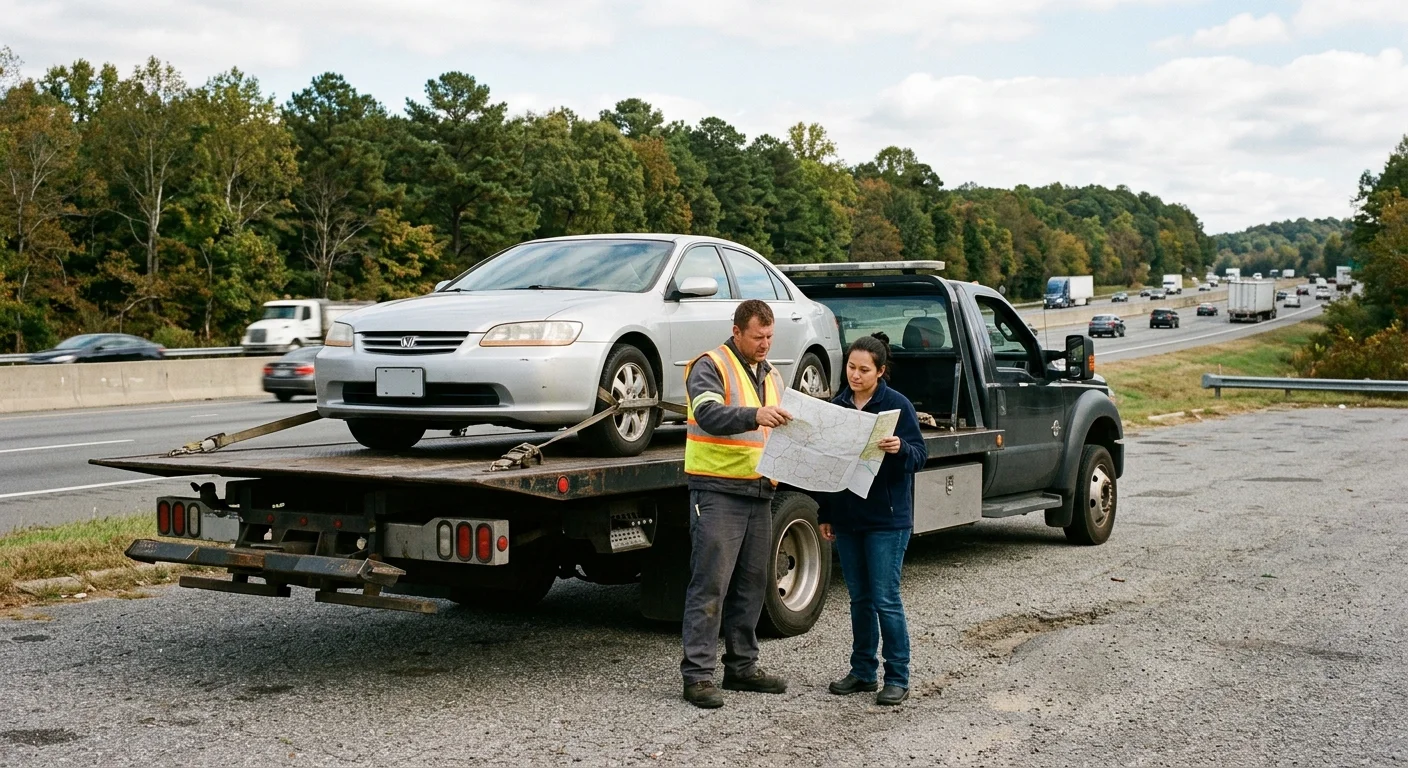
A long-distance tow across state lines needs a confirmed route, complete charge, and clear delivery plan. Give the independent operator both addresses, explain the vehicle’s condition, and verify the handoff before dispatch. Ask the operator about any cross-state requirements because no single rule for every destination could be confirmed from our approved Virginia sources.
Confirm that the operator serves the full route
Start with exact pickup and delivery addresses. A city and state aren’t enough for planning the job. Include the business name, entrance, parking area, and a nearby landmark when needed.
Tell the operator whether the vehicle is beside a house, inside a garage, or on a highway shoulder. Mention any gate, narrow driveway, parking deck, soft ground, or locked-wheel issue. The operator needs that information when deciding whether the move fits the available equipment.
Richmond pickups can begin along I-95, I-64, or I-295. The I-95 and I-64 overlap through downtown also creates a different starting point than a pickup farther south toward Chester or Petersburg. Share your actual location instead of naming the nearest large city.
Ask these questions before accepting the tow:
- Will one operator handle the entire route?
- Does the quoted service reach the exact delivery address?
- Will another operator take over anywhere?
- Who remains responsible for updates during a handoff?
- Does the vehicle need different equipment at either location?
- What information does the receiving facility require?
No universal cross-state licensing, permit, or service-boundary rule was confirmed in the approved Virginia sources. Ask the independent operator which credentials and documents apply along the full route. If another company will handle part of the trip, get its name and role too.
Quick Tow Richmond is a referral service. We connect drivers with independent operators who contract with and bill them directly. Our long-distance towing service page explains that referral process.
Check access at the destination
A complete street address doesn’t guarantee a workable delivery. The operator also needs to know where the vehicle can be unloaded and who can receive it.
Call the repair shop, storage facility, dealership, residence, or other destination first. Confirm its current receiving hours and the entrance used for vehicle deliveries. Ask whether someone must sign, provide identification, or direct the unloading location. Those details come from the facility, not the referral service.
If the destination may be closed, agree on a handoff plan before dispatch. Ask whether the facility accepts after-hours deliveries. If it does, confirm where the vehicle and keys should go. Don’t leave keys or authorize an unattended delivery without the facility’s approval.
Access matters at homes too. Tell the operator about hills, tight turns, low branches, locked gates, street-parking limits, or a driveway blocked by other vehicles. If the car must enter a garage, provide the opening’s measurements rather than guessing that the towing equipment will fit.
The destination may also affect the loading method. Share whether the car rolls, steers, brakes, starts, or has damaged wheels. If you believe the vehicle may need a flatbed, discuss flatbed towing when arranging the move. Let the operator choose the equipment after reviewing the vehicle and both properties.
Still choosing a destination? Our guide to deciding whether to tow the car to a nearby shop or take it home can help you settle that question before booking the longer route.
Ask how the complete charge is calculated
Get the complete proposed charge before authorizing the move. Ask the operator to explain how pickup, mileage, loading conditions, equipment, tolls, waiting, and delivery access affect the total. Then ask which items are included and which could be added later.
No universal interstate mileage rate appears in this site’s approved sources. We can’t confirm one figure that applies across operators, vehicles, routes, and destinations. The independent operator must explain its own calculation and bill you directly.
Use the same route details when comparing proposals. One proposal based on central Richmond can’t be compared fairly with another based on the actual pickup near I-295. Give each operator the precise addresses and the same vehicle information.
Before agreeing, request a written summary containing:
- The pickup and destination addresses
- The vehicle’s year, make, model, and condition
- The planned loading method
- The proposed complete charge
- The items included in that charge
- Any conditions that could change it
- Any cancellation or route-change terms
- The approved delivery and key-handoff plan
Richmond’s and Virginia’s private-property towing ceilings don’t set the price of a driver-requested interstate move. Those ceilings cover nonconsensual private-property hookups. Don’t use them as a quote for voluntary transport.
For a closer look at common quote questions, read our guide to long-distance towing prices in Richmond. Confirm the current total with the operator before the truck is dispatched.
Plan for passengers and belongings
Arrange transportation for every passenger before the vehicle leaves. Virginia’s operator rules don’t allow occupants to remain inside a vehicle being towed. Ask whether the tow truck has an available passenger seat, but don’t assume transportation is included.
If there’s no confirmed seat, arrange a ride, rental car, train, flight, or other safe option. Keep passengers together when practical. Make sure everyone knows the destination and the name of the person receiving the vehicle.
Remove anything you’ll need during the trip. That usually includes identification, medication, wallets, work equipment, travel documents, chargers, and house keys. Take toll devices and removable valuables unless the operator tells you they’re needed for the move.
Walk around the vehicle before loading. Photograph its exterior, wheels, windows, and visible damage. Take another set when the vehicle reaches its destination. These photos create a simple condition record without relying on memory.
Make a short belongings list if anything must remain inside. Ask the operator what can stay in the vehicle and how loose items should be handled. Don’t assume a loaded trunk or interior is acceptable for every trip.
The key plan deserves special attention. Confirm how many keys travel with the vehicle and who receives them. If a repair shop needs a key for diagnosis, name the employee or approved drop location. Keep a spare with you when possible. Never place a key under a mat or inside an unlocked vehicle unless the receiving facility has specifically approved that arrangement.
Confirm the route and total before dispatch
Review the entire arrangement once more before authorizing dispatch. Small address errors matter more when the destination is in another state. Read both addresses aloud and confirm the city, state, and postal code.
Check 511 Virginia for current Virginia traffic and incident information. This can help you understand conditions near the pickup and along the Virginia portion of the route. It isn’t an arrival estimate or a promise about the operator’s schedule.
For a disabled vehicle on I-95, I-64, or I-295, VDOT’s Safety Service Patrol may provide free roadside assistance and incident support. The patrol can help move a disabled vehicle away from active traffic and help the driver arrange a tow. It doesn’t act as the towing company for your interstate transport.
Before dispatch, confirm these final points:
- The exact pickup location
- The exact delivery entrance
- The vehicle’s current condition
- The operator handling each part of the route
- The planned equipment
- The proposed complete charge
- The payment method and responsible payer
- The destination contact
- The passenger transportation plan
- The key and belongings handoff
Save the operator’s written terms and destination instructions. If the route, vehicle condition, or delivery plan changes, ask whether the proposed charge or handoff must change too. Confirm the revision before the move continues.
Frequently asked questions about a long-distance tow across state lines
Must one operator complete the entire trip?
No universal rule requiring one operator for the whole route was confirmed in our approved sources. Ask whether the same operator will complete the trip or whether a handoff is planned. Get the second operator’s identity and responsibilities before dispatch.
How do I get an accurate proposed total?
Provide exact addresses, vehicle details, loading conditions, and destination access information. Ask for the complete proposed charge with mileage included. The independent operator should identify anything that could change that amount.
What if the destination will be closed?
Contact the destination before booking. Ask whether it accepts unattended or after-hours deliveries and where the vehicle and keys should go. If it doesn’t, choose an approved delivery time or another location.
When to call us
Call when an out-of-state move needs a licensed towing pro and a confirmed vehicle handoff. Our recorded line takes calls 24/7, plays a recording notice, and accepts your route details. Call us at (804) 701-6752.