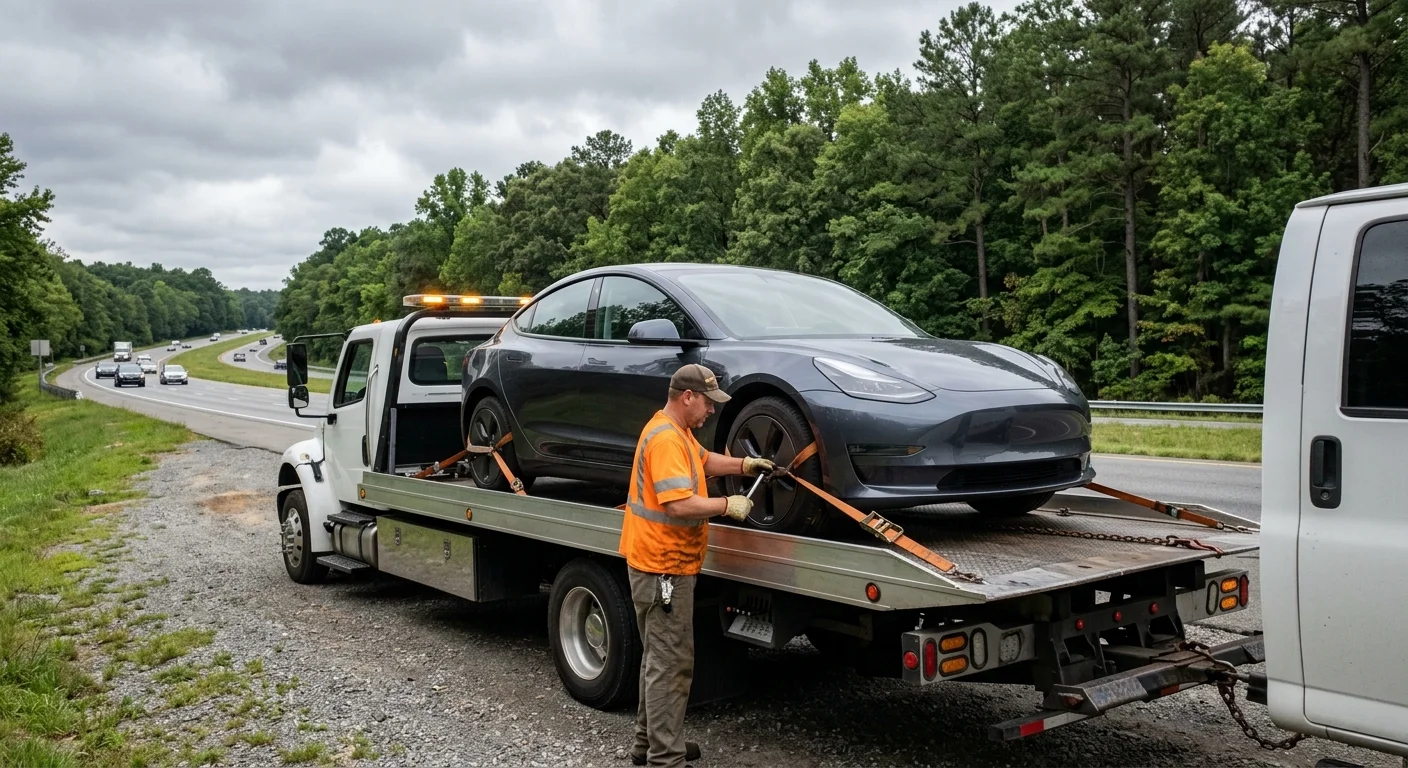
If you’re asking “can teslas be towed normally,” the practical answer is no. Request a flatbed that keeps all four wheels off the road, then follow the instructions in your car’s current owner’s manual.
That distinction matters whether you’re stranded near Short Pump, Scott’s Addition, or Midlothian Turnpike. The right request starts with how the car’s drivetrain connects to its wheels.
Can Teslas be towed normally? The short answer is flatbed, not a wheel lift
A conventional wheel-lift setup raises one end of a vehicle. The other wheels remain on the pavement and turn as the truck moves. That rolling setup is the concern with a Tesla.
An electric drivetrain stays geared to the wheels. When those wheels turn against the road, they also turn parts of the drive system. A flatbed changes that condition by carrying the complete car above the pavement.
Start by requesting Tesla and EV towing with all four wheels loaded onto a flat deck. Don’t approve a wheel-on-road setup simply because the destination seems nearby. A short trip from Scott’s Addition doesn’t replace the car’s official instructions.
The vehicle’s owner’s manual is the authority for your specific car. Manufacturer guidance can vary by model and software version. Check the manual available for the car you’re driving, not instructions copied from another owner’s post.
Tell the operator which Tesla you have before the tow is arranged. Ask whether the planned loading method follows that vehicle’s current guidance. If anything differs from the manual, pause and confirm the correct method with the manufacturer.
Our flatbed towing referral page explains how to request this type of operator. Quick Tow Richmond connects callers with independent licensed towing operators. The operator handles the work and bills the driver directly.
The drivetrain is the reason, not the weight
People often focus on the battery or the car’s overall weight. Those details may affect an operator’s equipment choice, but they aren’t the main answer here. The defining issue is the connection between the wheels and electric drive system.
Road contact makes the wheels rotate during a wheel-lift tow. Because the drivetrain remains geared to those wheels, that motion continues through the drive system. Carrying the car flat removes the rolling contact that creates the problem.
Don’t assume selecting a different driving state makes ordinary ground towing acceptable. Screen labels aren’t a substitute for the towing section of the owner’s manual. The manual’s instructions should guide both preparation and loading.
This also explains why a Tesla that looks undamaged still needs the right setup. The issue isn’t limited to a collision, a flat tire, or visible suspension trouble. It comes from how the drive system relates to wheel movement.
Use simple language when requesting help: “It’s a Tesla, and I need all four wheels off the road.” Then identify the exact model and explain whether the car can power on, shift, steer, or roll. Those details help the operator plan the loading method before reaching the vehicle.
Keep the manual available during that conversation. If the car’s current instructions contain a special preparation step, read the wording directly to the operator. Don’t rely on a remembered menu sequence from another model.
What to tell the operator when you call
Start with the vehicle, then describe its condition. Say that it’s a Tesla and give the exact model and model year. State clearly that you’re requesting a flatbed with all four wheels carried above the roadway.
Next, explain what the car will and won’t do. Tell the operator whether it powers on, shifts, steers, and rolls freely. Mention visible collision damage, a blocked wheel, a flat tire, or anything underneath the car that appears out of place. Don’t experiment with the controls just to produce a different answer.
Give a precise location. “Near Richmond” isn’t enough for planning access. Name the road, travel direction, nearby interchange, parking area, or building entrance. A car beside the Bryan Park interchange presents a different loading situation from one in a private driveway.
Access matters too. Tell the operator if the Tesla sits inside a garage, against a curb, behind another vehicle, or close to traffic. Describe the direction it faces and how much open space surrounds it. Let the licensed operator decide how that position affects loading.
When the operator contacts you, ask for the full total with mileage included before agreeing. Loading conditions and the destination can affect the final bill. Quick Tow Richmond doesn’t set the independent operator’s price.
Our line takes calls around the clock by a recorded system. A recording notice plays before you leave a message. Include your callback details, location, Tesla model, and whether the car can roll. We’ll use that information to match you with an independent licensed operator.
Where this goes wrong around Richmond
Problems often begin when the request is too general. Saying only “I need a tow” leaves out the detail that controls the transport method. Lead with “Tesla” and “flatbed,” then describe the car’s condition.
Location can also complicate the job. Richmond’s road network includes busy interstate shoulders, neighborhood streets, private lots, and constrained urban spaces. A breakdown near Short Pump isn’t the same loading scene as one in Scott’s Addition or along Midlothian Turnpike.
The I-95 and I-64 overlap through downtown deserves special attention. A VDOT-authored study describes it as one of the region’s highest-crash, heavily congested corridors. If you’re stranded there, share your exact direction and nearest interchange when arranging the tow.
VDOT’s Safety Service Patrol provides free roadside assistance on I-95, I-64, and I-295. The patrol isn’t a towing company. It helps move disabled vehicles from danger and assists drivers with arranging their own tow.
Check 511 Virginia for official real-time traffic and road conditions. That information can help you describe an incident near the Bryan Park interchange or another congested stretch. Our guide to breaking down on I-95 in Richmond adds local roadside context.
Another mistake is following instructions written for a different Tesla. Model details and software guidance can change the correct preparation process. Use the manual tied to the actual car, then relay those instructions to the operator.
If the car will not roll or will not shift
A Tesla that won’t roll or shift needs more information passed to the operator. Say so before the job is assigned. Don’t wait until the operator is looking at a car that can’t move as expected.
Avoid forcing the car into motion or guessing through unfamiliar screen controls. Instead, open the current owner’s manual and find its towing instructions. Describe exactly what the car is doing, including whether it powers on, responds to the selector, steers, or has a wheel that won’t turn.
Don’t drag the car simply to make loading easier. The licensed operator should choose a loading approach that respects the manual and keeps the wheels from rolling on the roadway during transport. If the operator needs clarification, confirm the manufacturer’s current instructions before proceeding.
The car’s position matters when it can’t move under its own power. Tell the operator if it’s nose-in, close to a wall, sitting at an angle, or blocking traffic. Mention whether it’s on a shoulder, in a parking area, or inside a garage.
Water exposure also belongs in that first description. Shockoe Bottom has a documented history of serious flash flooding. If water has reached the Tesla, tell the operator before anyone attempts loading or changes the car’s position.
Keep the explanation factual and brief. The operator needs the model, location, wheel condition, available space, and current manual instructions. That gives the licensed pro a clearer picture without relying on assumptions about the car.
When to call us
A disabled Tesla needs a licensed towing pro when it requires flatbed transport, won’t shift, or can’t roll normally. Quick Tow Richmond can match you with an independent licensed operator who will arrange the work and bill you directly. Call us at (804) 701-6752.