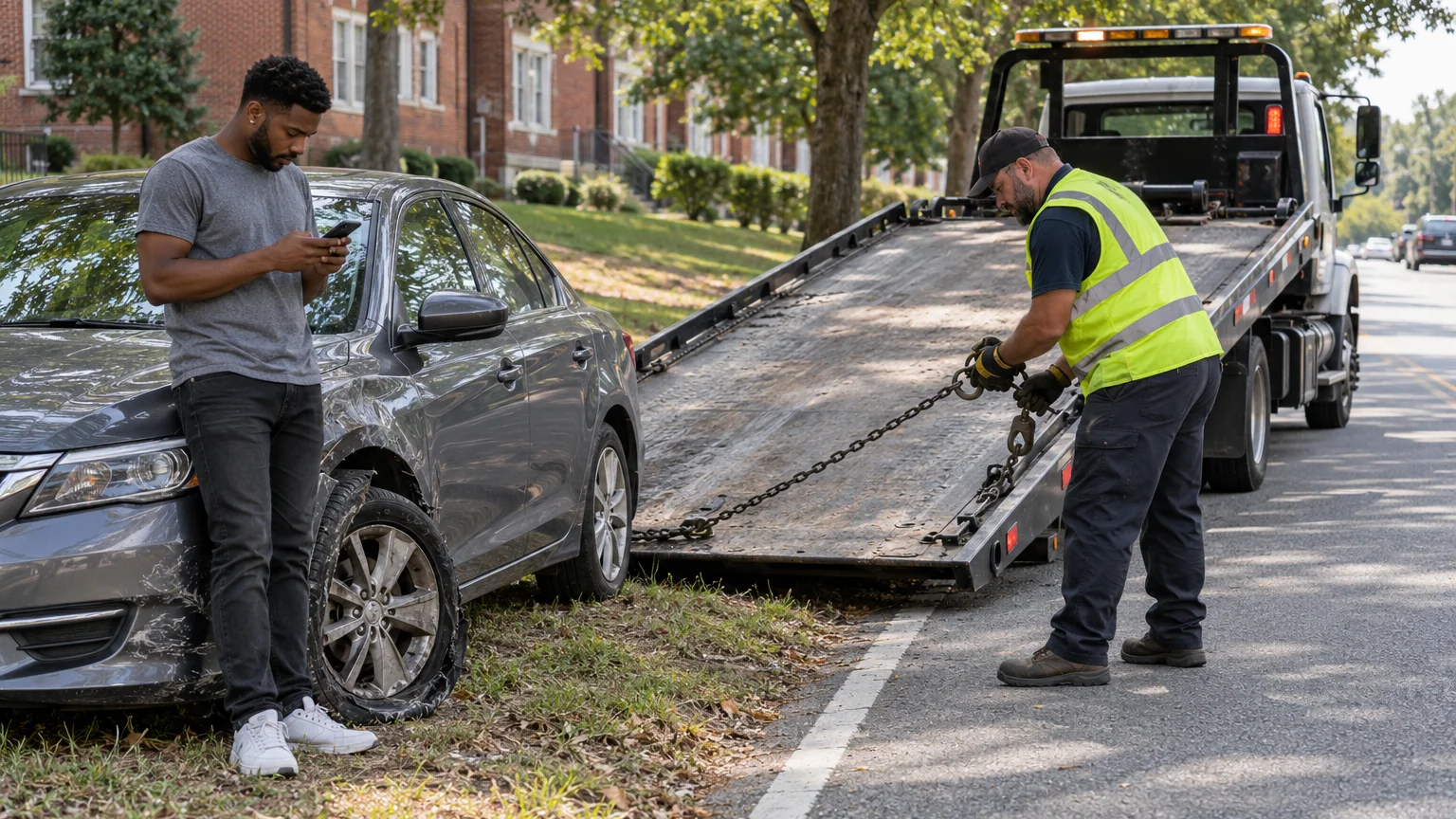
Flatbed towing Highland Springs VA drivers request after wheel damage starts with a clear description of the car. Report what happened, whether it rolls or steers, and what the operator will face at pickup. The operator can then decide whether a flatbed and a particular loading plan fit the situation.
Don’t drive farther just to test the damaged wheel. A bent-looking rim, torn tire, unusual wheel angle, or contact between the tire and body is enough reason to stop. Describe what you see without trying to diagnose the cause.
Stop and report what changed at the wheel
Start with the moment the problem appeared. Tell the operator whether the car struck a hole, curb, road debris, or another vehicle. If you didn’t see the cause, say that. A clear unknown is more useful than a confident guess.
Next, describe the visible change. Useful details include:
- The tire looks flat, torn, or separated.
- The rim appears bent or cracked.
- The wheel sits at a different angle.
- The tire touches the fender or another part.
- The car dropped lower near one corner.
- You heard scraping, grinding, or repeated knocking before stopping.
These observations don’t establish what failed. They help the operator understand the pickup before arriving. A wheel that merely looks damaged may present differently from one that won’t turn.
Avoid crawling beneath the vehicle. You don’t need a close mechanical inspection to request help. Stay where you can observe the car without entering moving traffic.
If the damage followed a pothole or hard road impact, our guide to pothole wheel damage in Richmond explains the main towing decision. After a collision, accident recovery and winch-outs may be more relevant when the car left the pavement or can’t be reached normally.
When calling, separate what you saw from what you suspect. “The front wheel points outward” gives the operator something concrete. “The suspension is broken” may be an incorrect diagnosis.
Describe whether the car rolls and steers
The operator needs to know how the car behaves at very low movement, if that’s already known. Don’t move it again solely to find out. Report what happened while you were bringing it to a stop or placing it in its current position.
Say whether any wheel appeared locked. Mention if the steering wheel turned without changing the front wheels. Also report if the car pulled sharply, resisted rolling, or scraped the pavement.
Tell the operator whether the transmission can shift into neutral. If you can’t verify that safely, say so. Keys, electronic controls, crash damage, or a dead battery may affect what the operator encounters. The operator should know about those conditions before choosing a loading approach.
A locked or badly angled wheel can change the plan. Our article about towing a crash-damaged car with a locked wheel covers the information worth sharing. It also explains why the condition of every wheel matters, not only the visibly damaged one.
Don’t promise that the car rolls because one wheel still turns. Don’t assume a flatbed can load every damaged vehicle in the same way. Vehicle position, ground clearance, wheel condition, and access all affect the operator’s decision.
Give the year, make, model, and drive type if you know them. If you don’t know the drive type, don’t guess. The operator can work from the vehicle information and the conditions you report.
Share photos before flatbed towing Highland Springs VA
Photos can show details that are hard to explain during a stressful call. Take them only from a safe position. A useful set shows the damaged wheel, the entire vehicle, and the space surrounding it.
Start with a wide photo from each accessible end. These images show whether another vehicle, curb, fence, ditch, gate, or building limits the approach. Then photograph the damaged corner from a standing position. Include the wheel and nearby bodywork in the frame.
Show the path between the vehicle and the road. If the car is in a driveway, apartment lot, narrow lane, or enclosed parking area, photograph the entrance too. Note any low branches, tight turns, soft ground, or overhead limits you can plainly see. Don’t estimate measurements you haven’t taken.
Location details also matter. Send the exact address or a dropped map pin. Name the business, apartment entrance, or nearby landmark when the street address doesn’t identify the correct access point. In Highland Springs, the pickup instructions should distinguish the actual entrance from the mailing address when they differ.
A photo can’t confirm internal damage. It also can’t guarantee which equipment will work. Its purpose is to help the independent operator assess access and prepare a loading plan.
If you’re stopped on I-64 or I-295, VDOT’s Safety Service Patrol provides roadside incident help but doesn’t act as a towing company. 511 Virginia provides current traffic and incident information.
Let the operator choose the loading plan
A flatbed keeps the vehicle supported on its deck during transport, but the operator still must determine how to load it. Visible wheel damage, limited access, and the car’s position can change that plan.
Quick Tow Richmond is a referral service. We connect callers with independent licensed tow operators. The operator contracts with and bills the driver directly. We don’t perform the towing, own the truck, or decide which loading method the operator uses.
Describe the result you need, then let the operator assess the equipment and approach. You can request flatbed towing, but don’t treat that request as confirmation that every flatbed can handle the pickup. The assigned operator should evaluate the vehicle and the site.
Before dispatch, ask the operator to confirm:
- Whether the reported wheel condition affects loading
- Whether the pickup position creates an access problem
- What information or photos are still needed
- Whether the planned equipment suits the vehicle
- Whether the operator needs keys or access instructions
Don’t attempt to straighten a wheel, remove damaged parts, or push the car into a better position unless a qualified professional directs the work on site. Changing the vehicle’s position can make access worse or cause further movement.
If crash debris, a ditch, or unstable ground is involved, say so during the first contact. That may require a different recovery plan from a car sitting level in an open parking area.
Confirm the destination before dispatch
Choose the destination before the operator starts toward the pickup. It may be a repair shop, dealership, body shop, secure property, or another location authorized to receive the vehicle.
Call the destination first when possible. Confirm that it can accept the car in its current condition. Ask where the operator should leave it and whether someone must be present. Don’t assume an after-hours lot accepts unattended vehicles or damaged cars.
Provide the destination’s complete address. A business name alone may point to several locations. Share the correct entrance when service access differs from the customer entrance.
The destination also affects the total. Quick Tow Richmond doesn’t set an independent operator’s final charge. Ask for the full expected total, with mileage included, before agreeing to dispatch. Explain any difficult pickup access because it may affect the operator’s assessment.
Keep voluntary towing separate from private-property towing rules. Virginia’s statutory fee ceilings concern nonconsensual private-property tows, not a tow requested by the driver. The relevant state rules appear in Title 46.2, Chapter 12 of the Code of Virginia.
Make sure the operator has your name, vehicle description, pickup point, and destination. If someone else will meet the truck, provide that person’s name and contact details through the operator’s approved process. Clear instructions reduce confusion at both ends of the trip.
When to call us
Call when visible wheel damage leaves the car unable to roll or steer normally, or when you need a licensed towing pro to assess the pickup. Our recorded line takes messages any time, day or night, and Quick Tow Richmond connects drivers with independent operators. Call us at (804) 701-6752.