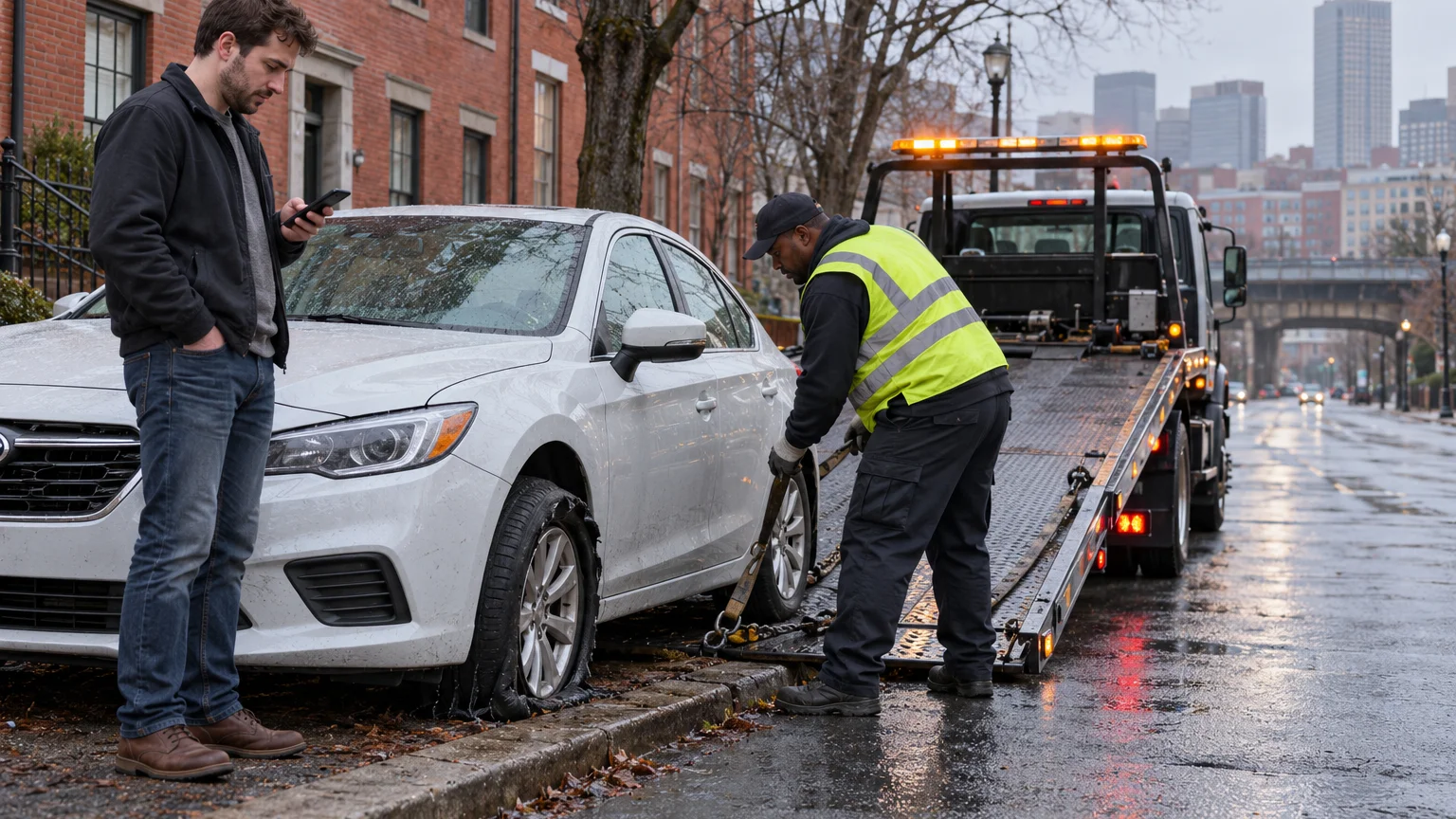
Pothole wheel damage towing is the cautious choice when the car changes after a hard impact and qualified guidance isn’t available. Get clear of moving traffic, describe what happened, and arrange a tow if you can’t confirm the vehicle should continue.
A pothole can leave you with an obvious flat or a less obvious change. Don’t diagnose the wheel, tire, steering, or suspension beside the road. Your immediate job is to notice what changed and communicate it clearly.
Get clear of traffic before making a pothole wheel damage towing decision
Your first decision isn’t about the wheel. It’s about getting away from moving traffic without making promises about the car’s condition.
If the vehicle still responds, move only as directed by responding authorities or qualified roadside personnel. Use your hazard flashers when appropriate. Don’t keep driving simply to reach a more convenient address if the car’s behavior has changed.
Location matters across Richmond. A stop on a neighborhood street in the Fan differs from one along the downtown I-95/I-64 overlap. That overlap runs from around the Bryan Park interchange toward the James River. VDOT describes it as one of the region’s most congested, high-crash corridors.
On I-95, I-64, or I-295, VDOT Safety Service Patrol may already be handling an incident nearby. The patrol provides free roadside assistance and scene control on covered routes. It doesn’t provide mechanical repairs or operate as a tow company. It can help move a disabled vehicle from the roadway and help the driver arrange towing.
Check 511 Virginia for current incidents and road conditions. If police, fire, or VDOT personnel arrive, follow their directions. Their traffic instructions take priority over a recovery plan made by phone.
Once you’re away from traffic, stay aware of passing vehicles. Examine the car only from a position where you aren’t stepping into an active lane.
Explain exactly what changed after the hit
A useful towing request begins with observations, not a diagnosis. Tell the operator what you felt, heard, and saw immediately after the impact.
Start with your location. Give the road, travel direction, nearest intersection, landmark, or exit. On the interstate, include the route and direction. In central Richmond, clarify whether you’re on I-95, I-64, or the shared downtown section.
Next, describe how the vehicle behaved. Useful details include:
- The steering wheel began sitting differently.
- The car started pulling toward one side.
- A new vibration appeared after the impact.
- You heard scraping, rubbing, or repeated knocking.
- The vehicle stopped rolling normally.
- A warning appeared on the dashboard.
- The tire lost visible height.
- The wheel no longer appears centered.
These details don’t prove which part failed. They help the operator understand the recovery request and prepare for a vehicle that may not roll or steer as expected.
Also report the vehicle’s make, model, approximate size, and drive type if you know it. Mention whether passengers, a trailer, or cargo affect the situation. Say whether the car is fully off the road, partly blocking a lane, or inside a parking area.
Don’t erase uncertainty. “I can’t tell whether the wheel will roll” is more helpful than guessing that the suspension broke. Clear limits help the operator plan without treating a roadside observation as a mechanical inspection.
Describe the wheel and tire without diagnosing them
Look for visible changes from a safe position. You don’t need to name the failed part. You only need to describe what’s different.
Tell the operator if the tire appears flat, torn, shifted, or separated from the wheel. Mention a visibly bent wheel edge, a wheel sitting at an unusual angle, or bodywork touching the tire. Report anything hanging beneath the vehicle. Don’t crawl under the car to identify it.
A routine flat and a wheel that won’t sit normally can require different recovery planning. Our guide to flat-tire roadside help or towing explains how to frame that choice. A tire change may be considered when the problem is limited and qualified help confirms the next step. A tow becomes the clearer request when the damage appears to involve more than the tire or the vehicle won’t roll normally.
Take photos if you can do so away from traffic. Capture the affected wheel, the vehicle’s position, and the surrounding area. Photos can help you explain the scene, but they don’t replace an inspection.
Tell the operator if the steering is turned, a wheel appears locked, or the car can’t be placed into the expected position. Those details affect loading. The related guide on towing a car with crash damage or a locked wheel covers that recovery problem in more depth.
Avoid moving loose pieces or testing the car repeatedly. Preserve what you observed and wait for qualified guidance.
Leave the roadworthiness decision to qualified help
A vehicle can look mostly normal after a pothole impact and still feel different. Appearance alone shouldn’t settle whether it continues under its own power.
A tow operator can assess access, loading conditions, and the equipment needed for transport. A qualified mechanical professional should address whether the vehicle is fit to return to the road. Those are separate decisions.
If a responding authority tells you not to move the vehicle, follow that direction. If a mechanic familiar with the vehicle gives specific instructions, pass them to the operator. Don’t treat a quiet engine or inflated tire as proof that the wheel, steering, or related parts are ready for more driving.
Equipment choice also depends on observed condition. A vehicle that rolls and steers presents a different loading problem from one with an angled or locked wheel. Give the operator the facts and let that operator determine the recovery setup.
Ask whether flatbed towing fits the reported condition. Don’t assume every pothole impact requires a flatbed, and don’t assume another method will work. The operator needs to consider clearance, wheel position, vehicle instructions, and the pickup location.
Be especially clear about low bodywork, all-wheel-drive systems, electric vehicles, or manufacturer transport instructions. If you have the owner’s manual, look for its towing or transport section. Share that information before loading begins.
The cautious line is simple: observation informs the call, but it doesn’t replace mechanical guidance.
Set the destination and recovery details before agreeing
Choose a destination before the vehicle is loaded when possible. That could be a repair shop, dealer, tire shop, or another location able to receive the car. Confirm that the destination will accept the vehicle, especially outside its published hours.
Give both addresses to the operator. Explain any access limits at the pickup point or destination. A narrow Fan street, an interstate shoulder, and a commercial lot create different loading conditions.
Ask for the full expected total, including mileage, before agreeing. Quick Tow Richmond doesn’t set the independent operator’s final price. The operator contracts with you and bills you directly.
Also confirm how the vehicle will be released at the destination. Ask whether someone must meet the operator, where the keys should go, and what contact information the receiving location needs. Remove loose valuables if you can access them without entering traffic or disturbing the damaged area.
If the car left the roadway, struck another object, or rests where ordinary loading isn’t possible, describe that during the first call. Accident recovery and winch-out service may fit a scene that requires recovery before transport.
Keep your explanation short and factual: where the car is, what changed, what you can see, and where it needs to go. That gives the independent operator a clearer starting point without turning your roadside observations into a diagnosis.
When to call us
Call when a pothole impact leaves the car unable to roll normally, changes its steering, or creates visible wheel or tire damage that needs a licensed towing pro. Quick Tow Richmond refers recovery requests to independent licensed operators, and its recorded line takes calls 24/7. Call us at (804) 701-6752.