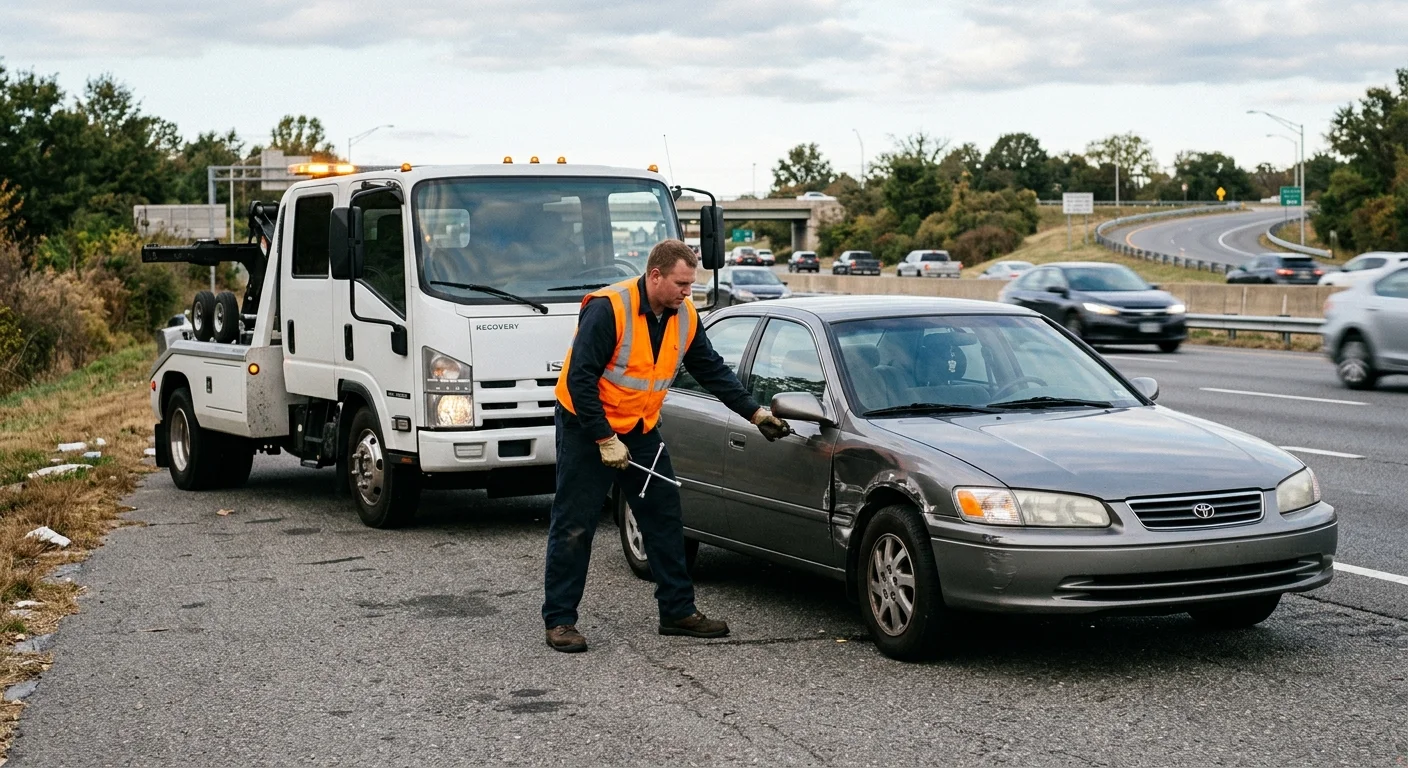
When you need to tow car with locked wheel after accident damage, report the stuck wheel before an operator is sent. Explain the vehicle’s position, share clear photos, and confirm where it needs to go. Let the independent operator decide how to recover it.
A wheel that won’t turn changes the information needed before the tow. Don’t diagnose the cause or force the car to move. Describe only what you can see and what happened when you tried moving it.
Tow car with locked wheel after accident: report which wheel won’t roll
Start by identifying the wheel as precisely as possible. Say front or rear, then driver or passenger side. “The front passenger wheel won’t roll” is more useful than “the car is stuck.”
Explain what happens when the vehicle moves, if you already know. The wheel might remain still, point at an unusual angle, or drag across the pavement. Report what you observed without naming a damaged part. A bent-looking wheel doesn’t confirm what failed behind it.
Tell the operator whether the other wheels appear to roll. Mention whether the steering wheel turns and whether the car can shift into neutral. Don’t keep testing the vehicle after a crash. A single clear description is enough to begin the conversation.
Also provide the vehicle’s year, make, model, and general size. Mention anything that changes access, such as a low front bumper or loose body panel. If keys are available, say so. If they aren’t, report that before dispatch.
This information helps the operator review the request as accident recovery, rather than a routine breakdown tow. Quick Tow Richmond refers each request to an independent licensed operator. That operator can decide what recovery approach fits the visible damage and scene.
Describe the crash scene and vehicle position
The vehicle’s location matters as much as the locked wheel. Give the road name, travel direction, nearest intersection, and a recognizable landmark. On an interstate, include the route, direction, and nearest exit or mile marker you can confirm.
Richmond’s road network can change the recovery plan quickly. A car beside the I-95 and I-64 downtown overlap presents a different scene from one parked in a Fan alley. A damaged vehicle on a Chesterfield driveway also differs from one near an active Henrico intersection.
Describe whether the car is on pavement, gravel, grass, or a slope. Say whether it’s against a curb, guardrail, wall, or another vehicle. Report if any part of the car left the roadway. Our guide to choosing a tow or winch-out after leaving the road explains why position must be described clearly.
Include current scene control. Tell the operator if law enforcement or another responding agency is present. Follow instructions from the personnel managing the crash. In the City of Richmond, vehicle accidents are among the city’s published reasons for a city-directed tow.
For current interstate incident information, check 511 Virginia. VDOT’s Safety Service Patrol covers Richmond-area sections of I-95, I-64, and I-295. The patrol provides roadside assistance and incident management, but it isn’t a tow company.
Share photos before dispatch
Photos can show details that are difficult to explain by phone. Take them only if you can do so without entering traffic or ignoring instructions at the scene.
Begin with one wide photo showing the whole vehicle and its surroundings. The operator needs to see where the car sits, not only the damaged wheel. Include nearby curbs, barriers, slopes, parked cars, and narrow access points.
Next, photograph the wheel that won’t roll. Take a straight view from the side and another from a slight angle. Include the tire, wheel opening, and nearby bodywork. Don’t reach behind the wheel, crawl under the car, or remove loose parts to improve the picture.
Photograph the other side of the vehicle as well. A second damaged area may affect how the operator approaches the car. Include anything visibly hanging, touching the pavement, or blocking access around the vehicle.
Avoid guessing about suspension, steering, brakes, or drivetrain damage. A photo records what’s visible. It doesn’t confirm what failed inside the car. Simple descriptions work better: “the wheel points inward,” “the tire touches the body,” or “the wheel didn’t turn when the car moved.”
Send current photos from the crash scene. Images taken before the collision won’t show the operator the vehicle’s present position or access conditions.
Let the operator choose the recovery plan
A locked wheel doesn’t automatically determine one truck or loading method. The operator needs the complete picture, including vehicle position, visible damage, available space, and destination.
You can ask whether flatbed towing is being considered. Don’t present a flatbed, wheel-lift, or any other setup as the guaranteed answer. The operator reviewing the request should choose the plan based on the actual car and scene.
Be ready to repeat the essential facts when the operator contacts you:
- Which wheel won’t roll
- Where the vehicle is positioned
- Whether other wheels appear to move
- Whether keys are available
- What obstacles surround the car
- Where the vehicle needs to go
If the car’s condition changes, report that before movement begins. A loose panel may fall farther, or the vehicle may settle after the initial impact. Describe the change without trying to correct it yourself.
Don’t ask anyone to force the car forward merely to test the wheel. Don’t assume a method guarantees no further damage. The operator should inspect the vehicle, explain the intended approach, and decide whether the available recovery plan fits the situation.
Quick Tow Richmond doesn’t perform the recovery itself. We pass the request to an independent licensed operator, who contracts with and bills the driver directly.
Confirm the destination before the vehicle moves
Choose the destination before loading begins whenever possible. Give the complete address and confirm whether the vehicle is going to a repair shop, home, storage location, or another approved site.
Tell the receiving location that the car has crash damage and a wheel that won’t roll. Ask whether it can accept the vehicle in its current condition. Also confirm where the operator should leave it and how the site handles arrivals when its regular entrance is unavailable.
If an insurer is involved, contact the insurer for policy-specific instructions. Towing coverage is optional in Virginia, so payment depends on the individual policy and circumstances. Our guide to who pays for a tow after a Richmond crash covers the questions to raise before authorizing the move.
Confirm the operator’s full price before agreeing. Ask for the total with mileage included, plus any other charge that applies to the requested tow. Quick Tow Richmond doesn’t set the independent operator’s price.
If law enforcement directs the tow, confirm what happens next with the officer and operator. When a vehicle has already been removed in Richmond, the city recommends checking its towed-vehicle listing before reporting it stolen.
Keep the operator updated if the destination changes. A new address can alter the route, mileage, access, and unloading conditions. Confirm the final location before the vehicle leaves the crash scene.
When to call us
Call when crash damage leaves a wheel unable to roll and the scene is ready for a licensed towing pro. Quick Tow Richmond refers requests to independent licensed operators, and our recorded line takes calls day or night. Call us at (804) 701-6752.