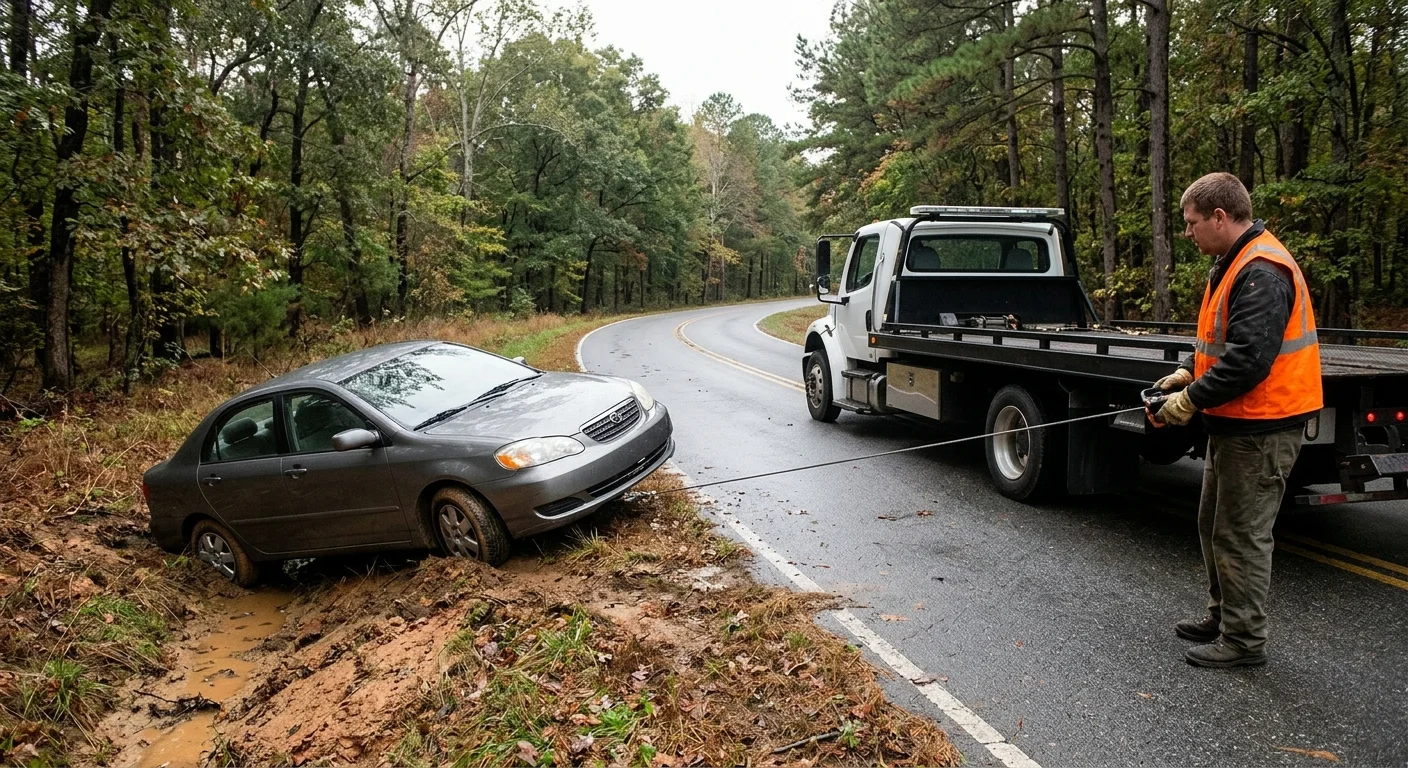
If your car has left the pavement, the tow or winch out choice depends on what happens after extraction. A winch-out brings the vehicle back to an accessible surface. A tow carries it away when it can’t be driven afterward. Some recoveries require both steps.
Tow or winch out: the practical difference
A winch-out solves a position problem. The car may be stuck in mud, resting in a ditch, or sitting below the road. The operator uses recovery equipment to move it toward a workable surface.
Towing solves a transportation problem. Once the vehicle reaches the pavement, it may still need a ride. Visible collision damage, a wheel that won’t turn, or a car that can’t roll can change the next step.
That distinction matters when you describe the problem by phone. “My car needs a tow” doesn’t tell the operator that it’s beyond the shoulder. “I only need a winch” may not account for damage hidden by mud, leaves, or the road’s edge.
Start with the vehicle’s position. Then explain whether it appears able to roll and steer. The operator can use those details to plan the recovery and decide what must be checked on scene.
A car sitting upright near the pavement may need only extraction. A car resting against an embankment or showing visible damage may need extraction followed by transport. Neither result should be promised before the operator sees the vehicle.
Our accident recovery and winch-out service connects drivers with independent operators who handle these situations. If the car must be transported after recovery, emergency towing may become part of the same job.
What the operator needs to know about the surface
The surface around the car can shape the entire recovery plan. Tell the operator whether the vehicle is on grass, loose dirt, wet mud, red clay, gravel, or pavement. Don’t describe everything as a ditch if the car is actually on a slope or soft shoulder.
Explain how the vehicle sits. Report whether it’s upright, angled downhill, facing the road, or pointing away from it. Say which wheels remain on firm ground. If you can’t see that clearly, say so.
Nearby obstacles matter too. Mention trees, guardrails, drainage areas, fences, parked vehicles, and steep banks. These details help the operator understand the available approach. A clear photo from a safe location can help when the operator requests one.
The operator also needs to know whether the car can roll. Say if a wheel appears bent, blocked, buried, or pressed against something. Report whether the steering responds and whether the tires appear inflated. Don’t force anything just to provide an answer.
Weather can change the description quickly. A grassy edge after rain may be softer than it looks. Red clay can also hide how deeply a tire has settled. Describe what you see now, not what the roadside looked like before the incident.
Give the nearest road, intersection, driveway, or recognizable landmark. A map pin can help on rural roads where addresses are spaced apart. Mention which side of the road the vehicle is on and whether the recovery vehicle can approach from pavement.
When vehicle damage changes the recovery plan
A vehicle can leave the road without obvious collision damage. It can also look manageable while a wheel, suspension area, or body panel remains hidden. The operator needs observations, not a diagnosis.
Report visible damage before recovery begins. Useful details include broken glass, a deployed airbag, a bent wheel, leaking fluid, or bodywork touching the ground. Say whether the front, rear, or side contacted a tree, bank, guardrail, or another object.
A car that starts isn’t automatically ready to drive. Starting, rolling, steering, and traveling are separate questions. Tell the operator what you’ve actually tested and what remains unknown.
Position can also limit what can be inspected. Mud may cover a tire. Tall grass can hide the edge of a drainage area. One side of the car may be inaccessible from where you’re standing. Don’t fill those gaps with guesses.
There’s no responsible way to promise that an off-road recovery will cause no additional damage. The existing damage, terrain, vehicle angle, and available access all matter. Ask the operator to explain the proposed approach after seeing the scene.
If the vehicle reaches the road but still can’t travel, it may need to be loaded and transported. Give the operator a destination before that stage begins. That could be a repair facility, another approved location, or the place directed by authorities controlling an accident scene.
Highway breakdowns create a different set of decisions. Our guide to breaking down on I-95 in Richmond explains the roadside-help layer for drivers who remain near the interstate.
Goochland roads and access limits
Off-road recovery around Goochland can look different from a call inside Richmond. Rural shoulders may lead into grass, mud, red clay, or shallow drainage areas. Narrow access roads can also leave less room around the vehicle.
A location description should cover the final approach, not only the nearest address. Tell the operator about a narrow driveway, soft entrance, low branches, a closed gate, or limited turning space. Mention whether firm pavement reaches the vehicle.
Trees and brush can make a shallow roadside departure look smaller than it is. A photo may show the car while missing the slope beneath it. Describe the ground between the pavement and the vehicle, including any drop, bank, or drainage feature you can see.
Richmond’s interstate network presents another setting. I-95 and I-64 share a downtown corridor between the Bryan Park interchange and the James River. I-295 also carries traffic around the metro. Those roads have broad travel lanes, controlled access, barriers, and moving traffic that differ from a rural Goochland shoulder.
VDOT’s Safety Service Patrol covers I-95, I-64, and I-295 in the Richmond area. It provides free roadside help and incident management, but it doesn’t act as a towing company or perform mechanical repairs. It can help move a disabled vehicle from the roadway and help the driver arrange a tow.
Drivers can also check 511 Virginia for current traffic and road conditions. That information can help identify closures or incidents affecting access. It doesn’t replace a direct description of where the car rests.
What to confirm before recovery begins
Start by confirming what the operator understands. Say that the vehicle is off the road, then describe its position, surface, visible damage, and ability to roll. Make sure the operator knows if a tow may be needed after extraction.
Confirm the location carefully. A street address may lead to a property entrance while the vehicle sits farther down a private lane. A highway name without a direction can also leave the location unclear. Share a map pin when possible, plus the nearest intersection or landmark.
Before agreeing to the job, ask what the quoted total includes. Confirm whether it covers the winch-out, towing, mileage, and any other expected work. If the operator can’t determine the full scope until arrival, ask what conditions could change the amount.
Quick Tow Richmond doesn’t set the independent operator’s final bill. The operator contracts with you and bills you directly. Our guide to tow costs in Richmond explains common cost drivers and the difference between a published rate and a legal fee ceiling.
Confirm the destination if transportation may be required. Also tell the operator whether anyone else controls access to the vehicle or property. That could include a property owner, gate holder, law-enforcement officer, or repair facility.
Finally, keep your description factual. “The car is upright, the right wheels are in mud, and I can’t tell whether the front wheel turns” is more useful than “it should pull right out.” Clear details help the operator arrive prepared without creating a promise about the method or outcome.
When to call us
Call when your vehicle is beyond the pavement, can’t roll, or shows damage that may require a licensed towing pro. Quick Tow Richmond connects callers with independent licensed operators, and our recorded line takes calls 24/7 with a recording notice before your message. Call us at (804) 701-6752.