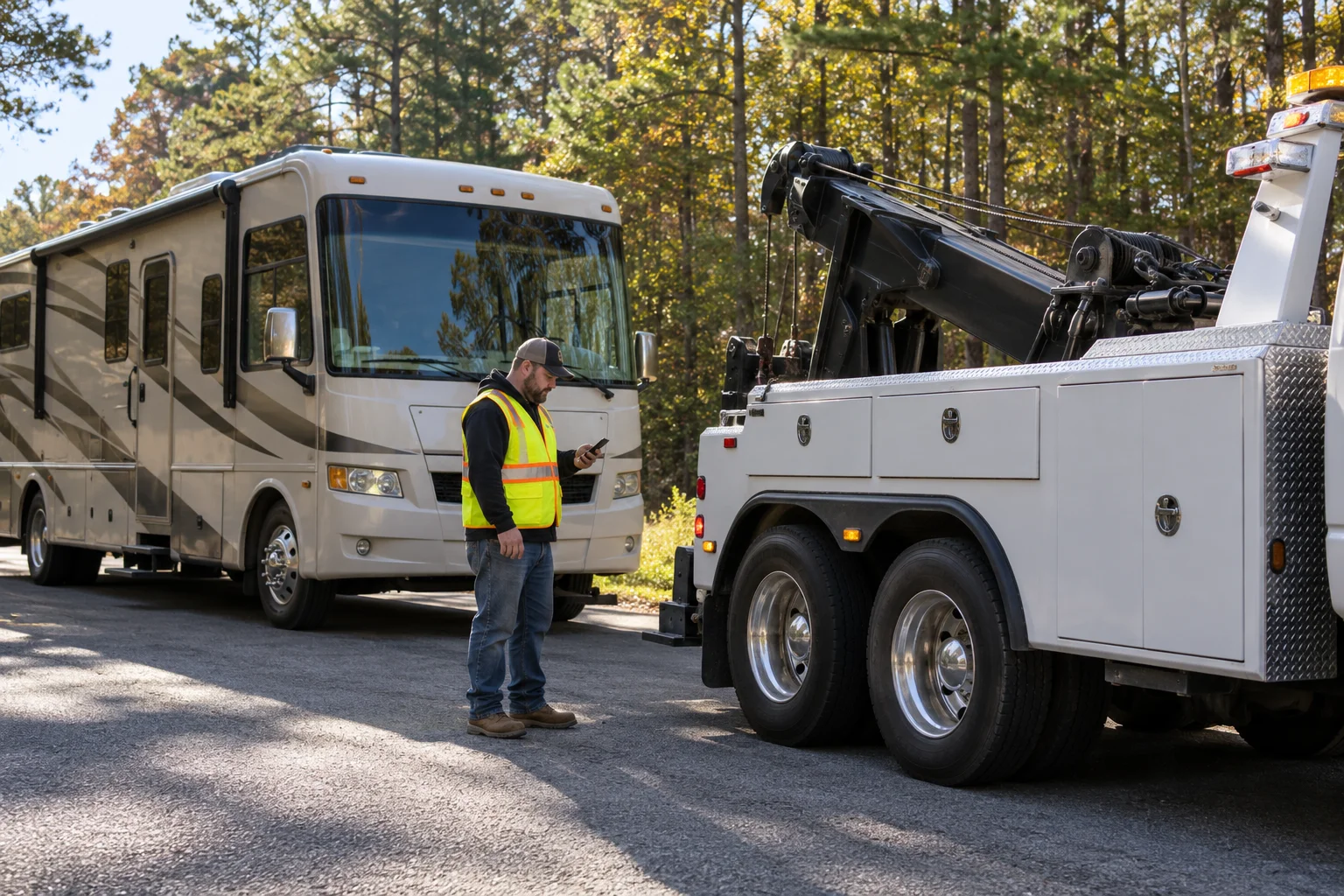
Arranging RV towing Goochland VA service starts with accurate vehicle details. Tell the referral line what stopped, whether the motorhome moves, where it sits, and where it needs to go. Quick Tow Richmond can then connect you with an independent licensed operator who contracts with and bills you directly.
A motorhome breakdown isn’t the same as a disabled passenger car. The operator needs more information before planning the pickup. A few clear notes and photos can prevent confusion when the RV is beside a road, in a driveway, or inside a storage area.
Identify the motorhome before requesting help
Start with the type of RV that needs transport. Say whether it’s a self-powered motorhome or a trailer pulled by another vehicle. This article covers self-powered motorhomes. A disabled trailer presents different questions about its hitch, tow vehicle, and running gear.
Share the manufacturer, model, model year, and approximate overall length. Use the registration, insurance paperwork, or exterior markings if you’re unsure. Don’t guess. Tell the operator which detail you couldn’t confirm.
Describe the body style in plain words. Note whether it resembles a van, has a truck-style cab, or uses a larger bus-style body. This helps the operator understand the vehicle before reviewing its specifications.
Mention anything mounted outside the basic body. Examples include bicycles, a rear carrier, a ladder, or equipment attached near the front. Report extended steps, awnings, leveling components, or slide-outs that won’t retract. Don’t try to force a stuck component solely to prepare for towing.
You should also mention how the RV is loaded. Tell the operator about passengers, pets, loose belongings, and any vehicle being carried or pulled. Ask what must be removed or secured before transport. The operator should make that decision after reviewing the motorhome and pickup conditions.
Our RV and trailer towing service page explains how the referral process works. If the RV’s size or condition changes the type of recovery needed, the request may also involve a heavy-duty towing operator. The operator, not the referral service, determines the suitable towing plan.
Describe what stopped it without diagnosing it
Report what happened in the order you noticed it. Keep the description factual. You don’t need to identify the failed part or offer a mechanical theory.
Useful observations include warning lights, unusual sounds, smoke, leaking fluid, lost power, or a failure to restart. Say whether the engine shut down while driving or wouldn’t start after parking. If the RV struck something, dropped into soft ground, or stopped after a tire problem, include that too.
Avoid turning an observation into a diagnosis. “The engine cranks but doesn’t start” is more useful than naming a failed component without confirmation. “Fluid is visible beneath the front” is clearer than guessing which system leaked.
Tell the operator what you’ve already done. That might include switching off the engine, moving belongings, or contacting a repair facility. Don’t claim the RV is ready to tow until the operator has assessed it.
The location of the breakdown also matters. State whether the motorhome occupies a travel lane, shoulder, parking area, driveway, or storage space. If it’s affecting traffic or another immediate hazard exists, contact the proper emergency authority first.
For current traffic and incident information, check 511 Virginia. Its information can help when choosing a transport route or explaining nearby closures. It doesn’t replace the operator’s assessment of the pickup.
A clear symptom report helps separate roadside assistance from transport. It also gives the operator a better picture without asking you to inspect or repair the motorhome yourself.
Explain whether the RV rolls and steers
The operator needs to know what the motorhome can still do. Start with three basic points: does it roll, steer, and brake normally?
Say whether the transmission selector moves and whether the parking brake releases. Report locked wheels, damaged tires, steering that won’t turn, or a suspension part resting unusually low. If you can’t verify something from the driver’s position, say that plainly.
Don’t test a motorhome by driving it farther after a serious warning or visible damage. You can describe its condition without proving that it moves. The operator can decide what assessment is needed at the scene.
Wheel position matters too. Tell the operator if the front wheels are turned sharply or blocked by a curb. Mention whether the RV faces toward the exit or into a confined area. Note anything directly ahead of or behind it.
If the motorhome left the pavement, explain which wheels are off the firm surface. Describe whether it’s upright and whether the ground looks soft, uneven, or sloped. A recovery from beside a road differs from a straightforward transport from pavement.
Don’t describe a motorhome as “towable” because its engine starts. Starting, rolling, steering, and braking are separate observations. Share each one you can confirm.
A non-rolling motorhome also differs from the trailer scenario covered in our guide to an RV trailer that won’t roll in Powhatan. Motorhomes combine the living space and powered vehicle in one unit. That changes the information an operator must review before moving it.
Share photos of the rural pickup access
Photos can show details that are hard to explain by phone. Take wide views of the motorhome and its surroundings when you can do so from a safe position.
Start with one photo from the front and another from the rear. Add both sides if they’re visible. Include the wheels, the surface beneath them, and the open space around the RV. Photograph visible damage or leaking fluid without making contact.
For a driveway pickup, show the entrance from the road. Include gates, trees, parked vehicles, sharp turns, narrow sections, and overhead obstructions. If the driveway changes slope, capture that from the side. Don’t estimate measurements unless you can verify them.
For a storage-area pickup, photograph the lane leading to the motorhome. Show neighboring RVs, fences, buildings, and the available turning space. Tell the operator whether someone controls access and whether a gate must be opened.
For a roadside breakdown, share a location pin when possible. Add the direction you were traveling and a nearby intersection or visible landmark. Don’t depend on a postal address alone if the RV stopped away from a building.
Mention the surface under the vehicle. Firm pavement, gravel, grass, mud, and soft shoulders create different planning questions. Report recent changes you can see, such as standing water or deep tire impressions, without predicting whether equipment can cross them.
Send current photos rather than older images of the RV. Remove readable personal documents from the frame. The goal is to show the vehicle, access path, surrounding space, and visible condition clearly enough for the operator to review.
Confirm the destination and recovery plan
Choose a destination before agreeing to transport. It may be a repair facility, storage location, campground, dealership, or another property that has agreed to receive the motorhome.
Confirm that the destination accepts the RV. Give the operator its complete address and any entrance instructions. If access depends on business hours, a gate code, or a named contact, verify those details directly with the destination.
Ask where the motorhome should be placed after arrival. “At the shop” may not be specific enough when the property has several entrances or parking areas. A clear drop location reduces decisions after the RV reaches the destination.
Discuss the entire job before agreeing. Ask the independent operator for the full total, including mileage and any recovery work. Quick Tow Richmond doesn’t set the operator’s price, and the operator bills the driver directly.
The published standard light-duty hookup fee is $105, but no signed network operator has agreed to that figure for this metro. A motorhome request may not qualify as light-duty work. Confirm the actual vehicle classification and complete price with the operator before accepting service.
Our guide to RV and motorhome towing costs in Richmond covers the questions to ask about a quote. Don’t treat Richmond’s legal ceilings for nonconsensual private-property passenger-car towing as a quote for a requested Goochland motorhome tow. They address a different towing situation.
Before transport begins, confirm who will meet the operator at pickup and destination. Ask what keys, documents, access permissions, or preparation the operator requires. If part of the plan remains uncertain, resolve it before the motorhome moves.
RV towing Goochland VA checklist
Have these details ready when requesting a referral:
- Motorhome manufacturer, model, year, and approximate length
- A plain description of what happened
- Whether it rolls, steers, and brakes
- Wheel, tire, and visible body condition
- Pickup address or location pin
- Photos of the RV and access route
- Gate, driveway, shoulder, or storage-area restrictions
- Confirmed destination and receiving instructions
- Items mounted outside the motorhome
- Passengers, pets, belongings, or another vehicle involved
Don’t hide an uncertain detail. Tell the operator what you know and what you couldn’t confirm. That’s more useful than an estimate presented as fact.
Keep the pickup and transport decisions separate. First, explain where the motorhome sits and what condition it’s in. Then confirm where it must go and what the operator needs before moving it.
Quick Tow Richmond is a referral service. It doesn’t perform towing, own recovery vehicles, or control arrival times. The independent operator reviews the request, contracts with you, chooses the towing approach, and bills you directly.
When to call us
Call when a disabled motorhome needs professional assessment and transport from a Goochland road, driveway, or storage area. Our recorded line takes calls day or night, plays a recording notice, and helps connect owners with independent licensed towing operators. Call us at (804) 701-6752.