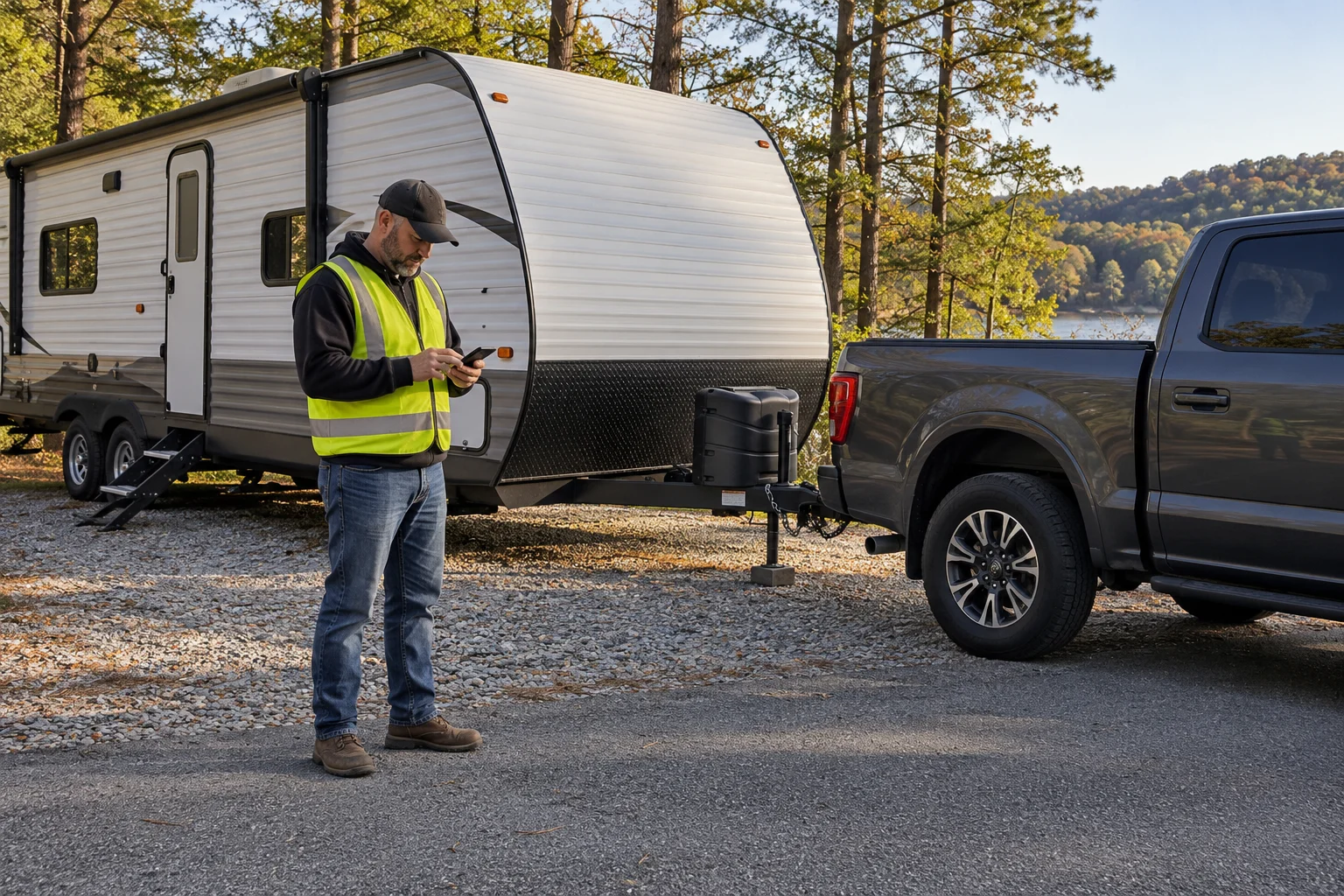
RV towing Powhatan VA requests need extra planning when a trailer won’t roll. Start by describing the trailer, the affected wheels, pickup access, and destination. Quick Tow Richmond can then refer the request to an independent towing operator for review.
A non-rolling trailer isn’t a routine roadside pickup. It may sit deep in a driveway, beside a barn, or inside a storage area. The operator needs a clear picture before accepting the job and choosing a recovery approach.
Describe the trailer for RV towing Powhatan VA
Begin with the type of RV or trailer at the property. A travel trailer, fifth wheel, motorhome, and utility trailer present different transport questions. If you aren’t sure what you own, describe its shape and how it normally connects to a tow vehicle.
Share the manufacturer and model when those details are visible. Provide the length and weight only when you can read them from reliable paperwork or the trailer itself. Don’t guess. An uncertain measurement should be identified as uncertain.
Explain whether the trailer is attached to a pickup. If it isn’t attached, say whether the hitch area is accessible. Mention any stabilizers, steps, awnings, or slide-outs that aren’t fully stored. These details help the operator understand the trailer’s current position. They aren’t a diagnosis of why it won’t move.
Describe where the trailer sits on the Powhatan property. Note whether it’s on pavement, gravel, grass, or another surface. Explain whether the area is flat, sloped, narrow, or enclosed. If the trailer is near a rural road, give the operator the exact entrance rather than relying on a mailbox description.
Our RV and trailer towing service page explains how referral requests work. Larger or unusually configured vehicles may also require review through the heavy-duty towing service. The independent operator decides whether the request matches its equipment and working plan.
Explain which wheels won’t turn
Tell the operator exactly what happened when someone tried moving the trailer. Report which wheels appeared not to turn and which ones still moved. Use left and right from the trailer’s forward-facing direction, then name the axle position if you can do so confidently.
Avoid assigning a mechanical cause. A wheel that drags, stops, or refuses to rotate doesn’t establish whether the issue involves a brake, bearing, tire, axle, or another component. The useful fact is what you observed.
Describe the last known movement. Did the trailer roll into its current position, or was it already stationary when the problem was discovered? Did every wheel stop moving, or only one side? If someone attempted to pull it, explain how far it moved before the attempt ended. Don’t repeat an uncertain distance as a measurement.
Visible conditions matter too. Tell the operator if a tire looks low, displaced, or visibly damaged. Mention loose material resting near a wheel. Report unusual sounds or smells only as observations. Don’t remove parts or present a visual guess as a confirmed failure.
This information helps distinguish a transport request from a repair question. Quick Tow Richmond doesn’t diagnose the trailer or perform repairs. We pass the details to an independent operator, who decides whether to accept the work and how to approach it.
If the concern began after hitch damage, our guide to camper trailer towing in Chester after hitch damage covers the information worth gathering. Keep this Powhatan request focused on the non-rolling wheels and present access.
Photograph the route to the trailer
Access photos often explain more than a long phone message. Start at the road entrance and photograph the route toward the trailer. Include gates, turns, trees, fences, parked vehicles, buildings, and overhead obstructions that affect the approach.
Take wide photos from several directions. A close image of one wheel won’t show whether an operator can reach the trailer. Include the full trailer and the open area around it. Photograph the front connection point, both sides, and the space behind it.
Show the driveway surface from the road to the pickup point. If the surface changes, capture each section. Photograph narrow sections with enough surrounding context to make their location clear. If a gate can open wider or another vehicle can be moved, explain that separately. Don’t change the property layout before the operator confirms what would help.
For storage areas, include the entrance and the trailer’s position within the space. State whether access requires permission, a gate code, or coordination with another person. Send the service address and any entrance instructions together. Rural addresses can cover more ground than the visible driveway suggests, so the pickup point should be unmistakable.
Photos don’t replace an operator’s assessment. They let the operator spot questions before traveling to Powhatan. Clear images also reduce the chance that a referral reaches someone without enough information to evaluate the request.
Pick a destination that can receive the trailer
Choose a destination before requesting transport. The operator needs to know where the trailer would go, not merely that it must leave the current property. Provide the complete destination address and the name of the person or business receiving it.
Confirm that the destination expects the trailer. Ask whether there is a specific entrance, parking location, or arrival procedure. If the destination is another private property, describe its access with the same care used for the pickup.
A repair facility may need details about the trailer’s condition before agreeing to receive it. A storage location may have its own access arrangements. Quick Tow Richmond can’t confirm those policies for another business, so contact the destination directly.
Distance also affects the operator’s total charge. Ask for the full total, including mileage, before agreeing to the transport. The brand doesn’t set the independent operator’s final price. For a broader discussion of quote factors, see our guide to RV and motorhome towing costs in Richmond.
If the first destination can’t accept a non-rolling trailer, identify another reachable location before dispatch. Changing destinations after the move begins can affect the route and total. Written pickup and destination addresses give everyone a consistent reference.
Don’t choose a roadside drop point simply because it’s nearby. The receiving location should be one where the owner has permission to leave the trailer and where the operator agrees the delivery can be completed.
Review the recovery plan before the request goes out
Before the referral moves forward, ask the operator to explain the proposed pickup and delivery plan. Confirm that the description, wheel observations, photos, addresses, and access notes were received. Correct any detail that changed.
Ask what must happen before the operator arrives. The answer may depend on the trailer and property. Don’t disconnect, reposition, or prepare components based on assumptions. Follow the instructions given by the operator who accepted the job.
Confirm who will meet the operator at both locations. That person should have access to the trailer and permission to authorize the requested move. If the owner won’t be present, explain the arrangement before dispatch.
Review the quote and ask whether it includes the entire planned trip. The operator contracts with and bills the customer directly. Quick Tow Richmond provides the referral and doesn’t perform towing, recovery, storage, or repair work.
Keep the plan limited to confirmed facts. A trailer that won’t roll may require a different approach than one with hitch damage or a trailer that rolls normally. The final method belongs to the independent operator reviewing the scene.
The recorded line takes calls every day, at any hour. A notice plays before messages are recorded and transcribed. Leave the pickup address, destination, trailer description, affected wheels, and a callback number. No live dispatcher answers the line, and we don’t promise a callback or arrival time.
When to call us
Call when a non-rolling trailer in Powhatan needs review by a licensed towing pro, especially when rural access or destination access may shape the job. Quick Tow Richmond will take the details through its recorded line and refer the request to an independent operator. Call us at (804) 701-6752.