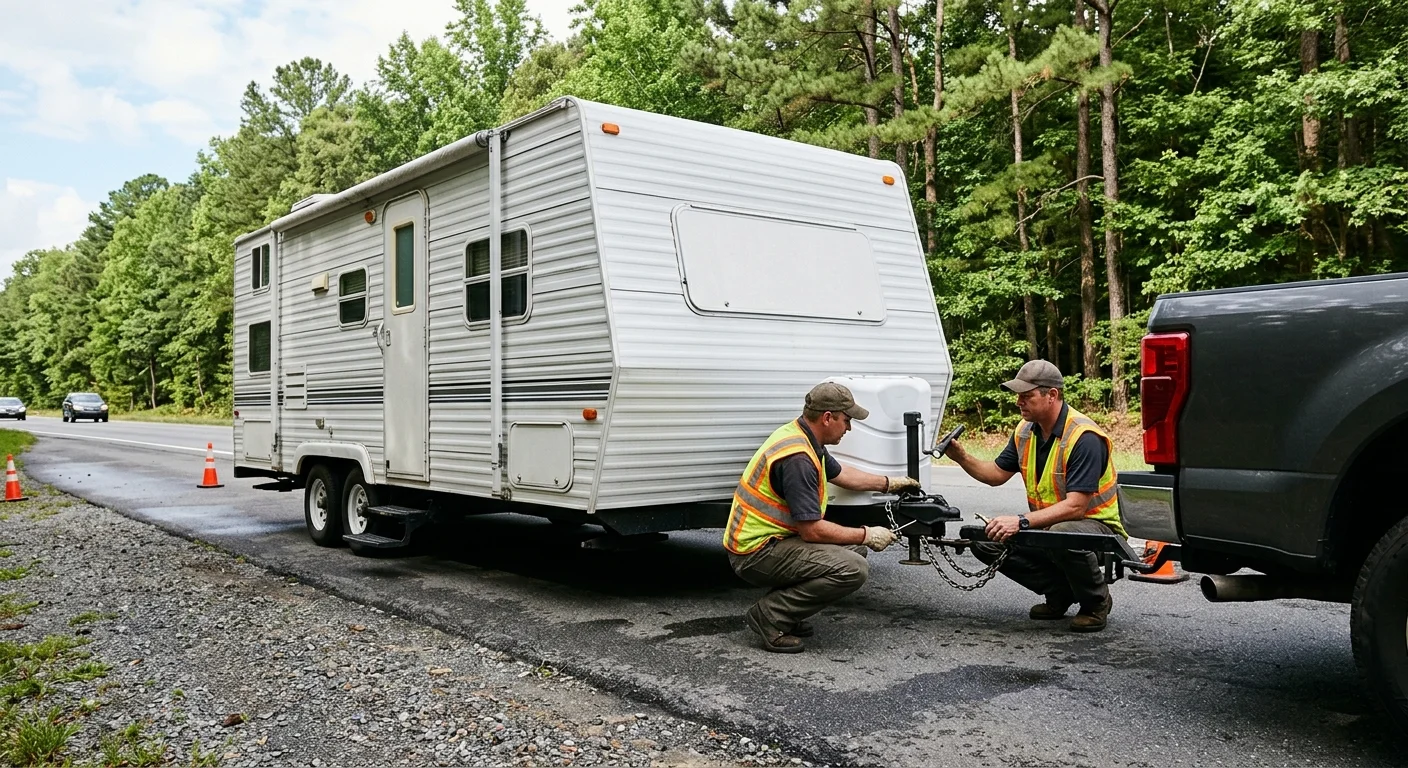
Camper trailer transport in Chester starts with clear details about the damaged connection point. Describe the hitch area, whether the trailer can roll, its location, and the planned destination. Quick Tow Richmond can then connect you with an independent licensed operator who chooses the recovery method and bills you directly.
Report the hitch and tongue condition for camper trailer transport in Chester
Start with what happened immediately before the damage appeared. The trailer may have struck the pavement, shifted while parked, or separated from its tow vehicle. Don’t diagnose the cause. A plain account gives the operator useful context without turning an observation into a mechanical conclusion.
Describe each visible part of the connection area. Useful details include:
- Whether the coupler still sits on the hitch
- Any visible bend, crack, twist, or separation
- Whether the tongue jack touches the ground
- Where the safety chains and breakaway cable are
- Whether loose parts are resting beneath the trailer
- Whether the trailer remains attached to another vehicle
Send clear photos if the operator requests them. Include a full side view and closer views of the damaged area. Take those photos without lifting, pulling, or repositioning parts. Mention anything that photographs don’t show clearly.
Location matters just as much as the damage. Say whether the trailer is on a driveway, campground pad, storage lot, parking area, or highway shoulder. Include the nearest entrance or landmark instead of relying on a broad Chester address.
If you’re stopped along I-95 near Route 10, check 511 Virginia for current incidents. VDOT’s Safety Service Patrol covers I-95 in the Richmond region. The patrol provides free roadside incident help, but it isn’t a towing company. It can help a stranded driver arrange a tow.
Explain whether the trailer can roll
The operator needs to know whether the trailer appears able to roll. That answer affects how the trailer can be approached, positioned, and moved. Report what you can see without testing damaged equipment.
Look at each tire and wheel from a standing position. Note any flat tire, missing wheel, unusual wheel angle, or contact between a tire and the trailer body. Say whether an axle area appears lower on one side. Report visible debris beneath the trailer as well.
Don’t force a wheel to turn or pull the trailer to test it. Instead, explain its last known condition. If it rolled normally before the hitch incident, say so. If a wheel locked, dragged, or made noise beforehand, include that detail. Be clear when you simply don’t know.
Tell the operator whether the parking brake or wheel chocks are in use. Mention stabilizers, leveling blocks, or other items currently touching the ground. These details help the operator understand the trailer’s present position before arriving.
Have the trailer’s paperwork nearby when possible. Share the manufacturer, model, and listed dimensions from the documents or manufacturer label. Don’t guess its weight or towing requirements. The operator can use confirmed information when selecting a recovery approach.
Our RV and trailer towing service page explains how Quick Tow connects trailer owners with independent operators. The operator, not Quick Tow, decides what equipment the job requires.
Share the trailer type and pickup access
“Camper trailer” can describe several layouts. Tell the operator whether yours is a travel trailer, fifth-wheel, pop-up camper, teardrop, or another configuration. Describe the damaged connection in ordinary words. Don’t assume two trailers need the same pickup plan because their bodies look similar.
Mention any slide-outs, steps, awnings, or exterior storage doors that aren’t in their normal travel position. Say whether anything is loose along the sides or roofline. The operator can explain what must happen before movement begins.
Next, describe access to the pickup point. Useful observations include:
- Whether the trailer is parked nose-in or backed into place
- The surface beneath it, such as pavement, gravel, or soil
- Any slope near the trailer
- The width and shape of the entrance
- Parked vehicles near the approach
- Gates, low branches, walls, or tight turns
- Space available beyond the trailer for positioning
For a storage property or campground, confirm how the operator enters. Share the gate instructions and identify anyone who controls access. If the trailer sits on private property that isn’t yours, make sure the appropriate person knows an operator is coming.
Some trailer configurations may require a different class of recovery vehicle. Don’t choose that equipment from a photo or online description. Give the operator accurate dimensions and let that operator decide. Our heavy-duty towing page provides more context when a larger vehicle or trailer needs transport.
Choose the destination before dispatch
Choose the receiving location before requesting movement. It might be a trailer repair business, storage property, campground, or another location you control. The right destination depends on what that location can accept, not only what’s nearby.
Contact the destination first. Confirm that it accepts your trailer type and can receive a trailer with hitch-area damage. Ask where the operator should enter and where the trailer should be placed. A street address alone may lead to the wrong gate or an unsuitable unloading area.
Tell the receiving location about the visible condition. Mention whether the trailer rolls, whether its tongue rests low, and whether loose parts remain attached. Ask what access instructions the towing operator will need.
A Chester pickup and a destination elsewhere in Chesterfield County may require different routing than a trip into Richmond. Share both complete addresses when requesting service. The operator can then consider the full movement instead of only the pickup.
Ask the operator for the complete quoted total, including mileage, before agreeing. Quick Tow doesn’t set the operator’s price. The independent operator contracts with you and bills you directly.
For a camper that has a normal connection but another breakdown problem, see our Colonial Heights camper breakdown guide. For broader budgeting questions, read our guide to RV and motorhome towing costs in Richmond.
Confirm the operator’s recovery plan
Before dispatch, repeat the main facts in one short summary. State the trailer type, visible hitch damage, rolling condition, pickup access, and destination. This final review can uncover a missing detail before the operator travels to the site.
Ask how the operator plans to approach, secure, move, and unload the trailer. You don’t need to prescribe a truck or loading method. You do need to understand whether the plan accounts for the damaged connection point.
Confirm what the operator needs from you. That may include keys, registration details, property access, or contact information for the destination. Ask whether you must remain at the pickup point and who needs to meet the operator at delivery.
If the trailer remains connected to another vehicle, state that clearly. Don’t disconnect, lift, or reposition damaged components unless the operator gives instructions for the specific situation. Report any change in the trailer’s position while you wait.
Review the price directly with the operator. Ask whether the quoted total includes the full trip mileage and the planned unloading location. If the destination changes, request an updated total before authorizing a different trip.
Quick Tow Richmond’s recorded line takes calls 24/7. A recording notice plays before your message is recorded and transcribed. Leave your name, callback number, location, trailer type, and a short description of the hitch damage. The line doesn’t connect you with a live dispatcher or promise a callback time.
Frequently asked questions
Can I tow the camper with another passenger vehicle?
Don’t make that decision from a roadside guess. Describe the damaged hitch area to the towing operator. Ask how the trailer can be moved without depending on the damaged connection.
What if I don’t know whether the trailer can roll?
Say that you don’t know. Report each tire’s visible condition and anything touching the ground. The operator can decide what other information is needed before dispatch.
Who decides which towing equipment is used?
The independent licensed operator makes that decision from the trailer details, damage description, access, and destination. Quick Tow Richmond provides the referral and doesn’t perform the recovery.
When to call us
Visible hitch or tongue damage calls for a licensed towing pro when the camper must leave its current location. Quick Tow Richmond connects you with an independent operator, and the recorded line takes calls 24/7. Call us at (804) 701-6752.