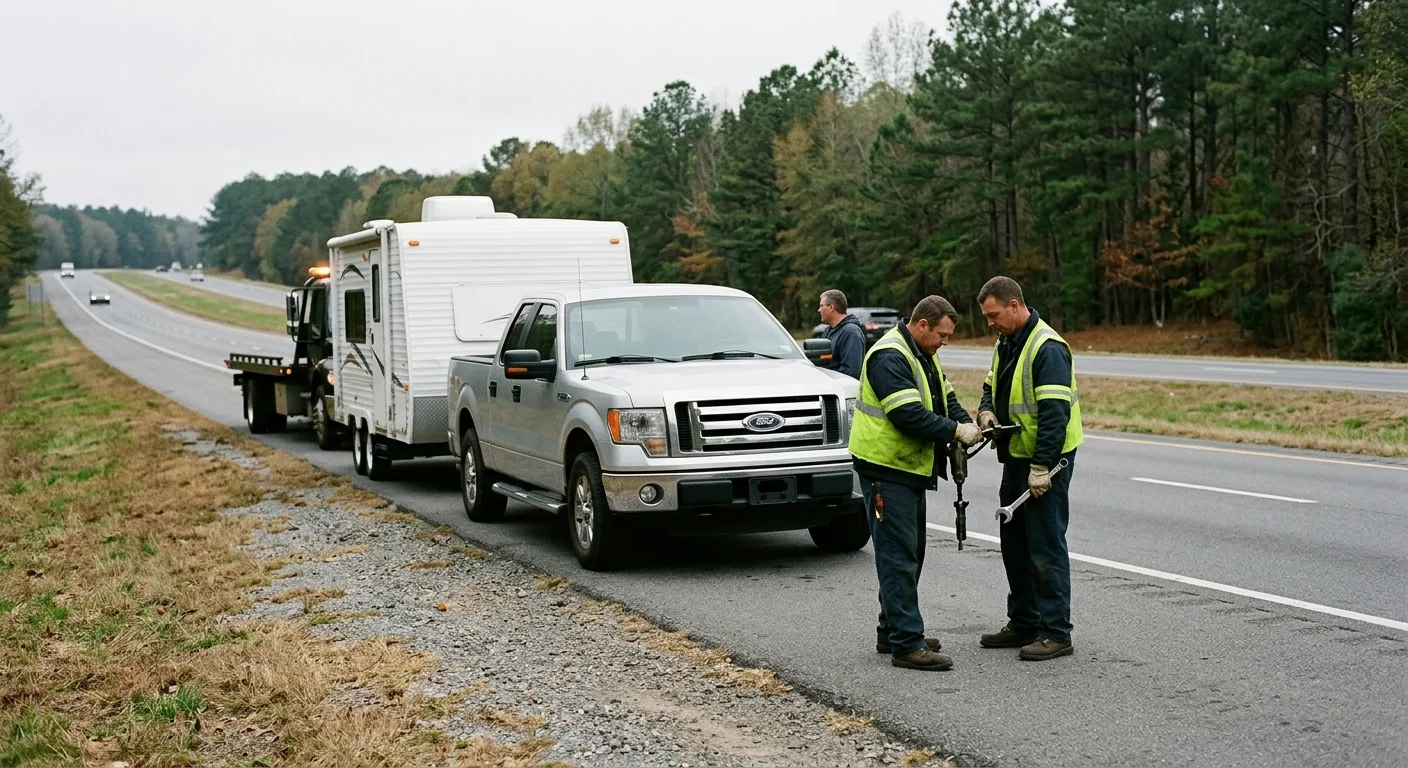
A breakdown can turn an RV trip into an urgent need for camper trailer transport in Colonial Heights. Move yourself away from traffic first. Then report the trailer type, visible damage, wheel condition, exact location, and intended destination.
Move yourself away from traffic first
Your first concern isn’t the trailer. It’s getting everyone away from moving vehicles.
If you’re already outside a travel lane, stay clear of traffic. Don’t step back toward the roadway to inspect a wheel or hitch. Avoid crawling beneath the camper or trying roadside repairs where drivers pass nearby.
A disabled pickup and camper can occupy more room than a passenger car. Describe whether the entire combination is off the road. Mention if any part of the trailer remains close to a travel lane, intersection, or driveway.
Use landmarks that an operator can identify without guesswork. On I-95, note your direction of travel and the last exit you passed. In Colonial Heights, a business name or cross street can help distinguish the interstate from the Boulevard corridor. Share your live map location when possible.
Check 511 Virginia for current incidents and road conditions. If you’re on I-95, VDOT’s Safety Service Patrol provides free roadside assistance and scene support. It isn’t a towing company, but it can help a stranded driver arrange a tow.
Our guide for a breakdown on I-95 near Richmond covers the information worth gathering before you request help. Don’t delay leaving an exposed position just to collect every detail. Your location and immediate traffic risk come first.
Tell the operator what you’re towing
“Camper” can describe several different trailers. Tell the operator whether yours is a travel trailer, fifth-wheel, pop-up camper, or toy hauler. Also explain whether it remains connected to the pickup.
Give the make and model if you have them. Use the identification plate or registration for exact information. Don’t guess about weight, length, or towing capacity.
The operator also needs a clear description of the breakdown. Say whether the problem appears to involve the pickup, camper, hitch, jack, wheel, tire, axle area, or body. Report anything dragging, leaning, detached, or sitting unusually low.
Mention these details before dispatch:
- Whether the pickup still runs
- Whether the trailer can roll
- Which wheels look damaged or blocked
- Whether the hitch remains connected
- Whether stabilizers or steps are extended
- Whether the camper is loaded
- Whether loose parts or cargo are present
- Whether there’s enough room beside the trailer to work
Photos can help an operator evaluate the situation. Take them only from a place away from traffic. Useful views include the full roadside position, hitch connection, affected wheel, and visible damage.
Quick Tow Richmond connects callers with independent licensed operators. The operator decides which transport method fits the actual condition. Our RV and trailer towing service explains how the referral process works for disabled campers around the Richmond metro.
Why trailer condition changes the equipment
A camper that rolls normally presents a different job from one with a damaged wheel area. The same applies when the hitch is bent, the frame is low, or part of the trailer is dragging.
Don’t describe the problem as “just a flat” unless that’s been confirmed. A wheel that looks flat from a distance may have other visible damage nearby. Tell the operator what you can see without diagnosing the cause.
Wheel condition matters because the trailer may not be ready to roll. Report whether every wheel is present and upright. Note any tire pressed against the body, loose material, or wheel sitting at an unusual angle.
Hitch condition matters too. Say whether the coupler or fifth-wheel connection remains seated. Mention visible twisting, separation, or damage around the tongue. Don’t disconnect a damaged combination unless a qualified operator directs the process on scene.
The trailer’s position adds another layer. A camper sitting level on pavement differs from one leaning into soft ground or resting near a ditch. Explain the surface and surrounding space. Include barriers, curbs, guardrails, low branches, and narrow entrances.
These details help the operator prepare for the camper’s current condition. They also reduce the chance that important information surfaces only after arrival. The final equipment choice belongs to the operator evaluating the trailer, access, and destination.
If both the pickup and camper are disabled, say that clearly. Moving one vehicle may not resolve the entire roadside problem.
Routes that shape camper trailer transport in Colonial Heights
The I-95 corridor runs through Colonial Heights between Chester and Petersburg. That creates a different recovery setting from a camper stopped on a local street.
On I-95, direction matters. “Near Colonial Heights” isn’t specific enough for dispatch. State whether you’re traveling north toward Chester or south toward Petersburg. Give the nearest exit, mile marker, or visible landmark when available.
The Boulevard carries local traffic through Colonial Heights and connects with US 1 and US 301. A camper stopped there may be near turning traffic, commercial entrances, or closely spaced intersections. Describe the nearest cross street and which side of the road you’re on.
Chester sits north in Chesterfield County, while Petersburg lies south of Colonial Heights. Don’t use “Richmond” as the location if you’re actually in the Tri-Cities area. Naming the correct city or county helps the referral line understand the pickup point.
Route choice also depends on the trailer’s condition and destination. An operator may need to consider roadway access, turns, clearances, and the space available at both ends. Share any known gate, driveway, or parking restrictions before the move begins.
For a destination outside the Tri-Cities area, review our long-distance towing service. Mileage can affect the operator’s total, so compare the proposed destination with closer suitable options. Ask for the full total, including mileage, before agreeing to the transport.
Choose the destination before dispatch
Decide where the camper should go before an operator starts toward you. That choice can change the route, mileage, and type of access needed at delivery.
A repair shop isn’t automatically prepared to receive every camper trailer. Call first. Ask whether it accepts your trailer type and the visible problem you described. Confirm where the operator should enter and leave the camper.
The same check applies to an RV dealer, campground, storage property, or private address. Make sure someone can authorize entry. Ask whether there’s enough space for the towing vehicle and trailer to turn or unload.
If the breakdown involves both the pickup and camper, decide whether they’re going to the same place. The pickup may need automotive service while the camper needs a different destination. Tell the operator before accepting the job.
For a longer move, gather the complete destination address and contact name. Share gate instructions without including private access codes in public messages. If the destination can’t accept the camper, choose another location before dispatch.
Cost depends on the actual job. Mileage, trailer condition, roadside position, access, and destination can all affect the operator’s total. Quick Tow Richmond doesn’t set that total. Independent operators contract with and bill drivers directly.
Ask what the quoted amount covers. Confirm that mileage is included and explain every known complication. Our guide to long-distance towing prices in Richmond outlines the questions to ask without treating any figure as a guaranteed price.
A confirmed destination keeps the conversation focused. It also gives the operator both ends of the move before evaluating the request.
When to call us
This kind of move needs a licensed towing pro when the camper can’t roll normally, the connection is damaged, or its condition makes the transport method uncertain. Quick Tow Richmond is a referral service, and our recorded line is available 24/7 with a recording notice before your message. Call us at (804) 701-6752.