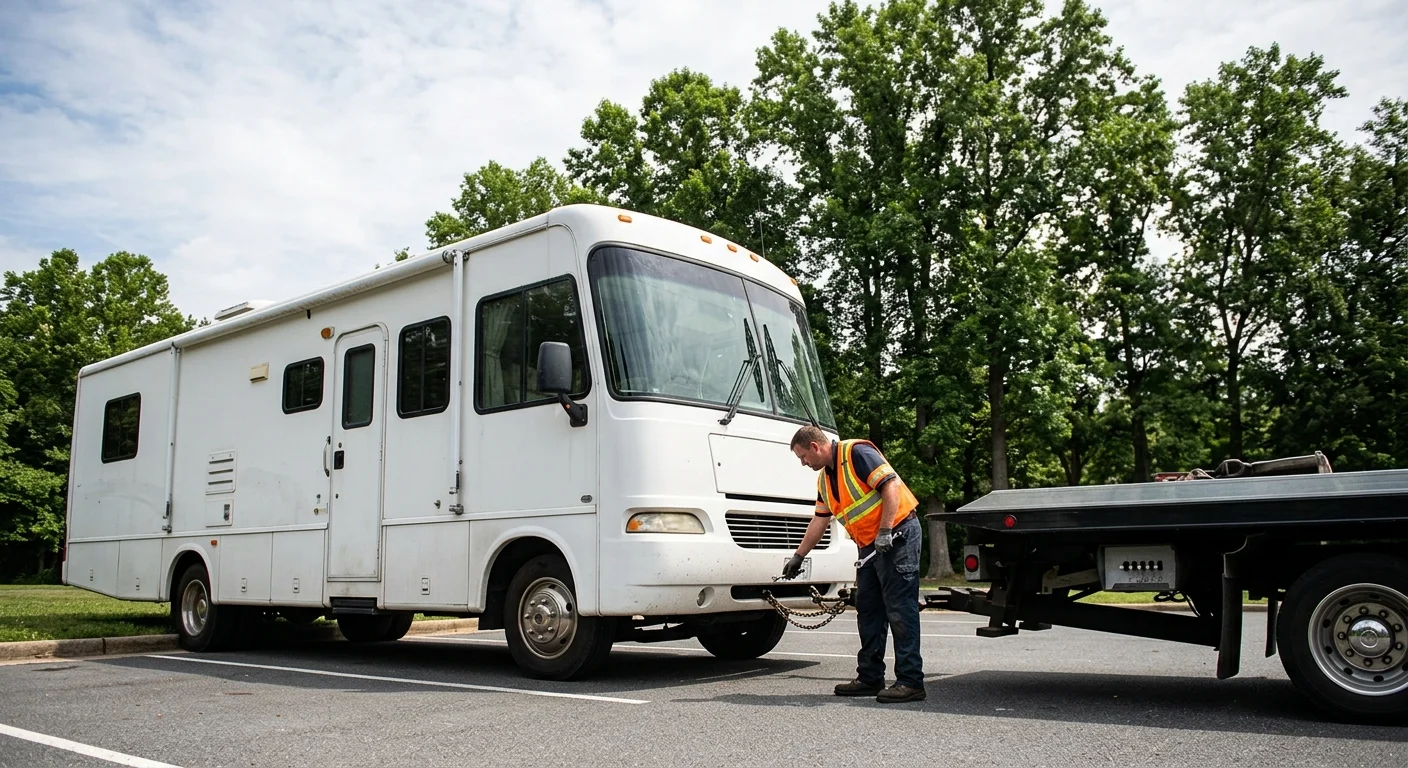
The RV towing cost in Richmond can’t be reduced to one verified citywide rate. The total depends on the vehicle, its condition, distance, access, timing, and the independent operator accepting the job.
Quick Tow Richmond is a referral service, not the towing contractor. We match drivers with independent licensed operators. The operator contracts with you, sets the quote, and bills you directly.
Why an RV towing cost quote needs more details
A useful quote starts with the exact type of RV. “Camper” isn’t enough information for an operator to assess the move. The vehicle may be a motorhome, a travel trailer, or another large trailer.
Start with the year, make, model, and approximate length. Tell the operator whether the RV is motorized. Explain whether it starts, rolls, steers, and can shift into neutral. Report damaged tires, locked brakes, steering trouble, or visible collision damage.
Location matters too. A motorhome sitting in an open paved lot presents a different access picture than one beside a house. A trailer deep inside a campground loop may require more planning. Low clearance and tight turns can also affect the operator’s approach.
The destination completes the basic quote. Give the exact pickup and drop-off locations. Say whether the destination is a repair shop, storage site, campground, or private property. Confirm that the operator can enter both locations.
Our RV and trailer towing service page explains how to request a match. If the vehicle’s size or condition falls outside ordinary towing work, the request may need a heavy-duty towing operator.
Class A, Class C, and travel trailer requests
A Class A or Class C motorhome is a motorized vehicle. A travel trailer depends on a separate tow vehicle. That difference changes the information an operator needs before accepting the job.
For a motorhome, describe the starting and rolling condition clearly. Mention any damage around the wheels, steering, suspension, or hitch area. Don’t diagnose the problem if you aren’t sure. Photos and an accurate description help the operator assess the request.
For a travel trailer, say whether a tow vehicle remains attached. If it isn’t attached, tell the operator that immediately. Share the trailer identification and any information available from its documentation. The operator must confirm whether the proposed truck and towing setup fit that trailer.
Don’t assume that equipment suitable for a passenger car will suit an RV. Quick Tow Richmond doesn’t select the towing method or equipment. That decision belongs to the independent operator handling the job.
A large vehicle may also fall into a different service category than its name suggests. Let the operator classify it after reviewing the details. That keeps the conversation focused on the actual vehicle, not a broad label that could hide important differences.
Cost drivers you can control
Distance is one part of the quote, but it isn’t the only part. Ask for the full total with mileage included before agreeing to the job. Also ask which conditions could change that total.
You can reduce uncertainty by giving complete information before dispatch. Send the correct pickup pin and destination address. Identify gate codes, restricted entrances, narrow approaches, or low clearance. Tell the operator if the RV can’t roll, steer, or shift as expected.
Timing can affect a quote too. Ask the operator whether the requested pickup time changes any charge. Don’t assume a daytime and nighttime move will be priced the same.
Published private-property towing ceilings aren’t a reliable quote for a consensual RV move. Richmond caps the initial nonconsent hookup fee at $195 for vehicles under 10,000 pounds. Virginia’s statewide towing-fee statute sets a $210 ceiling for the hookup and initial towing of a passenger car. Those figures don’t establish a universal motorhome or trailer transport rate.
For a broader look at ordinary vehicle pricing, read how much a tow costs in Richmond. Longer moves have their own planning questions, covered in our guide to long-distance towing prices in Richmond.
Richmond access problems that can affect the quote
Richmond-area RV moves can begin in very different settings. The city, Henrico, Chesterfield, and the Tri-Cities don’t share one road pattern. Give the operator both jurisdictions and complete addresses.
An interstate pickup needs different planning from a campground or driveway pickup. Richmond’s I-95 and I-64 overlap runs through the city from the Bryan Park interchange toward the James River. I-295 also carries traffic around much of the metro. If the RV is beside one of these routes, provide the direction of travel and the nearest confirmed exit.
VDOT’s Safety Service Patrol covers I-95, I-64, and I-295 in the Richmond area. Its roadside help is free, but it doesn’t act as a tow company or make mechanical repairs. It can help move a disabled vehicle away from danger and help the driver arrange towing.
At a campground, describe the loop, site position, gate, and available turning room. At a house, mention tight residential turns, parked vehicles, trees, or overhead clearance. Do the same for the destination. Access at the repair shop or storage property matters just as much as access at pickup.
Never guess about clearance. Ask the property manager when you can’t confirm it. Then pass the answer to the operator before dispatch.
Why the full operator quote comes first
A public rate chart can’t account for every motorhome or large trailer. No verified single Richmond RV rate could be confirmed for this page. The independent operator sets the price after reviewing the job.
Before accepting, ask the operator to state the full quoted total. Confirm that mileage is included. Ask whether loading, recovery work, waiting, tolls, storage, or difficult access could add charges. If a part of the quote isn’t clear, request an explanation before the truck rolls.
Quick Tow Richmond doesn’t set the operator’s total. It also doesn’t own the truck, perform the tow, or collect the operator’s bill. Its role is to take your information and seek a match with an independent licensed operator.
Accuracy matters more than guessing low. A vague request can leave the operator without details needed to assess the job. A good request includes the RV type, condition, pickup, destination, access notes, and desired pickup time.
Keep the quote and any written messages. At payment, ask for an itemized receipt. Virginia towing operators must maintain towing records, including itemized fees, for one year. Richmond also requires an itemized receipt for covered private-property tows.
RV and motorhome towing cost FAQ
Can an RV be towed with belongings inside?
There isn’t one confirmed Virginia rule in the approved record that answers this for every RV move. Tell the operator what’s inside before accepting the quote. Ask what must be removed and whether the remaining load affects acceptance of the job.
Remove valuables, medication, identification, and anything you may need immediately. Don’t assume you’ll have access while the RV is being moved or held at another property. Confirm access directly with the destination.
Does a dead RV cost more to tow?
A dead RV may change the operator’s loading and recovery plan. That can change the quoted total, but no universal Richmond price difference could be confirmed.
Describe exactly what still works. Tell the operator whether the engine starts and whether the RV rolls, steers, or shifts into neutral. Mention visible damage and the surface beneath the vehicle. The operator can then explain how those conditions affect its quote.
What if a trailer has no tow vehicle?
Tell the operator that the trailer is detached and has no tow vehicle available. Provide its identifying details, condition, pickup location, and destination. The operator must decide whether it can accept the move and what towing setup it proposes.
Don’t attach unfamiliar equipment or move the trailer just to simplify the request. If it’s blocking traffic or sitting in an unsafe position, share that condition when requesting help.
When to call us
Call when a disabled motorhome, detached large trailer, or difficult access point needs assessment by a licensed towing pro. Our recorded line takes calls 24/7, and a notice plays before your message is recorded. Call us at (804) 701-6752.