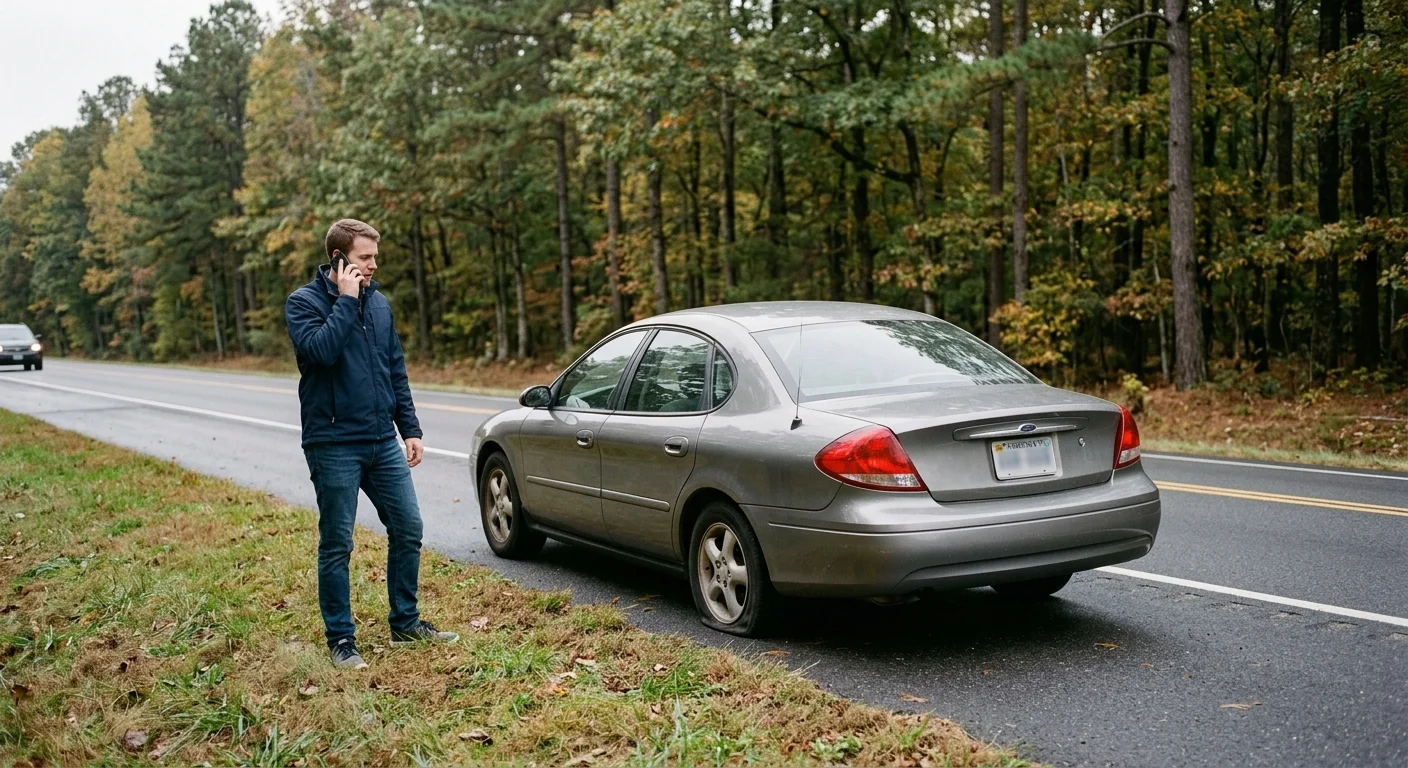
The choice between roadside assistance for flat tire or tow depends on whether a tire change can make the car safely movable. Choose tire help when the car is stable, accessible, and has a usable spare. Choose a tow when there’s visible damage, no suitable spare, or an unsafe place to work.
You don’t need to diagnose the problem yourself. Describe what happened, where the car stopped, and what you can see. The operator can then decide what equipment the job may require.
Start safely when choosing roadside assistance for flat tire or tow
Your location matters before the condition of the tire. A flat in a quiet parking area presents a different situation from one beside I-95. First, identify whether the car is fully outside moving traffic.
If the vehicle remains in a travel lane, contact emergency services. Don’t attempt a tire change while traffic passes beside the car. Use your hazard lights so approaching drivers can see the stopped vehicle.
A shoulder isn’t always a workable repair area. It may be narrow, soft, sloped, or exposed to traffic. Tell the roadside provider about those conditions before anyone is dispatched. The provider may decide that moving the vehicle is the safer option.
Richmond’s downtown interstate network can make location descriptions confusing. I-95 and I-64 overlap through the city, from the Bryan Park interchange toward the James River. Give the route, direction, nearest exit, and any visible marker. “I-95 south near Bryan Park” is more useful than “near downtown.”
On a local road or in a parking lot, share the entrance you used. Include the business name or nearby intersection when available. In Henrico or Chesterfield, name the county too. Similar road names can appear in different parts of the metro.
Once the location is clear, focus on the car. Report the flat tire without guessing what caused it. That gives the operator a cleaner picture of the actual request.
When roadside tire help may fit
Roadside assistance may fit when the problem appears limited to one tire. The car should be on firm, level ground with enough space around the affected wheel. You’ll also need to tell the provider whether a spare is present.
Don’t assume the spare is ready. Check whether it’s in the vehicle and whether you can access it. Some drivers find an empty compartment, a repair kit, or a spare they’re unsure about. Simply report what you see.
Ask whether the dispatched operator can install that specific spare. Give the vehicle’s year, make, and model. Mention if the flat is on the traffic-facing side or blocked by a curb. Those details help the provider evaluate the work before dispatch.
Roadside help can still be the right first call when you’re uncertain. Explain that you have a flat but don’t know whether the wheel was damaged. Avoid driving the car merely to test it. The operator can assess the situation at the scene without relying on your diagnosis.
Cost depends on the service requested, the location, mileage, and whether towing becomes necessary. Ask for the full expected total, including mileage, before agreeing. For more planning guidance, read our guide to lower-cost roadside assistance in Richmond.
If a tire change restores normal movement and no other concern appears, a tow may be unnecessary. If the operator sees a reason not to continue, the request can shift to towing.
When vehicle damage changes the call
A flat tire isn’t always the only visible problem. The tire may be shredded, the wheel may sit at an unusual angle, or the car may lean toward one corner. You might also notice that the vehicle struck a pothole, curb, or road debris before stopping.
These signs aren’t a diagnosis. They’re reasons to describe the situation carefully and avoid testing the car in traffic. Tell the provider what you saw and felt before stopping. Mention any impact, scraping sound, steering change, or dashboard warning.
A tow may also make more sense when two tires are flat. The same applies when there’s no usable spare or the wheel area isn’t safely accessible. If the car can’t roll normally, tell the provider before equipment is sent.
Request emergency towing when a tire change alone won’t return the vehicle to usable condition. The independent operator can determine how to load or move the car after seeing it. Quick Tow Richmond doesn’t perform that inspection or towing work itself.
Don’t choose a towing method based only on a photo or a guess. Vehicle position, wheel condition, clearance, and access can affect the operator’s decision. Accurate details are more useful than naming equipment yourself.
Before approving a tow, confirm the destination. You may choose a repair shop, dealership, or another lawful drop-off point. Also ask for the full total with mileage included. The independent operator contracts with you and bills you directly.
What to report before dispatch
Start with the exact location. On an interstate, give the route, travel direction, nearest exit, and mile marker when visible. On a county road, provide the nearest intersection or recognizable entrance. Share a phone location pin if the provider can receive one.
Next, identify the vehicle. Give its year, make, model, color, and approximate position. Say whether it’s in a parking space, a paved pull-off, a shoulder, or a travel lane. Mention nearby barriers, curbs, ditches, or tight entrances.
Describe the tire in plain language. Say which corner is flat and whether the tire still appears attached to the wheel. Report visible wheel damage without naming a mechanical failure. If the car was involved in a collision, say so immediately.
Tell the provider what’s inside the vehicle. Confirm whether you have a spare, repair kit, wheel-lock key, or none of those items. Don’t promise that a spare fits or works if you haven’t confirmed it.
Also report anything that may change access. That includes passengers, pets, a loaded trunk, a trailer, or a vehicle parked inside a garage. If another vehicle blocks the car, include that detail before dispatch.
Quick Tow Richmond matches callers with independent licensed tow operators. The operator decides what work it can accept, then contracts with and bills the driver directly. The brand doesn’t own the responding truck or set the operator’s total price.
Clear information can prevent a roadside request from being sent as the wrong job type. It also gives the operator a chance to explain whether tire help or towing better fits the scene.
How interstate and local-road help differ
Richmond drivers have an extra assistance layer on major interstates. The free VDOT Safety Service Patrol covers Richmond-area portions of I-95, I-64, and I-295.
The patrol can help with tire changes, fuel delivery, jump starts, radiator water, directions, and arrangements for a tow. It also helps manage disabled-vehicle scenes. However, it doesn’t perform mechanical repairs or operate as a tow company.
Safety Service Patrol is a roaming highway service, not a private call-out provider. Coverage can depend on the route and time. VDOT also operates an overnight I-95 route between the I-295 interchange in Hanover County and Route 10 in Chester.
Check 511 Virginia for current traffic, road conditions, and reported incidents. That information can help you describe congestion or a closure near your location. It doesn’t replace a roadside or towing request.
A local road in Richmond, Henrico, or Chesterfield usually lacks that interstate patrol layer. You’ll need to arrange roadside help or towing directly. Give the county or city because the Richmond metro crosses several jurisdictions.
Interstate locations also demand more precise directions. “Near Richmond” covers too much roadway. A route, direction, exit, and marker help distinguish I-95 north from the shared I-95 and I-64 segment downtown.
For a flat on I-95, our Richmond interstate breakdown guide explains what information to gather. If you’re already in a safe parking area, focus instead on the tire, spare, access, and repair destination.
When to call us
Call when a tire change may not restore normal movement, or the wheel area shows possible damage. Quick Tow Richmond can match you with an independent licensed operator, who contracts with and bills you directly through our recorded line. Call us at (804) 701-6752.