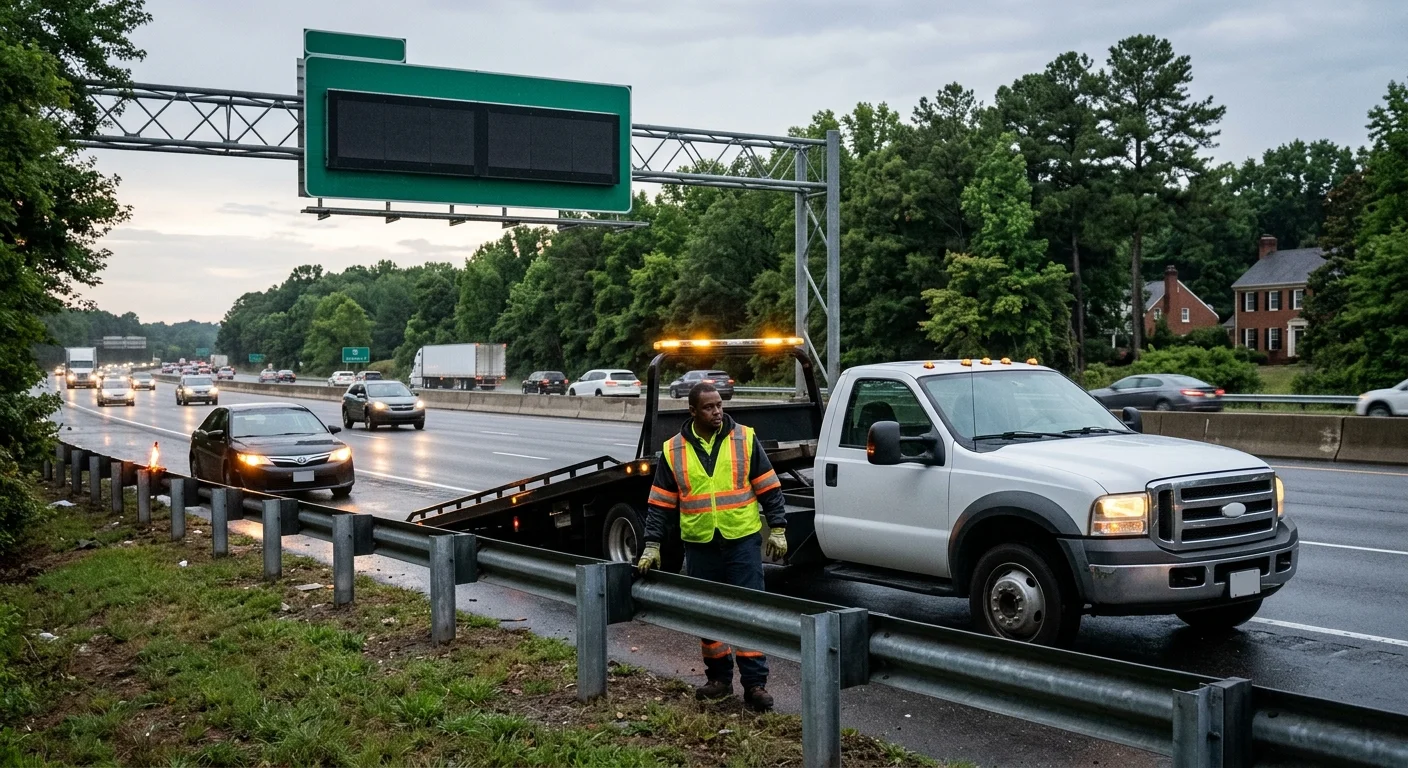
The lowest-cost option may already be patrolling the interstate. If you need cheap roadside assistance in richmond, start with VDOT’s free Safety Service Patrol on covered highways. When that service can’t solve the problem, compare paid help by the full expected total, not one attractive starting number.
Your location matters. The free layer covers major Richmond interstate corridors. It doesn’t follow you onto every county road, neighborhood street, or parking lot. Knowing that boundary can save time while you’re deciding what to do next.
Cheap roadside assistance in Richmond starts with VDOT’s free layer
The VDOT Safety Service Patrol provides free roadside assistance and incident management. Its statewide coverage spans roughly 1,079 interstate miles, including I-95, I-64, I-81, I-85, and I-66.
In the Richmond area, coverage includes I-95, I-64, and I-295. That puts the patrol on the region’s busiest interstate routes. It’s especially relevant through the I-95 and I-64 overlap downtown. A VDOT study calls that overlap one of the region’s highest-crash, heavily congested corridors.
The patrol can change a tire, deliver fuel, or provide a jump start. It can also bring radiator water, give directions, or offer a phone or ride so you can arrange a tow. Its crews handle scene control, debris removal, and temporary traffic direction too.
The published daytime schedule runs from 5:00 a.m. through 9:00 p.m. An overnight route operates from 9:00 p.m. through 5:00 a.m. on I-95. That route runs between the I-295 interchange at mile 84 in Hanover County and Route 10 at mile 61 in Chester. VDOT’s Richmond District also describes the patrol as operating around the clock, every day, on its core Richmond routes.
Check 511 Virginia for official traffic and incident information. If a dead battery is the immediate problem, our jump-start guide explains the paid-help option when the free patrol isn’t available.
What the patrol will not do for you
Safety Service Patrol isn’t a repair shop or towing company. It won’t perform mechanical repairs. Its role is to move a disabled vehicle toward safety and help the driver arrange a tow when needed.
That distinction matters after a breakdown near downtown Richmond. A jump start or tire change may get you moving. An engine, transmission, steering, or collision problem may leave the vehicle unable to continue. At that point, you’ll need to arrange service with an independent towing operator.
Location can also end the free option. The patrol covers I-95, I-64, and I-295 around Richmond. It doesn’t extend across every road toward Powhatan or Goochland. The same issue applies after you leave the interstate for a neighborhood, business lot, or rural shoulder.
The I-295 belt around Henrico and Chesterfield can put you within patrol territory. A nearby county road may not. Give any roadside service your exact location, direction of travel, and nearest visible landmark. Don’t describe yourself as merely “near Richmond” when you can identify the actual corridor.
Safety comes first on an interstate shoulder. Stay away from moving traffic and don’t attempt work that puts you in a live lane. Our guide for drivers who have broken down on I-95 in Richmond covers the local corridor in more detail.
For problems beyond the patrol’s role, review the available roadside assistance options. Quick Tow Richmond matches callers with independent licensed operators. Those operators contract with and bill drivers directly.
Where the free layer stops and you are paying
Paid help begins when the free patrol isn’t present or can’t complete the needed service. That may happen off the covered interstate network. It may also happen when the vehicle needs towing instead of a basic roadside task.
Start by identifying the service you actually need. A jump start differs from a tow. A tire change differs from moving a damaged vehicle. The operator also needs to know the vehicle type, its condition, its location, and the requested destination.
Those details shape the bill. Ask for the full expected total, including mileage, before agreeing. Confirm whether the number covers only the hookup or the complete trip. If the destination changes, ask how that affects the total.
Quick Tow Richmond publishes a $105 standard light-duty hookup rate. That figure isn’t a total, quote, or cap. The independent operator bills the driver directly and sets the full total.
Don’t confuse that published rate with Richmond’s legal ceilings for nonconsensual private-property towing. Those rules cover a different situation, where a vehicle is removed without the owner’s permission. A tow requested after your own breakdown is a consensual service.
The practical comparison is the complete job you’re authorizing. A low opening figure tells you little if mileage and other job details remain unclear. State your destination before the vehicle is moved. Then repeat the full total you were given and ask what could change it.
If you don’t have a roadside club, start with our guide to getting roadside help without AAA. It explains the direct-call route without assuming you already have a membership.
Membership plans against paying per call
A roadside membership and a direct service call solve the payment decision differently. The better choice depends on the written plan, your existing coverage, and the help you need now.
Check your auto policy before buying overlapping protection. Towing and roadside coverage is optional in Virginia. State law doesn’t require it as part of mandatory auto coverage. Your declarations page or insurer can confirm whether your policy includes it.
For any membership or policy benefit, read the actual terms. Don’t rely on a logo in an app or an old card in the glove box. Confirm these points:
- Does the plan cover the vehicle, the member, or both?
- Is the current location inside its service area?
- Does it cover the specific roadside problem?
- How far will it move the vehicle?
- Can you choose the destination?
- What portion, if any, would you pay directly?
- Does using an independent operator affect reimbursement?
If you already have suitable coverage, use the contact method shown in those documents. Keep the plan details nearby while arranging help. That makes it easier to confirm what the plan authorizes.
Paying per call can be simpler when you lack applicable coverage. You describe the job, request the full expected total, and decide whether to proceed. The independent operator then contracts with and bills you directly.
Don’t compare an annual plan with one hookup number alone. Compare the written benefit against the complete service you need. The useful answer sits in the coverage terms, destination limit, and driver responsibility. If any term is unclear, ask the membership provider or insurer to confirm it before you authorize outside service.
The questions that keep the bill honest
Clear questions work better than asking for the “cheapest tow.” Cheap can mean a low hookup number, a short destination, or help already included in a policy. You need the full job described before comparing options.
Start with your exact location. Name the road, direction, nearest exit, and whether the vehicle is on a shoulder or in a lot. Then describe the vehicle and what happened. Mention visible damage, a locked wheel, a flat tire, or a no-start condition.
Ask these questions before agreeing:
- Is the amount you gave me only for the hookup?
- What is the full expected total with mileage included?
- What destination did you use for that calculation?
- What could change the total after the operator arrives?
- Who is the independent operator performing the service?
- Who will bill me?
- Can I receive an itemized breakdown?
Write down the operator’s business name and the agreed destination. Keep any messages or paperwork connected with the call. If circumstances change, ask for a revised total before authorizing a different destination or service.
Virginia towing operators must keep towing records, including itemized fees, for one year. Operators also must display a full fee list at their principal office. Those rules don’t turn an early estimate into a guaranteed total, but they support asking for a clear breakdown.
Quick Tow Richmond is a referral service, not the tow operator. The line takes your call and we match drivers with independent licensed operators. The operator contracts with you, performs the work, and bills you directly.
When to call us
Call when VDOT’s free patrol can’t handle the problem, or when your vehicle needs a licensed towing operator. Our recorded line takes calls 24/7, and a recording notice plays before you leave a message. Call us at (804) 701-6752.