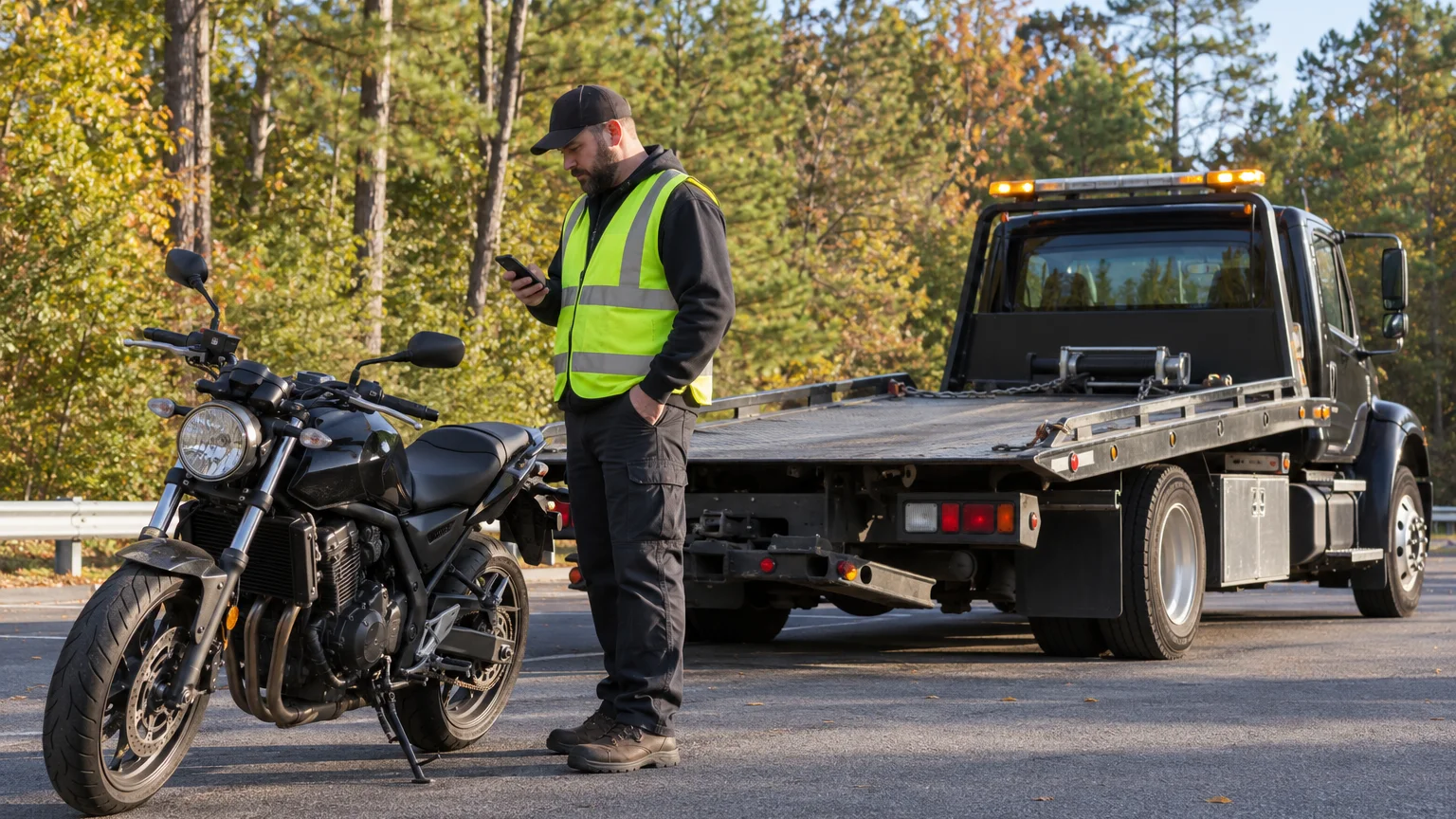
If you’re searching for motorcycle towing Ashland VA, arrange transport without guessing what failed. Report where the bike is, whether it rolls, and where it needs to go. Quick Tow Richmond refers the request to an independent tow operator.
A motorcycle that won’t start may be in a driveway, parking lot, or roadside space. Each setting changes how the operator can approach and load it. Clear observations are more useful than an uncertain diagnosis.
Move the motorcycle away from traffic risk
Start with your position, not the motorcycle’s mechanical condition. A bike beside moving traffic creates a different problem than one parked at home. Move yourself away from traffic before making calls or checking the motorcycle.
Don’t try to ride a motorcycle that won’t start reliably. If you can move it without entering traffic or losing control, place it somewhere more visible and accessible. Don’t push it across active lanes or down an unstable shoulder.
Ashland sits within the northern Richmond travel area, where I-95 carries traffic through Hanover County. I-295 also meets I-95 in Hanover. A roadside pickup near either interstate needs a precise location, direction of travel, and nearby reference point.
Check 511 Virginia for current incidents and road conditions. That can help you describe delays or closures near the pickup point. It doesn’t replace emergency help when someone faces immediate danger.
VDOT’s Safety Service Patrol covers I-95 and I-295 in the Richmond area. It provides free roadside assistance and incident management, but it isn’t a tow company. Its role includes helping drivers arrange their own towing after reaching a safer position.
If the bike is already in a parking space or driveway, leave it there. Note any gate, curb, gravel, slope, or narrow approach. Those details help the operator assess access before arriving.
Describe what happened without diagnosing it
Tell the operator what you observed before the bike stopped starting. Keep the description short and factual. You don’t need to identify the failed part.
Useful details include whether the motorcycle shut off while parked or after a stop. Say whether the lights appear, whether the controls respond, and whether you heard anything when attempting to start it. These are observations, not a diagnosis.
Avoid declaring that the battery, starter, fuel system, or wiring failed. Similar symptoms can have different causes. An incorrect diagnosis may also distract from the immediate need, which is moving the motorcycle.
Mention anything unusual that affects transport. Examples include visible crash damage, loose bodywork, leaking fluid, or a locked steering position. Don’t touch a suspected leak. Simply describe where it appears and keep people away from it.
The motorcycle towing service page explains how to request transport through the referral line. Quick Tow Richmond doesn’t perform the tow. The recorded line takes calls around the clock, and a notice plays before messages are recorded and transcribed.
Your message should include your name, callback number, pickup location, destination, and the bike’s condition. State that it won’t start. Then add the facts an operator can use to plan the pickup.
A no-start is different from a damaged tire or transmission concern. The guides about motorcycle towing after a flat tire and a motorcycle that won’t shift cover those separate situations.
Explain whether the bike can roll
The most helpful question is whether the motorcycle can move without its engine. Test only what you can check from a stable, traffic-free position. Don’t force a control or attempt to ride it.
Tell the operator whether the bike stands upright and whether its wheels appear blocked. Note whether the steering is locked. If you already know that a brake is stuck, a wheel won’t turn, or the bike can’t leave its current position, say so clearly.
You don’t need to prove that it rolls. If checking would place you near traffic, on a steep grade, or on loose ground, report that you couldn’t confirm it safely. That answer is more useful than a guess.
Also mention whether you have the key. A missing key doesn’t automatically explain the no-start, but it can affect access to the motorcycle’s controls. If another person has the key, say whether that person will meet the operator.
Visible damage matters too. A motorcycle resting on its side isn’t the same pickup as an upright bike in a marked space. Describe its current position without trying to lift it alone.
Ask the referred operator how they plan to move the bike in its present condition. If a flatbed towing method is being considered, confirm that choice directly with the operator. Quick Tow Richmond doesn’t select equipment or control the loading method.
This short condition report gives the operator a useful picture:
- The motorcycle won’t start.
- It is upright or on its side.
- It can roll, can’t roll, or hasn’t been checked.
- The steering is free, locked, or unknown.
- The key is present or unavailable.
- Visible damage or leaking fluid is present or absent.
Share the pickup point for motorcycle towing Ashland VA
An Ashland address is a starting point, but the operator also needs the bike’s exact position. A motorcycle behind a building may not be visible from the street. One inside a controlled lot may require access from a specific entrance.
Give the full pickup address when you have it. Add the business name, parking area, driveway position, or nearby entrance. If you’re near I-95, include your travel direction and the nearest confirmed reference point shown on your phone.
Don’t rely on a dropped map pin alone. Pins can land on the wrong side of a divided road or behind a property. Pair the pin with a plain description such as “inside the lot” or “beside the driveway entrance.”
Ashland pickups can also involve traffic moving toward Doswell and Kings Dominion, which sits off I-95 north of Richmond. If event traffic or a closure changes access, mention the route that remains open. Don’t promise that a particular entrance will accommodate a towing vehicle unless the operator confirms it.
Explain any access restrictions before the operator starts the trip. Mention gates, parking decks, low branches, tight turns, soft ground, or permission needed from a property manager. If the bike is on private property, confirm that you have authority to access and move it.
Share where you’ll wait and how the operator can identify you. Use your clothing, the motorcycle’s color, and its location. Don’t send sensitive documents through an ordinary text unless the operator explains why they’re needed.
Finally, make sure the destination is ready to receive the bike. A closed gate or unavailable recipient can change the transport plan. Confirm access with the destination before agreeing to the tow.
Confirm the loading plan and destination
Before accepting the tow, ask the independent operator to explain the loading plan. Confirm that the operator understands the motorcycle’s position, rolling condition, steering status, and visible damage. Correct any detail that changed during the wait.
Ask where the bike will be placed at the destination. A repair shop may have a designated drop area. A home may have a narrow driveway, gravel surface, or locked gate. The destination details matter as much as the pickup details.
Get the operator’s full total before agreeing. Ask whether that total includes mileage and any charge tied to access or the motorcycle’s condition. Quick Tow Richmond doesn’t set the independent operator’s total, and the operator contracts with and bills you directly.
Don’t confuse voluntary transport with nonconsensual towing fee ceilings. Virginia’s towing laws address several kinds of removal, storage, and private-property towing. Those rules are available in Title 46.2, Chapter 12 of the Code of Virginia. A rider-requested Ashland transport isn’t automatically priced by Richmond’s private-property towing ceiling.
Confirm who will release the motorcycle at pickup. Have proof that you own or may move it if the operator requests that information. If someone else is meeting the operator, share that person’s name and role.
Keep the destination unchanged once the operator accepts the job. If it must change, discuss the new location and total before transport continues. A clear agreement reduces confusion at drop-off.
Before ending the call, repeat the pickup point, destination, bike condition, and agreed total. That final check catches wrong addresses and missing access details.
When to call us
Call when a motorcycle in Ashland won’t start and needs transport by an independent licensed towing operator. The recorded line takes calls day or night, but no callback time or arrival time is promised. Call us at (804) 701-6752.