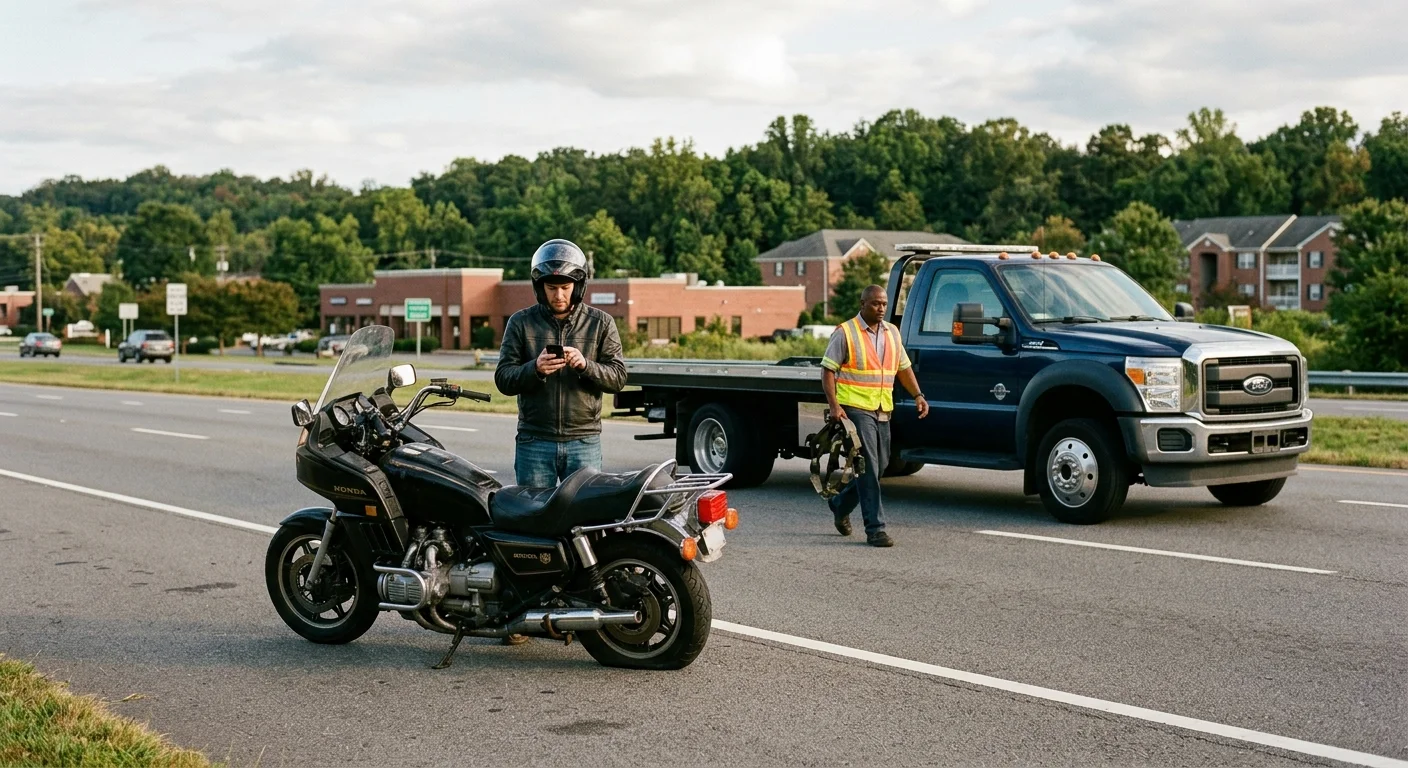
A flat on I-64 through Short Pump or on a Fan side street is the same decision. You need motorcycle towing after a flat tire, not a roll to the next exit. Stay out of the travel lane, then we match you with a licensed operator who can load a bike that shouldn’t be ridden on a ruined tire.
Move away from traffic before arranging help
Get the bike and your body out of moving traffic before you pick up the phone. On the I-95/I-64 overlap from the Bryan Park interchange south to the James River, about 10 miles, VDOT has called that stretch one of the highest crash, heavily congested corridors in the region. A motorcycle in a travel lane there is easy to miss. The same is true on Midlothian Turnpike in Chesterfield and on Parham Road in Henrico, where speeds stay high between lights.
Put the hazard lights on if they still work. If the bike will ease a few feet without you riding on the ruined tire, get onto the shoulder, a side street, or a legal space. If it won’t move, get yourself behind a barrier or well off the pavement. Don’t stand in the lane to flag anyone down.
Virginia’s move over rule, Va. Code § 46.2-861.1, applies on highways with four or more lanes. Drivers coming up on a stopped vehicle with hazard flashers must change lanes away from you, or slow down if a lane change isn’t safe. That rule is for them. It doesn’t make the shoulder safe. Treat every pass as if the driver hasn’t seen you.
If you’re on I-95, I-64, or I-295, VDOT’s Safety Service Patrol may already be working that corridor. SSP is free roadside help. It can get a disabled vehicle off the roadway and help you arrange your own tow. It isn’t a tow company and it doesn’t do mechanical repairs. Richmond-area coverage includes those three interstates from 5:00 a.m. to 9:00 p.m., plus an overnight I-95 route between the I-295 interchange in Hanover County and Route 10 in Chester. Check 511 Virginia for incidents while you wait.
A city street in The Fan, Shockoe, or Manchester is a different problem. There’s often no real shoulder. If you duck into a private lot, read the entrance signs. Virginia lets a property owner request a trespass tow only when signs at all entrances disclose that policy, under Va. Code § 46.2-1231. Richmond caps the hookup fee on that kind of nonconsent private-property tow at $195. That figure is a legal ceiling, not a quote from us, and it isn’t what a rider-requested job costs.
Then call from a safe spot. The line takes calls 24/7. A recording notice plays before your message. Have the cross street ready: Chamberlayne, Broad, Hull, Laburnum near the Raceway, or the I-95 mile if you can see one.
Describe the tire and wheel condition
The operator who shows up hasn’t seen the bike yet. What you say about the tire and wheel is how they decide what to send. This isn’t a diagnosis. It’s a description of what you can see and hear.
Say which end failed, front or rear. Say whether the tire is fully down, still holding a little air, or sitting on the rim. If the sidewall is torn, the bead has come off, or the rim looks bent, say that. If you hit a pothole on Chamberlayne, a seam on the downtown overlap, or debris on I-295, say that too. A slow leak on a Glen Allen side street and a shredded rear on I-95 south toward Chester are different jobs.
Don’t ride it to “see if it holds.” Don’t try to limp to a shop on Hull Street or in Short Pump. A ruined tire can wreck the wheel. A damaged wheel can lock, fold, or drop the bike when someone tries to roll it.
Leave the repair kit in the bag unless an operator later asks you to move it. This page is for transport, not a roadside patch. If you only needed air in a car tire, roadside assistance might be the right call. A motorcycle with a flat, a torn carcass, or a bent rim needs to be loaded, not pumped up.
Mention bags, a top case, a windscreen, and aftermarket wheels if you have them. Those details change how someone approaches the bike. They don’t change the first rule: stay off the travel lane and don’t ride on the damage.
Explain whether the motorcycle can roll
The next fact the operator needs is simple. Can the bike roll a few feet on its own wheels, or is it stuck where it sits?
If the good tire still turns and the damaged end isn’t jammed against the pavement, say it will roll slowly in a straight line. If the rim is on the ground, the wheel won’t turn, or the bike is on its side, say it won’t roll. Don’t guess. Push an inch with the bike off and see. If it binds, stop.
Pavement matters. A center stand on dry asphalt in Manchester is one thing. A side stand on wet gravel along a Chesterfield shoulder is another. After a storm, dirt near the James can swallow a kickstand. An operator who thinks the bike will roll onto a bed, then finds it planted in mud off Route 10, has the wrong picture.
Say whether it’s on the side stand, the center stand, or down. Say if a crash bar or bag is taking weight. If you already picked it up, say so. If you left it down because of traffic on the overlap, say that too. Don’t drag it onto a sidewalk or over a downtown curb to “make it easier.” That can fold a wheel that was only flat.
Keys, steering lock, and a disc lock matter here. If the fork is locked, the bike won’t track. If a disc lock is on, that wheel won’t turn. Tell the operator before anyone tries to move it. The licensed operators we connect you with load what they can see. They can’t see a lock you didn’t mention.
Share the pickup access and destination
Where the bike sits is as important as what’s wrong with the tire. A shoulder on I-64 west of the city, an alley behind a Fan row house, and a parking deck off Broad are three different pickups.
Describe the access in plain words. Interstate shoulder, with or without a guardrail. Surface lot, with the entrance on which street. Deck, including the level and whether a truck can enter. Gravel, grass, or a narrow one-way in The Fan. If you’re between the white line and a wall on the downtown overlap, say there’s no room to stage a truck behind you.
Henrico, Chesterfield, the city, and the Tri-Cities are not the same run. A bike on Parham near the Western Government Center is a different distance from a southside shop than a bike on I-95 in Colonial Heights. Say the locality. Say the nearest named road. If you’re near Richmond Raceway on Laburnum, or near the I-95/I-85 split in Petersburg, use those names. A page that swapped Short Pump for Petersburg wouldn’t help the operator find you.
Then say where the bike should go. Home in Glen Allen, a shop in Chester, a garage in Manchester, or a dealer off Midlothian Turnpike. If you don’t have a shop yet, say you need a nearby option and ask what the operator can do. Mileage is part of the total. Ask for the full figure with mileage included before you agree. For what usually moves a motorcycle quote, read motorcycle tow rates and quote factors. Our published standard light-duty hookup fee is $105. That is our published figure, not a cap, and not a promise of the operator’s total on a motorcycle.
If a friend can meet the truck at a wider pull-off, say so. Don’t send the bike down the road on a flat to make the meeting easier.
Motorcycle towing after a flat tire: confirm the loading plan before dispatch
Once the operator has the location, the wheel condition, and whether the bike can roll, confirm how they plan to load it before anyone is on the way. You’re not directing the work. You’re making sure they heard you.
Ask whether they need the bike to roll onto the truck. If you already said it won’t roll, hear that back. Ask whether a torn rear, a bent rim, or a bike on its side changes the setup. For when a bike belongs on a bed rather than another method, see when a motorcycle needs flatbed towing. That article is the equipment question. This call is the tire-and-wheel question.
Ask where they want bags, a helmet, and a cover. Virginia law lets an owner recover personal items from a towed vehicle without paying a fee to grab them, under Va. Code § 46.2-118(B)(19). That’s a lot-retrieval right after a nonconsent tow, not a loading checklist. For a tow you requested, still say what stays on the bike and what you’ll carry.
Don’t agree to a plan that assumes you’ll ride the damaged tire up a ramp. Don’t leave the scene to “meet them at the next exit.” Stay with the bike, off the travel lane, until the operator takes it.
Quick Tow Richmond is a referral service. We don’t own the truck and we don’t perform the tow. The line takes your details 24/7, a recording notice plays, and we match you with an independent licensed operator who contracts with you and bills you directly. Confirm the loading plan with that operator. If the story you told and the truck they send don’t match, say so before the bike is moved.
When to call us
Call when the tire or wheel is damaged and the motorcycle shouldn’t be ridden another block, whether you’re on the I-95 shoulder in Chester, a Fan curb, or a lot in Short Pump. We’ll match you with a licensed operator who can load the bike from where it sits. Call us at (804) 701-6752.