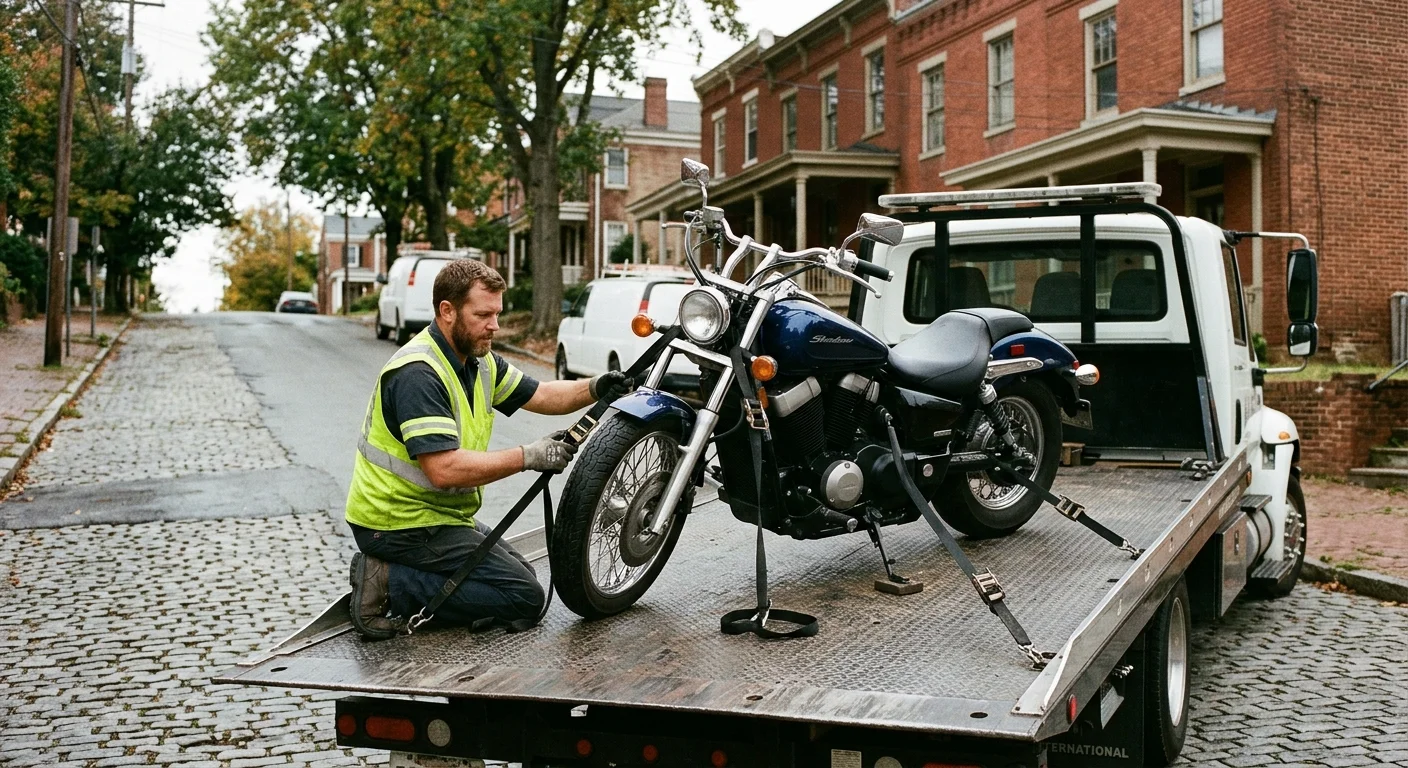
Motorcycle flatbed towing is worth discussing when a disabled bike can’t roll, steer, or remain controlled during loading. Wheel, tire, fork, suspension, or crash damage can change the equipment decision. The dispatched operator should evaluate the bike’s condition and its model-specific instructions.
Start with the bike’s condition: motorcycle flatbed towing
Begin with what the motorcycle can still do. A bike that rolls freely presents a different loading problem from one with a locked wheel. Steering condition matters too. So does any visible damage near the fork, suspension, controls, or frame.
Don’t diagnose the bike if you’re unsure. Describe what happened and what you can see. Tell the operator whether the problem followed a collision, pothole strike, mechanical failure, or flat tire. Mention any parts touching the ground.
Check whether the motorcycle is upright or already on its side. Note whether the handlebars appear straight. Explain whether the transmission can shift into neutral and whether the steering lock is engaged. If you can’t confirm something, say that plainly.
The motorcycle’s owner’s manual should guide model-specific handling. Look for the manufacturer’s towing, transport, or tie-down instructions. Some instructions may identify approved contact points or warn against pressure on certain parts. Share those details before loading begins.
A flatbed request isn’t a damage guarantee. It’s an equipment question for the independent operator. Our motorcycle towing service connects riders with operators who can assess that question using the information provided.
Photos can help explain the condition before dispatch. Capture the damaged wheel, the bike’s resting position, and nearby access. Avoid guessing what a photo proves. Its purpose is to help the operator arrive with a clearer picture of the job.
Why wheel damage changes the loading plan
Wheel condition affects whether the motorcycle can move onto the selected equipment. Start by identifying the front or rear wheel. Then describe whether it turns, drags, sits at an angle, or has visible tire or rim damage.
A flat tire and a wheel that won’t rotate aren’t the same loading problem. Neither should be treated as a complete diagnosis. Tell the operator exactly what you observed and what remains unknown.
Don’t force a wheel to turn just to test it. If the motorcycle’s position makes inspection difficult, leave it alone. The operator can inspect the bike after reaching the scene and seeing the available working space.
Visible wheel damage may also affect how the motorcycle rests once loaded. Ask how the operator plans to support the bike and keep damaged parts from bearing unintended pressure. The answer should account for the specific motorcycle, not a generic procedure.
The owner’s manual remains the best model-specific reference. If the manual identifies transport points, have that information ready. Accessories can change access to those points. Mention saddlebags, fairings, windscreens, crash bars, and other added parts before dispatch.
When you request flatbed towing, explain that the vehicle is a motorcycle and identify the damaged area. Don’t assume the equipment name alone communicates the whole job. A clear condition report gives the dispatched operator a better basis for selecting the loading approach.
What to tell the operator before dispatch
Give the operator two sets of details: information about the motorcycle and information about its location. Both affect the plan.
For the bike, provide the make, model, and model year if known. Describe its position and visible damage. Say whether either wheel turns, whether the handlebars move, and whether the bike can shift into neutral. Mention loose parts, leaking fluid, or accessories that extend beyond the motorcycle’s usual outline.
Share any relevant instructions from the owner’s manual. Don’t rely on another model’s guidance, even when the bikes look similar. If you can’t access the manual, tell the operator that too.
For the location, give the street, direction of travel, nearest cross street, and nearby landmark. On an interstate, identify the route, direction, and nearest exit or interchange. Explain whether the motorcycle is on a shoulder, ramp, parking lot, alley, garage entrance, or sloped street.
Access details matter around Richmond. A bike in a broad suburban parking area presents a different setup from one beside a narrow downtown curb. Low branches, overhead structures, tight turns, gates, and parked vehicles may restrict where equipment can approach.
If you’re stranded on the interstate, review our guide for a breakdown on I-95 in Richmond. You can also check 511 Virginia for current incidents and traffic conditions.
Before agreeing to service, ask the independent operator for the full total, including mileage. Quick Tow Richmond makes the referral, while the operator contracts with you and bills you directly.
How a careful load is secured
The loading conversation should begin before the motorcycle is moved. Show the operator the damaged area and any manufacturer instructions you found. Point out loose accessories, repaired bodywork, luggage, or parts that shouldn’t carry pressure.
Ask which contact points the operator plans to use. The motorcycle’s bodywork shouldn’t be treated as a substitute for manufacturer-approved transport points. If the manual contains a warning or diagram, bring it to the operator’s attention.
The operator should choose the supports and restraints for that bike and its condition. There isn’t a responsible universal strap count, loading angle, or attachment pattern for every motorcycle. Those details depend on the model, visible damage, and equipment at the scene.
Before transport begins, look at the motorcycle’s position from both sides. If something appears to touch a damaged wheel, painted panel, exhaust component, or accessory, mention it. Let the operator inspect and adjust the setup.
Keep the keys and owner’s manual available. Tell the operator about any steering lock, alarm, immobilizer, or transport setting you know about. Don’t activate or disable a model-specific feature unless the manual supports that step.
Owners of unusual, restored, or highly modified bikes may also find useful questions in our classic vehicle towing guide. The vehicles differ, but both jobs benefit from a clear condition report and a loading plan based on the actual vehicle.
Richmond streets and shoulders that limit access
Richmond’s street layout can shape the pickup before loading starts. Shockoe Bottom’s cobblestone blocks and the grades toward Church Hill may limit where a flatbed can line up. Parked cars, narrow curb space, and sloped approaches can further restrict positioning.
Give the operator the exact block and the motorcycle’s orientation. “Church Hill” or “Shockoe Bottom” alone isn’t enough. Say whether the bike faces uphill or downhill and whether it’s against a curb, in an alley, or inside a parking entrance.
Interstate shoulders present a different access problem. The I-95 and I-64 overlap passes through central Richmond, with major movements around the Bryan Park interchange and downtown. I-95, I-64, and I-295 also carry traffic across multiple parts of the metro.
VDOT’s Safety Service Patrol covers those Richmond-area interstates. Its roadside help is free, but SSP doesn’t act as a towing company or perform mechanical repairs. It helps move disabled vehicles from the roadway and assists drivers with arranging a tow.
Tell the dispatched operator if VDOT or law enforcement has already moved the motorcycle. The new location may require different access than the original breakdown point. Give the updated shoulder, ramp, lot, or landmark rather than repeating the first location.
County also matters. Richmond, Henrico, Chesterfield, and the Tri-Cities don’t share one street network. A precise location helps the operator understand the route and physical approach before reaching the motorcycle.
When to call us
When a motorcycle won’t roll normally, has visible wheel or steering damage, or needs model-specific handling, ask a licensed towing pro to evaluate the loading method. Quick Tow Richmond connects you with an independent operator, and our recorded line accepts messages 24/7 after playing a recording notice. Call us at (804) 701-6752.