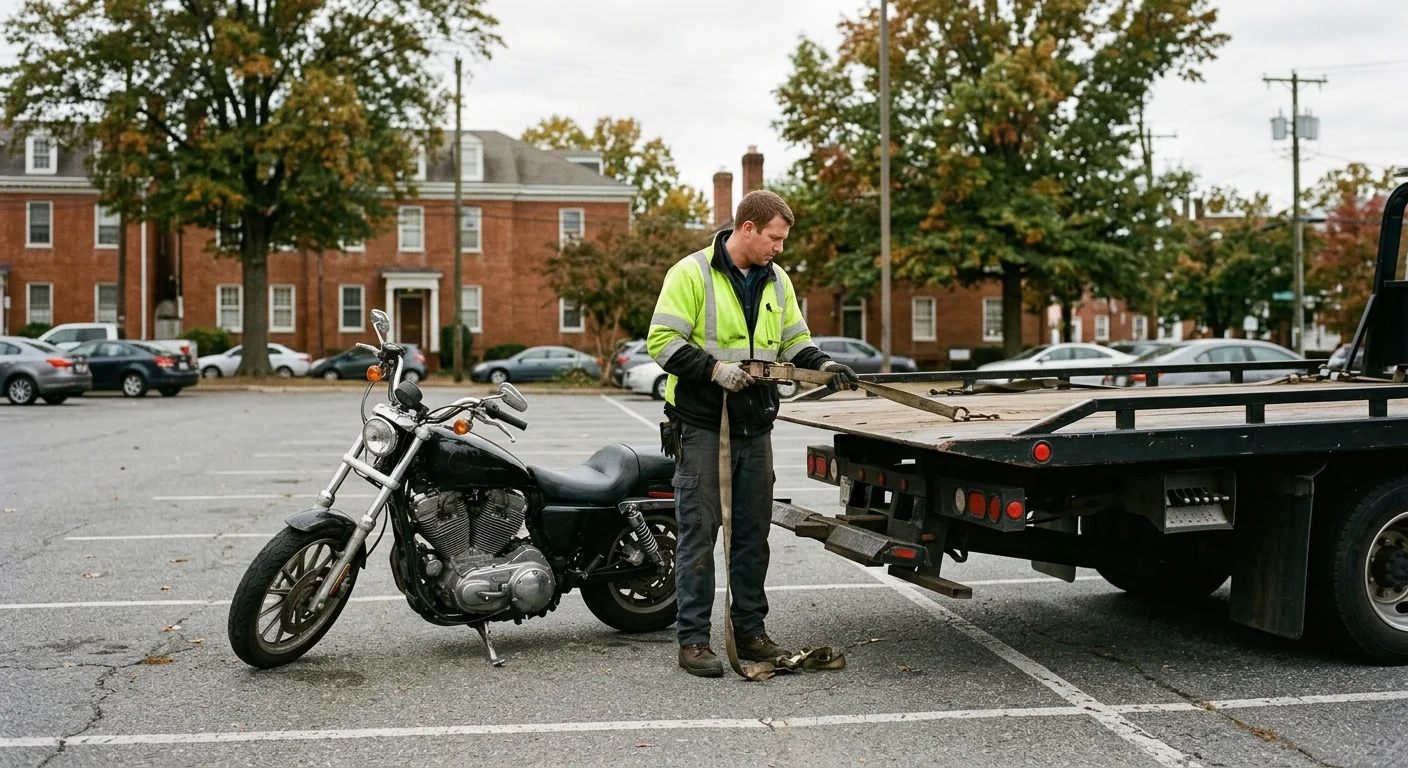
Motorcycle tow rates don’t come from one universal Richmond price. The useful number is the full operator quote from the bike’s location to your chosen destination. Quick Tow connects callers with independent operators, who provide the equipment and bill drivers directly.
Motorcycle tow rates start with the full quote, not one fee
We couldn’t confirm a government-published rate, range, or average for a rider-requested motorcycle tow in Richmond. Virginia’s towing laws address regulated situations such as nonconsent towing. They don’t create one universal price for every motorcycle move.
That distinction matters when you’re standing beside a disabled bike. A single fee doesn’t always reveal the complete charge. Ask for the total from the pickup point to the exact destination. Also ask which details could change that number after the operator arrives.
Quick Tow doesn’t set the independent operator’s price. The operator should provide the quote and explain what it covers. If the destination hasn’t been chosen, say so before accepting service. A quote to a nearby address isn’t automatically a quote to another part of the metro.
Share accurate information before dispatch. Give the motorcycle’s location, condition, and destination. Explain whether the operator can reach it from the street or parking aisle. These details let the operator plan the job before quoting it.
Don’t substitute a private-property towing ceiling for a roadside motorcycle quote. Those are different situations. Our guide to tow costs in Richmond explains why one published figure may cover only one part of a tow.
Write down the operator’s total and the destination. If anything is unclear, ask before agreeing. A complete quote is more useful than a low number with undefined limits.
How pickup access changes the operator’s plan
Start with the motorcycle’s exact position, not only its street address. A bike beside an open curb presents a different pickup than one behind a gate. Parking decks, alleys, loading areas, soft ground, and tight corners also deserve mention.
In the Fan, limited parking can make street access less direct. Downtown lanes near the I-95 and I-64 overlap can present another setting entirely. The operator needs the actual pickup point, not a broad neighborhood name.
Tell the operator where the bike sits relative to the nearest clear approach. Mention any gate, low clearance, steep grade, blocked aisle, or property access rule you can see. Don’t guess whether the operator’s equipment will fit. Describe the space and let the operator decide.
Photos can help when the operator accepts them. Capture the full motorcycle and the path leading toward it. Avoid close photos that hide the surrounding access. If someone controls the gate or garage, confirm how entry will work.
Equipment choice belongs to the independent operator. Our motorcycle towing service page explains how we connect riders with operators. You can also review flatbed towing before discussing the available options.
The separate guide on when a motorcycle needs flatbed towing focuses on equipment considerations. For the quote, your job is simpler. Describe the bike, the space, and the intended destination.
Ask whether the quoted total is based on the access details provided. Then ask what access change would require a revised quote. That gives both sides a clear starting point.
Why the bike’s condition matters
“Disabled motorcycle” can describe several different situations. One bike may remain upright and roll normally. Another may be down, damaged, missing a key, or unable to move freely.
Report what you know without diagnosing the mechanical problem. Tell the operator whether the motorcycle starts, rolls, steers, and remains upright. Say whether you have the key. Mention visible damage or detached parts.
If the bike was involved in a crash, state that plainly. If it stopped because of a mechanical problem, explain what happened before it quit. You don’t need to name the failed part. The operator needs observable facts for the recovery plan.
Don’t force a wheel, straighten damaged parts, or move the bike into traffic. If you’re beside a busy road, focus first on your position and surrounding vehicles. On Virginia interstates, the VDOT Safety Service Patrol provides roadside assistance and incident management. It isn’t a tow company, but it can help move a disabled vehicle from danger and help arrange a tow.
The bike’s condition should be described before the quote is accepted. Ask whether the total assumes the motorcycle rolls and steers. If it doesn’t, request a revised total based on its actual condition.
Also identify anything attached to the motorcycle. Saddlebags, loose cargo, and removable accessories should be discussed before pickup. The operator can tell you what must be secured or removed.
Clear details reduce surprises at the scene. They also help the operator decide whether the requested move matches the available equipment.
What distance and destination can change
A quote needs two usable locations. Give the exact pickup point and the intended drop-off address. A neighborhood name or highway exit usually isn’t enough for a complete route.
Metro Richmond covers several jurisdictions and road networks. A trip within the city differs from a move toward Henrico, Chesterfield, or the Tri-Cities. Don’t assume the operator treats every destination the same way. Ask how the named destination affects the total.
Route conditions can also complicate the plan. The I-95 and I-64 overlap runs through central Richmond between the Bryan Park area and the James River. Before dispatch, 511 Virginia can show current incidents and road conditions. It doesn’t set the towing quote, but it can help you describe closures near the pickup.
Decide where the motorcycle should go before calling when possible. That may be a repair shop, your home, or another location that has agreed to receive it. Confirm that someone can accept the bike. If the destination changes, ask the operator for an updated total before continuing.
Don’t assume the closest shop is open or prepared for the motorcycle. The towing operator handles transportation, not the destination’s intake policy. Contact the destination separately when you can.
Ask whether the quote covers the entire trip between the two addresses. If mileage is part of the operator’s calculation, request the mileage basis and total in plain words. We couldn’t confirm a universal Richmond per-mile motorcycle rate, so that figure must come from the operator.
A precise destination gives you a quote you can compare. An undecided destination leaves a major part of the trip undefined.
Questions to confirm before dispatch
Keep the conversation short, but cover the facts that shape the move. Start with the motorcycle’s exact location. Then give its condition, pickup access, and destination.
Ask these questions before accepting the operator’s quote:
- What is the full total to the named destination?
- Which motorcycle condition did you use for that quote?
- Does the quote assume the bike rolls and steers?
- Does the pickup access I described change the total?
- What could cause the operator to revise the quote?
- Who will bill me for the service?
- Which payment methods will the operator accept?
- Can I receive an itemized record of the charges?
Virginia rules prohibit towing operators from refusing the standard payment methods listed in state law. Operators must also retain towing records, including itemized fees, for one year. Asking for an itemized record gives you a clearer account of what was billed.
Repeat the pickup and destination addresses before ending the call. Confirm the motorcycle’s condition one more time. If you later discover that a wheel won’t move or the bike isn’t where described, contact the operator before arrival.
Quick Tow’s recorded line takes calls around the clock. A recording notice plays before you leave a message, and messages are recorded and transcribed. Include your name, callback number, bike location, condition, and requested destination.
Quick Tow then matches callers with independent licensed tow operators. The operator contracts with you, owns the equipment, sets the quote, and bills you directly. Confirm those details with the operator before accepting service.
When to call us
Call when a disabled or damaged motorcycle needs a licensed towing pro and you can describe its location, condition, and destination. Quick Tow can connect you with an independent operator who will provide the quote and bill you directly. Call us at (804) 701-6752.