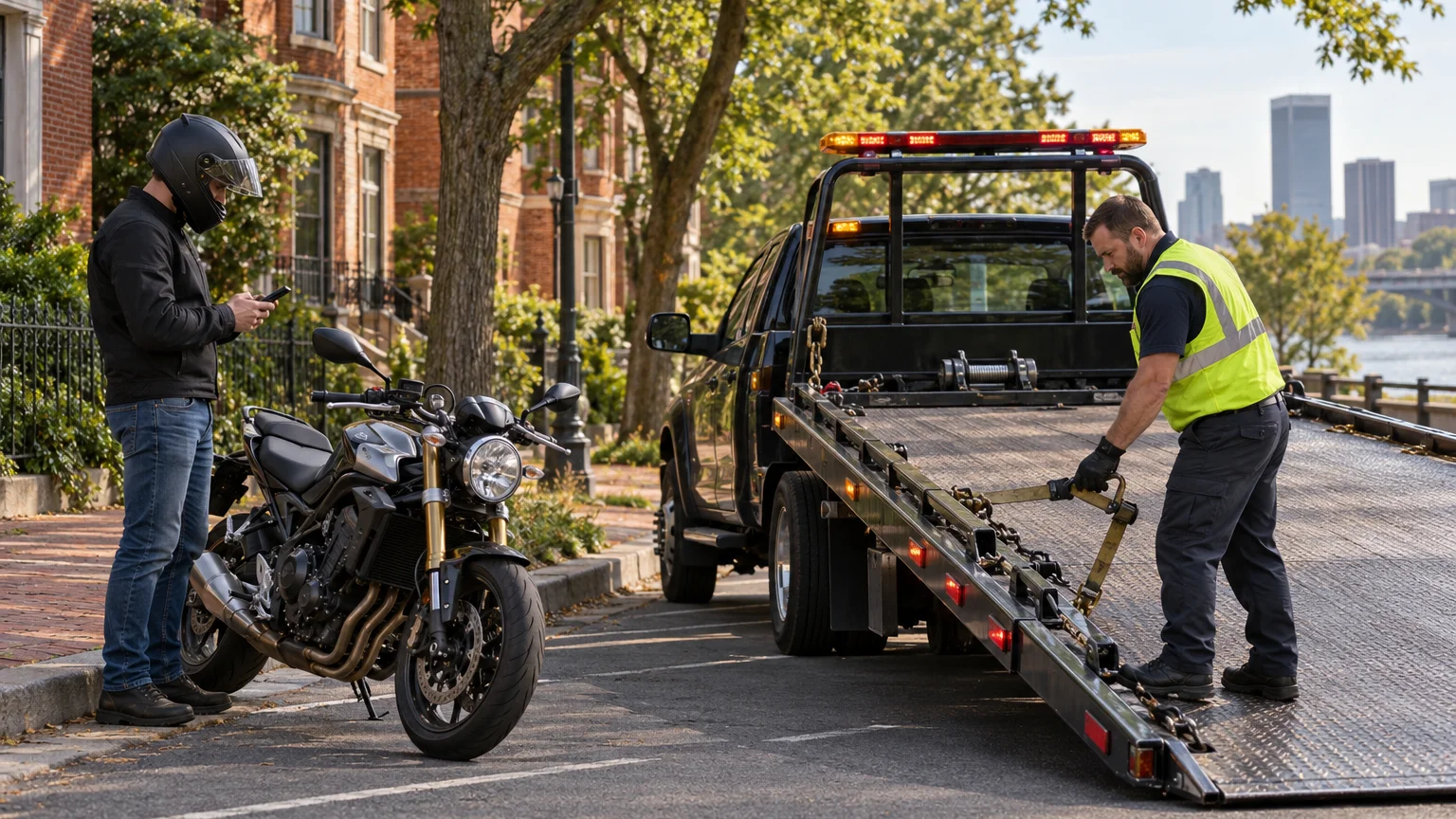
If you’re searching for bike towing services near me because your motorcycle won’t shift, arrange transport instead of trying to ride it. Tell the operator whether the bike rolls, where it’s parked, and where it needs to go. Those details shape the pickup plan.
A shifting problem doesn’t need a roadside diagnosis first. The immediate task is moving the motorcycle without making assumptions about its condition.
Move the motorcycle away from traffic risk
Start by looking at where the motorcycle stopped. A bike beside moving traffic presents a different pickup than one inside a parking garage. Don’t try to ride it simply because the engine still runs.
If you can move yourself away from traffic, do that first. Don’t push the motorcycle across active lanes or down an exposed shoulder. Tell the operator if the bike must remain where it stopped.
Location details matter around Richmond. The I-95 and I-64 overlap through downtown carries traffic between the Bryan Park interchange and the James River. VDOT describes that overlap as one of the region’s most congested, high-crash corridors. I-95, I-64, and I-295 also fall within the Richmond-area Safety Service Patrol network.
The VDOT Safety Service Patrol provides free roadside assistance and incident management on covered highways. It isn’t a towing company and doesn’t make mechanical repairs. Patrol personnel can help move a disabled vehicle from danger and help a driver arrange a tow.
Check 511 Virginia for current incidents and road conditions. Then give the towing operator your road, direction of travel, nearest exit, and visible landmark. A location such as “I-64 east near the I-95 interchange” is more useful than “downtown.”
For a motorcycle on a city street, share the nearest cross street. In a garage or private lot, provide the entrance and parking level. Clear directions help the operator assess access before arriving.
Describe what changed without diagnosing it
Give a short account of what happened. You don’t need to identify a failed clutch, transmission part, or drivetrain component. That diagnosis belongs with a motorcycle repair professional.
Useful details include what you noticed before stopping. Say whether the shifter stopped moving, the selected gear became unclear, or the motorcycle no longer moved normally. Mention unusual sounds, visible fluid, smoke, or impact damage if present. Describe only what you observed.
Also explain whether the engine is running or shut off. Tell the operator if the key is available. If the motorcycle was involved in a collision, disclose any bent controls or visible damage near the wheels.
Avoid testing the bike repeatedly for the sake of the call. The towing operator mainly needs its current condition and position. A repair shop can investigate why the shifting changed after transport.
When requesting motorcycle towing in Richmond, identify the motorcycle’s make and model. Share any modifications that change its height, width, or access points. Saddlebags, a sidecar, a lowered stance, or added bodywork may affect the loading discussion.
Keep the explanation simple:
- The motorcycle won’t shift or move normally.
- The engine is on or off.
- The key is present or unavailable.
- There is or isn’t visible damage.
- The bike is upright, leaning, or down.
That information helps the independent operator consider the pickup without relying on a roadside guess.
Explain whether the bike can roll
The operator needs to know what the wheels will do. “It won’t shift” doesn’t reveal whether both wheels turn freely.
With the engine off, describe whether the motorcycle can be moved by hand from its current position. Don’t force it. If you haven’t checked, say that its rolling condition is unknown. That answer is better than guessing.
Tell the operator if the bike appears stuck in gear. Mention whether the handlebars turn and whether either brake seems engaged. If a wheel is blocked by crash damage, a curb, a parking stop, or a security device, include that detail.
A motorcycle that rolls normally may require a different loading approach than one with a locked wheel. The operator should choose the method after hearing the condition and seeing the pickup area. Ask how the motorcycle will be loaded, stabilized, and unloaded at the destination.
This problem is different from a puncture. Riders dealing with damaged rubber can use our guide to motorcycle towing after a flat tire. Here, the main issue is whether the bike can move predictably during loading.
Don’t describe the motorcycle as rollable if you only know that the engine starts. Engine operation and wheel movement aren’t the same observation. Likewise, don’t assume neutral has engaged because an indicator appears on the display.
A clear answer can be brief: “The rear wheel moves, but the bike won’t shift,” or “I haven’t moved it, and the rolling condition is unknown.” That gives the operator something concrete to plan around.
Share the pickup access and destination
Pickup access can matter as much as the motorcycle’s condition. Richmond has interstate shoulders, narrow city streets, apartment lots, garages, and alleys. Each presents a different working space.
Describe the ground under the bike. Note a slope, gravel, soft soil, standing water, or a tight parking space. Tell the operator about gates, clearance limits, sharp garage turns, or vehicles blocking a direct approach.
In the Fan, limited street parking can leave little space beside a motorcycle. Shockoe Bottom adds low-lying streets with a history of flash flooding. A pickup near either area needs an exact cross street and an honest account of current access.
Metro Richmond also crosses several jurisdictions. A motorcycle in Short Pump is in Henrico County. One near Chesterfield Courthouse is in Chesterfield County. Petersburg and the Tri-Cities involve longer routes from central Richmond. Give the actual pickup municipality instead of using “Richmond” for the whole region.
Choose the destination before dispatch when possible. That might be a motorcycle repair shop, dealership, home, or another location that has agreed to receive the bike. Confirm the destination address and whether someone will be there.
If the trip crosses the metro, share that before accepting the tow. Quick Tow Richmond is a referral service. We connect riders with independent operators, and the operator contracts with and bills the rider directly.
If you’re comparing transport methods, read about flatbed towing and when a motorcycle may need flatbed towing. The operator should still confirm the actual loading method for your motorcycle.
Confirm the loading plan before dispatch
Before agreeing to the tow, repeat the bike’s condition, access limits, and destination. Ask the operator what loading method is proposed for a motorcycle that won’t shift.
Confirm that the operator understands whether the bike rolls. Mention any locked steering, missing key, blocked wheel, collision damage, or limited garage clearance. Don’t assume those details carried over from an earlier message.
Ask what needs to be removed before loading. Loose luggage, helmets, covers, and personal items may need separate handling. Keep the key available if you have it. If someone else will meet the operator, make sure that person can identify the motorcycle and destination.
Price also needs a direct conversation with the independent operator. Quick Tow Richmond doesn’t set the operator’s final bill. Ask for the full total, including mileage and any condition-related work, before agreeing. No verified universal price for towing a non-shifting motorcycle could be confirmed from the approved sources.
Don’t apply Richmond’s private-property towing caps to this situation. Those ceilings concern nonconsensual private-property tows, not a motorcycle transport requested by its rider. A requested tow depends on the operator’s quote and the job details.
The phrase “80% rule” can refer to unrelated towing or vehicle guidance. No Richmond motorcycle-towing rule by that name could be confirmed in the approved sources. Ask the operator about the actual motorcycle, pickup access, and loading plan instead.
Finally, confirm the receiving location. A successful pickup still creates a problem if the destination is closed or can’t accept the motorcycle. The operator should know the complete route before dispatch.
When to call us
Call when your motorcycle won’t shift, won’t roll normally, or can’t be moved without professional transport. Our recorded line takes calls 24/7 and connects riders with independent licensed towing operators. Call us at (804) 701-6752.