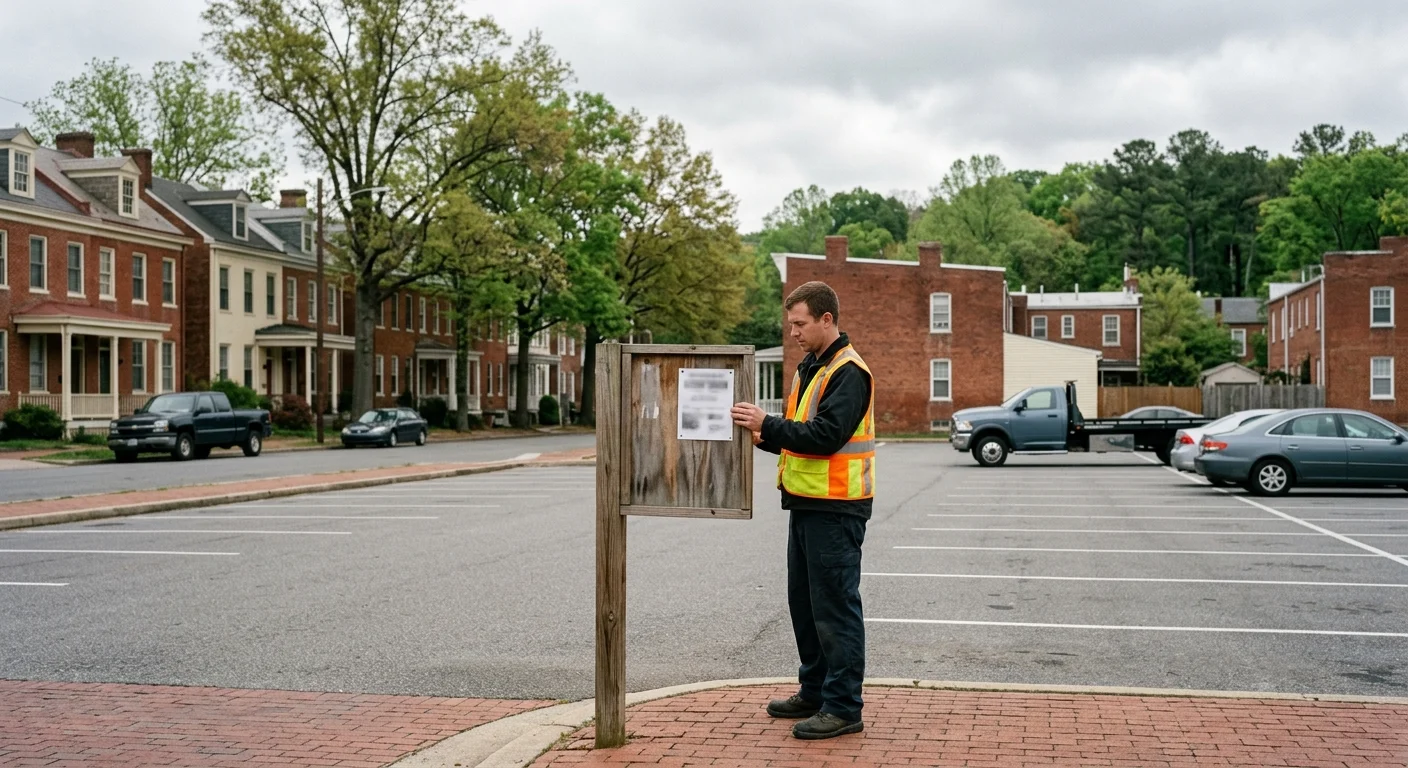
Richmond towing operators can’t use fraud, refuse standard payment, or hold your belongings until you recover the vehicle. Virginia law gives you clear rights, while Richmond adds local rules for certain private-property tows within the city.
These protections matter whether your car disappeared from the Fan, Scott’s Addition, or a Shockoe Bottom lot. Start by identifying who ordered the tow and where it happened.
What an operator may never do in Virginia: Richmond towing basics
Virginia’s prohibited-acts rules cover every tow truck driver and towing and recovery operator. They aren’t limited to apartment lots or other private-property removals.
Under Virginia’s towing laws, an operator can’t use fraud or deceit. The operator also can’t add fraudulent charges or advertise deceptively. These rules apply across Richmond, Henrico, and Chesterfield.
A nonconsent tow from private property carries added requirements. The property must have clear signs at every entrance. Those signs must disclose that unauthorized vehicles may be removed, towed, or immobilized. They must also include the non-emergency number for local law enforcement or the responsible towing operator.
After removing a vehicle without consent, the operator must immediately notify State Police or local law enforcement. Failure to provide that notice is a traffic infraction carrying a fine of up to $100. It also limits the storage charge to one day.
If your car vanished inside Richmond, check the city’s towed-vehicle information before reporting it stolen. The live listing includes vehicle details, partial plate and VIN information, tow time, and the lot address. Records remain online for 14 days. Our guide to finding a towed car in Richmond explains that process.
Virginia also lets owners challenge improper conduct through a state complaint. It doesn’t give Richmond residents the special ten-times civil penalty available in other Virginia planning districts.
They cannot refuse your payment
Virginia law identifies the payment types towing operators must accept. These include cash, an insurance-company check, a certified check, a money order, or a credit card. The statewide prohibited-acts rule requires operators to accept at least one of two commonly used nationally recognized credit cards.
An operator can’t refuse to release the vehicle when you offer an accepted payment method. If the operator refuses, further storage charges are suspended. Keep a record of what you offered, when you offered it, and who responded.
Ask for the full amount before heading to the lot. Confirm which payment method the operator will accept and what proof of ownership you’ll need. If you’re arranging a consensual tow, request the complete total with mileage included before agreeing. Quick Tow Richmond doesn’t set the operator’s bill. Independent operators contract with and bill drivers directly.
Virginia also requires access for inspection or relocation. With a written request and proper payment, the towing business must allow either the owner or another towing business to inspect or relocate the vehicle.
The towing locality’s ordinance governs a private-property removal, even when the vehicle is stored elsewhere. That boundary matters around the metro. Richmond, Henrico, and Chesterfield belong to Planning District 15, but Richmond City Code doesn’t automatically govern a county tow.
For a removal requested by a property owner, see our overview of private-property towing. It explains how signage, consent, and the location of the tow affect the next step.
Your belongings come out free, whether or not you pay
A towing operator can’t force you to recover the entire vehicle before collecting personal property. Once you provide proof of ownership, Virginia law gives you access to personal items without paying a retrieval fee.
That means the vehicle bill and your belongings are separate issues. An unpaid towing or storage balance doesn’t let the operator keep ordinary personal property as pressure for payment. The keeper’s lien covers towing, storage, recovery, and care. It doesn’t extend to property or cargo that isn’t attached to the vehicle or necessary for its operation.
Bring proof that the vehicle belongs to you. Call the storage lot before traveling there because Virginia law doesn’t set statewide retrieval hours. The right to your belongings is clear, but each lot controls its access schedule.
A different deadline applies when the vehicle is approaching a lien auction. The keeper must allow access when the owner claims and retrieves personal property at least two business days before the auction date. After that window, unclaimed property may be disposed of.
That deadline doesn’t mean every owner has only two days after a tow. It applies specifically to personal property inside a vehicle nearing sale through the keeper’s-lien process.
Make a simple list of anything you remove. If access is denied, note the time, the person you spoke with, and the reason given. Don’t leave essential documents or personal property behind because someone says the towing balance must be paid first.
The itemized receipt and the posted fee list
Virginia requires towing operators to keep towing records, including itemized fees, for one year. Operators must also display a complete fee list prominently at their principal office.
Private-property towing rules add another posting requirement. The full fee list must appear at the main office and at vehicle recovery sites. An operator can’t collect more than the posted amount.
Ask to see that list before paying. Then compare each line with the itemized bill. Record the hookup charge, storage periods, authorized surcharges, release charge, and any administrative fee separately. A single unexplained total makes a dispute harder to document.
Richmond adds an express itemized-receipt requirement for covered private-property tows. City Code § 27-302 says anyone taking payment must provide one. The correct section is § 27-302.
The statewide ceiling and Richmond’s local ceiling aren’t quoted prices from Quick Tow Richmond. They’re legal limits for defined nonconsent towing situations. Your total can depend on which permitted charges apply and where the removal occurred.
Our guide to Richmond towing costs breaks down those separate fee categories. Before accepting a consensual tow, ask the independent operator for the complete total with mileage included. For a private-property tow, compare the bill against the posted list and the law governing the location.
Keep the receipt, payment record, photographs, and written messages together. Those records can support a complaint if the operator refuses access, rejects an accepted payment, or charges more than an applicable limit.
Where a towing complaint actually goes
Virginia doesn’t run a formal towing hearing. There’s no standard administrative hearing date or statutory resolution deadline for these disputes.
An aggrieved consumer may file a towing complaint with the Division of Consumer Counsel in the Virginia Office of the Attorney General. The office provides a specific Towing Complaint Form for complaints involving tow truck drivers and towing and recovery operators.
The Attorney General may then bring a circuit-court action. That action can seek an injunction, damages, restitution, costs, and fees for the consumer. The Attorney General decides whether to bring the lawsuit. Filing the complaint doesn’t automatically schedule a hearing or guarantee a court case.
A useful complaint starts with documents. Include the tow location, removal time, operator’s name, posted fee list, itemized bill, and proof of payment offered. Add photographs of every parking-lot entrance when signage is disputed. If personal-property access was refused, identify what you requested and the response you received.
For a nonconsent removal, keep any information showing whether law enforcement received immediate notice. That issue matters because failure to notify can limit storage charges to one day.
Richmond, Henrico, and Chesterfield don’t share one city complaint process or fee ordinance. The law of the towing locality governs, even if the storage lot sits across a boundary. A car removed from Scott’s Addition is therefore different from one removed in Henrico or Chesterfield.
Don’t add remedies from Northern Virginia to a Richmond complaint. Richmond and its neighboring counties are in Planning District 15. The special ten-times civil penalty from Planning District 8 doesn’t apply here.
What Richmond’s own ordinance adds on top
Richmond City Code § 27-302 applies to vehicles under 10,000 pounds removed from private property without the owner’s permission at the property owner’s request. Ordinance 2025-222 amended that section in November 2025.
Richmond caps the hookup or initial towing fee at $195. That local ceiling sits below Virginia’s $210 statewide ceiling for a qualifying nonconsent passenger-vehicle tow.
The city permits an after-hours surcharge of up to $30 for a tow between 7:00 p.m. and 8:00 a.m. It also permits a weekend or holiday surcharge of up to $30. Each surcharge may be charged only once per occurrence, not once each day.
Storage is capped at $50 for each 24-hour period. No storage fee applies during the first 24-hour period. It also can’t accrue while recovery is prevented because the towing business is closed.
If you reach the vehicle before it leaves the property, a different rule applies. Once it has been hooked up but hasn’t been removed, the operator may charge a drop fee of up to $40 when you arrive and pay to claim it.
An administrative or notification fee of $75 can be charged only after the vehicle has remained at the lot more than 72 hours. An after-hours release between 7:00 p.m. and 8:00 a.m. may carry a fee of up to $35. Richmond bars adding other fees, liens, towing, storage, or administrative costs on top of that release fee.
The person taking payment must give you an itemized receipt. Violating the fee, storage, drop-fee, administrative-fee, release-fee, or receipt provisions is a Class 1 misdemeanor.
These are ceilings, not a guaranteed bill. They also apply within Richmond’s city limits, not automatically to a tow originating in Henrico or Chesterfield.
When to call us
Call when a disabled vehicle needs an independent licensed towing operator. Quick Tow Richmond matches drivers with operators who contract with and bill them directly. Our recorded line takes messages 24/7, and a recording notice plays first. Call us at (804) 701-6752.