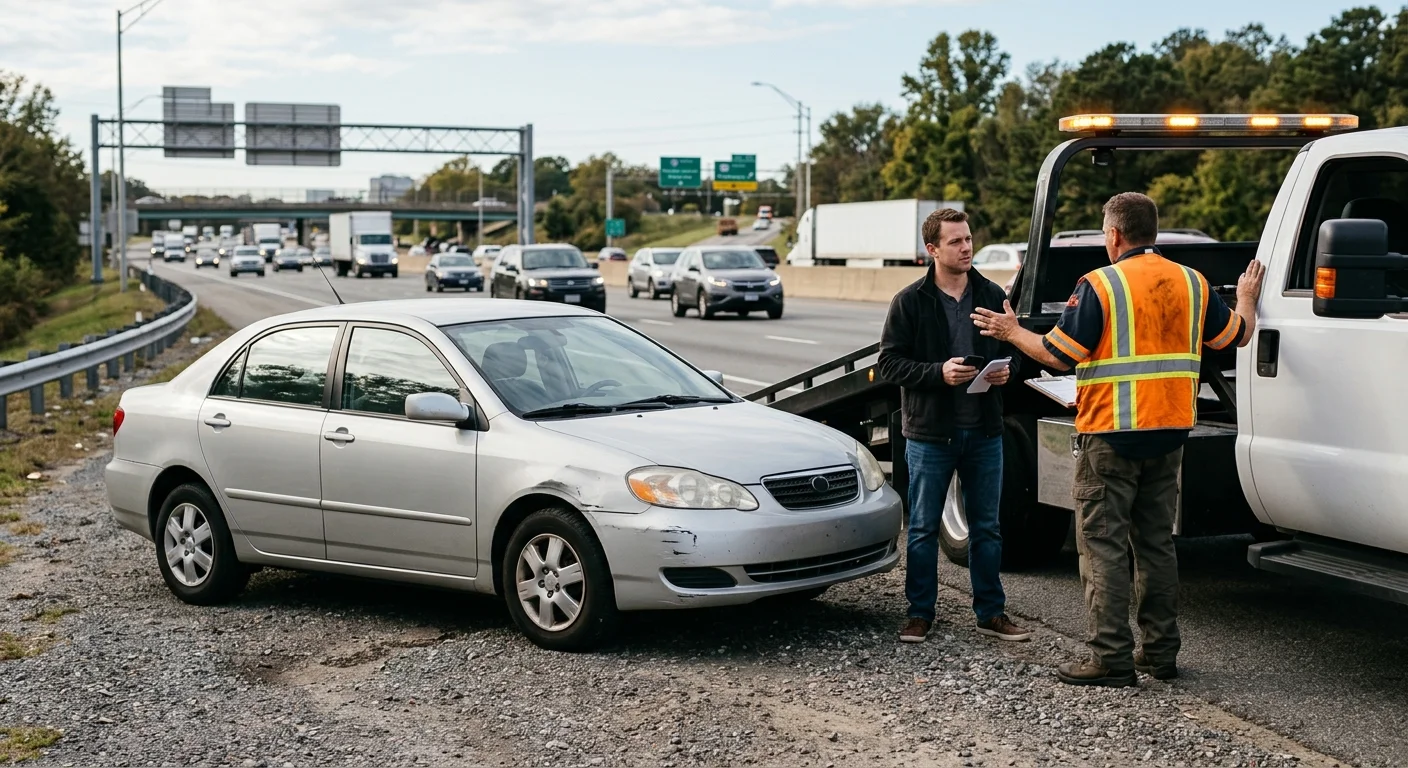
If you are asking do I need a tow after a minor accident, look at the wheels, the leaks, and the officer. A tap on West Broad or on the I-95/I-64 overlap can look tiny and still leave the car unfit to drive. A running engine does not settle it.
Put scene safety before the vehicle decision
You’re on a live Richmond roadway. The bumper question can wait. Put the hazards on. Get people out of the travel lane if you can do that without rolling a damaged wheel into traffic. If you cannot move the car, stay put. Stay away from passing traffic.
Shoulders on I-95, I-64, and I-295 are tight. Keep people as far from live lanes as you can.
VDOT studied the I-95/I-64 overlap through downtown. That stretch runs from the Bryan Park interchange south to the James River, about 10 miles. The study calls it “one of the highest crash, heavily congested corridors in the region.” Don’t stand in a lane to photograph a bumper.
If you’re on I-95, I-64, or I-295, VDOT’s Safety Service Patrol may already be working the scene. SSP is free roadside help. Patrols can change a tire, bring fuel, jump a battery, or help you arrange a tow. SSP isn’t a tow company. It doesn’t do mechanical repairs. Check 511 Virginia for incidents on those routes.
Get people out of the car before an operator hooks it. You don’t have to take the first truck that offers a hook.
A tap on Midlothian Turnpike in Chesterfield isn’t the same scene as a tap in The Fan. People first. Then the car.
Report visible damage without diagnosing it
You’re not a shop. Walk around the car only from a safe spot. Report what you can see. Don’t decide what it means.
Note a bumper cover hanging into a wheel. Note a wheel sitting at an angle. Note an airbag that deployed. Note a puddle under the engine or transmission. Those are observations. They are not a green light to drive.
Do not call the car fine because it still starts. Do not call a crumpled fender only cosmetic. A wheel that looks almost straight can still be bound. A leak you cannot name can still empty a system on the next mile of Chamberlayne Avenue.
Follow the officer if one is there. Follow the owner’s manual for that model if you have it. Manufacturer guidance is specific to the car. This site cannot certify a damaged vehicle as safe to drive.
If a wheel will not turn, stop. Forcing it down a Richmond street can deepen the damage. That job is covered in our guide to towing a car with crash damage and a locked wheel. You don’t need to name the broken part. You need to stop driving it.
Tell the operator what you see, not what you hope. “The right front wheel is tucked” helps. “I think it’s only the bumper” does not.
Do I need a tow after a minor accident when the wheels still roll
Rolling is the first mechanical question, not the last. If the car will not roll, it does not leave under its own power. If it rolls but will not steer, same answer. If it rolls and steers but pulls hard, scrapes, or shakes, treat that as a tow until a shop says otherwise.
Test only when you’re already out of live traffic and the officer hasn’t told you to stay put. See whether each wheel turns. See whether the car tracks straight for a few feet, not a few miles. If either fails, you have your answer.
A wheel that rolls with a grinding sound is not a pass. Fluid on the pavement is not a pass. An airbag in your lap is not a pass. This page will not call those safe to drive.
Short Pump can feel calmer than downtown. A quieter road still isn’t permission if the car will not track.
Accident recovery is the work when the car is on the roadway, in a median, or sitting at an angle a simple hook-up cannot fix. A minor crash can still need a winch or a flatbed. The operators we dispatch make that call on scene from what they see.
When in doubt, tow. Follow the manufacturer’s guidance for that vehicle even if the officer lets you leave. A second mile that “should be fine” is how a minor crash becomes a disabled car in a worse place.
Ask the responding authority before moving the car
If police, a deputy, or a trooper is on scene, they own the next move, not you. Ask before you put the car in gear. Ask before you call a truck. A vehicle that’s a traffic hazard can be removed under Virginia law. In the City of Richmond, vehicle accidents are also on the city’s own list of what can trigger a city-directed tow.
Richmond doesn’t run a municipal impound yard. Since 1992 the city’s exclusive towing contractor has been Seibert’s Towing, at 642 W. Southside Plaza Dr. If an officer in the city directs the tow, that’s the path. You don’t pick a West Broad shop as the drop. Check the city’s towed-vehicle listing, kept online for 14 days, before you assume the car was stolen. The city recommends checking it before you file a stolen-vehicle report. Questions go to Richmond Emergency Communications at (804) 646-5100.
Henrico is a different map. No public towed-vehicle lookup turned up in our research, so call Henrico Police non-emergency at (804) 501-5000 with the plate, VIN, or case number. Chesterfield Police non-emergency is (804) 748-1251. Chesterfield doesn’t appear to run one county impound lot. County-directed tows go to companies on the Police Department’s approved list.
A crash in Petersburg or Colonial Heights isn’t a Richmond city tow. Follow the officer for that locality.
If nobody in uniform has arrived and the car is blocking a lane, get people safe, then arrange help. Don’t drag a scraping wheel down Monument Avenue to clear a lane.
Choose the destination before recovery begins
If you’re the one arranging the tow, pick the destination before the truck hooks the car. A shop, a body shop, or home are different tows. Say the address up front. Ask for the full total with mileage included before you agree. The operators we connect you with bill you directly. This brand doesn’t set that total.
A police-directed tow is the exception. In the city, that tow goes to Seibert’s. In the counties, it goes where that agency’s rotation sends it. You sort the next move after you find the car, not while it’s still in the intersection.
Who pays is separate from whether the car should move. Towing coverage is an optional add-on on a Virginia auto policy, not something the state requires. Confirm it with your insurer. Then read who pays for the tow after a crash in Richmond.
Tell the operator if a wheel is locked, if the car is on a slope, or if it sat partly off the pavement. Those details change the truck, not the dent. Keep this simple: destination, what you can see, and that you need emergency towing from a crash scene, not a parking-lot hop.
Our line takes calls 24/7. It’s a recorded line. A recording notice plays before you leave a message. No one picks up live. Call any time, day or night, and leave the location, the destination, and what you see on the car.
Frequently asked questions
If the car starts, is a tow still needed?
Starting isn’t the same as being safe to drive. If the wheels don’t roll and steer true, if anything is leaking, or if an officer says the car stays put, arrange a tow.
Can I stay in the car while it’s towed?
Don’t stay in it. Get people out before the operator hooks the car, and stay clear of the truck and passing traffic.
When to call us
Call when the car shouldn’t be driven from the scene: a wheel that will not roll, a car an officer wants off the roadway, or crash damage you cannot honestly call safe. We match you with licensed operators who handle that recovery and bill you directly. Call us at (804) 701-6752.