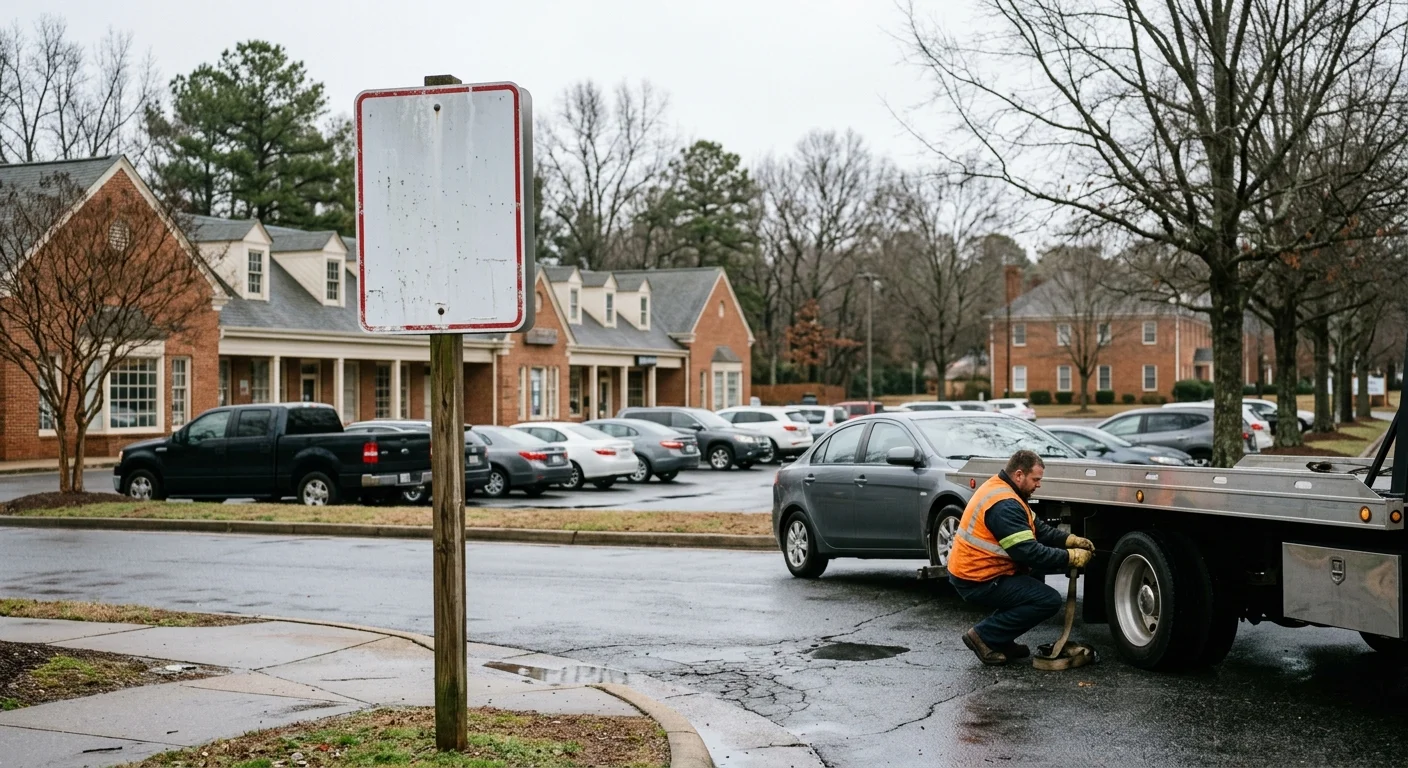
The answer behind virginia tow-away sign requirements is simpler than many property managers expect. Virginia sets no statewide dimensions, letter height, or font size for these signs. Instead, the law focuses on placement, a clear warning, and the required contact information.
Virginia tow-away sign requirements don’t set a size
Virginia law takes a content-and-placement approach. Title 46.2 doesn’t prescribe a sign’s width, height, typeface, or letter size. That means there isn’t one state-approved metal sign template that every parking lot must buy.
Size alone doesn’t decide whether a sign meets the rule. Virginia instead requires a clear and conspicuous disclosure at every entrance to the parking lot or area. The warning must tell drivers that an unauthorized vehicle will be removed, towed, or immobilized.
That distinction matters across Richmond. An apartment lot off Broad Street won’t share the same layout as a Carytown retail lot. A Southside strip center may have several entrances. A Short Pump shopping center may connect with another parking area. The statute applies the same standard to each setting, even though it doesn’t assign measurements.
Property managers should therefore start with the actual entrances, not an online sign catalog. A sign’s visibility, warning, and contact information matter more than a seller’s chosen format. Review the current Virginia towing statutes before relying on a prefabricated sign.
No additional Richmond-specific sign dimension was confirmed from the adopted city fee ordinance. Before printing signs, confirm whether the City of Richmond has added a separate local requirement elsewhere in its current code.
What the statute requires the sign to say
Virginia Code § 46.2-1231 supplies the core rule. Signs must clearly disclose that unauthorized vehicles will be removed, towed, or immobilized. They must appear at every entrance to the parking lot or parking area.
Each sign also needs at least one qualifying phone number. It can show the non-emergency number for the local law-enforcement agency. It can instead show the phone number for the responsible towing operator.
That choice doesn’t change the entrance requirement. A lot with separate entrances from Broad Street and a side road needs signage at both entrances. A warning posted only near the building doesn’t satisfy the statute’s instruction to post at all entrances.
The state rule doesn’t make a logo, decorative border, or particular color the legal test. It also doesn’t replace the required disclosure with a general message such as “customer parking.” The sign needs to communicate the possibility of removal, towing, or immobilization and carry an accepted contact number.
A useful site review starts from a driver’s approach. Identify every entrance and read the proposed warning at each location. Confirm that the wording covers unauthorized vehicles. Then verify that the displayed number belongs to either local law enforcement or the responsible towing operator. Those checks track what the Virginia statute actually requires.
The separate fee list a towing business has to post
The entrance warning isn’t the operator’s fee list. Virginia treats these as separate postings with different purposes and locations.
Under § 46.2-1231, a towing business must prominently display its full list of fees at its main office and at vehicle-recovery sites. Section 46.2-118 also requires fee-list display at the principal office. An operator may not collect more than the posted amount.
An entrance sign tells a driver that unauthorized parking can result in removal. The fee list tells an owner what the towing business charges after removal. Adding a phone number to the entrance sign doesn’t replace the office posting. Likewise, displaying fees at a recovery lot doesn’t excuse missing entrance warnings.
Posted fees must also remain within applicable legal ceilings. For qualifying private-property tows inside the City of Richmond, City Code § 27-302 caps the hookup fee at $195. That rule covers vehicles under 10,000 pounds removed without the owner’s permission at the property owner’s request. The figure is a ceiling, not a promised price.
Virginia separately sets a $210 statewide hookup ceiling for passenger vehicles removed without consent. Localities may establish lower limits, as Richmond has done for covered tows. The statewide fee statute explains that broader ceiling.
Richmond also requires the person accepting payment to provide an itemized receipt. Property managers should confirm that a prospective operator maintains the required postings and documentation before arranging private-property towing.
The 72-hour sign is a different duty
Virginia has another sign rule for vehicles left on private property for an extended period. It shouldn’t be confused with the entrance warning used for ordinary trespass towing.
Under § 46.2-1215, localities may let a property owner request removal after a vehicle has remained more than 72 hours. When a parking lot is normally open to public parking, it must display warning signs describing that 72-hour removal policy.
That sign serves a different purpose. The § 46.2-1231 entrance warning addresses vehicles parked without authorization. The § 46.2-1215 warning concerns the separate 72-hour private-property process. One rule shouldn’t be used as a substitute for the other.
Apartment communities can face a third notice requirement. When a multifamily-dwelling resident’s vehicle is targeted because its registration or inspection has expired, written notice must be posted on that vehicle at least 48 hours before removal. That protection applies to this specific multifamily setting. It isn’t a blanket statewide grace period for expired registration everywhere.
Skipping the required vehicle notice means reimbursing the resident for the tow, along with a civil penalty of up to $100. A general entrance sign doesn’t replace that individual notice.
Before authorizing a removal, identify which legal path applies. Unauthorized parking, a vehicle left beyond 72 hours, and an apartment resident’s expired registration involve different signage or notice duties. Keeping those paths separate prevents one posting from being stretched beyond its legal purpose.
What happens when the signage is wrong
Virginia doesn’t set a standalone fine specifically for a defective tow-away sign. Instead, § 46.2-1231 makes proper signage a condition of the authority to remove a trespassing vehicle without its owner’s permission.
A missing entrance sign, an unclear warning, or absent qualifying contact information therefore reaches the basis for the tow. If the required signs weren’t posted at all entrances, the removal isn’t authorized under that section. The consequence should be understood as loss of towing authority, not an invented automatic fine.
Drivers who find their vehicle missing should document the parking area before leaving. Photograph each entrance and any posted warning. Save the towing receipt and record which contact information appeared. These details preserve what was visible when the vehicle was removed.
The tow operator must immediately notify State Police or local law enforcement after a nonconsent removal. Richmond also publishes a towed-vehicle lookup containing vehicle details and the lot address for 14 days. Our guide to finding a towed car in Richmond explains that process.
Virginia doesn’t run a formal towing hearing. Section 46.2-119 allows an affected consumer to submit a towing complaint to the Division of Consumer Counsel within the Office of the Attorney General. The Attorney General may then pursue a court action. Filing a complaint isn’t the same as receiving an automatic refund or scheduled hearing.
What this means for a Richmond property manager
Start by identifying where the tow would occur. Under § 46.2-1232, the ordinance of the towing locality governs, even if the operator stores the vehicle somewhere else. A Richmond property isn’t governed by Henrico’s rules merely because the recovery lot sits in Henrico.
Use this short review before starting a towing arrangement:
-
Map every entrance to the parking area. Include entrances shared with adjacent lots.
-
Confirm that each sign clearly warns about removal, towing, or immobilization.
-
Check that every sign carries a qualifying law-enforcement or operator phone number.
-
Keep the entrance warning separate from the operator’s posted fee list.
-
For a lot normally open to public parking, review the distinct 72-hour warning rule.
-
At multifamily housing, apply the vehicle-specific 48-hour notice when the issue is expired registration or inspection.
-
Confirm the current ordinance for Richmond, Henrico, or Chesterfield before ordering signs.
The last step matters because Richmond’s City Code § 27-302 addresses fees. It doesn’t set a Richmond-specific sign size, and no separate local measurement could be confirmed, so property managers should check the city’s current rules directly.
Dated photographs of each entrance can also support routine recordkeeping. They aren’t listed as a state sign requirement, but they can show what was posted and when. Repeat that check after construction, landscaping changes, or entrance reconfiguration.
Quick Tow Richmond is a referral service. We connect callers with independent licensed operators rather than performing towing or storage ourselves. The selected operator handles the work and billing directly.
When to call us
When a properly authorized removal needs a licensed operator, or a disabled driver needs emergency towing, our recorded line accepts messages 24/7 and plays a notice before recording. We match callers with independent licensed operators who handle the work and billing directly. Call us at (804) 701-6752.