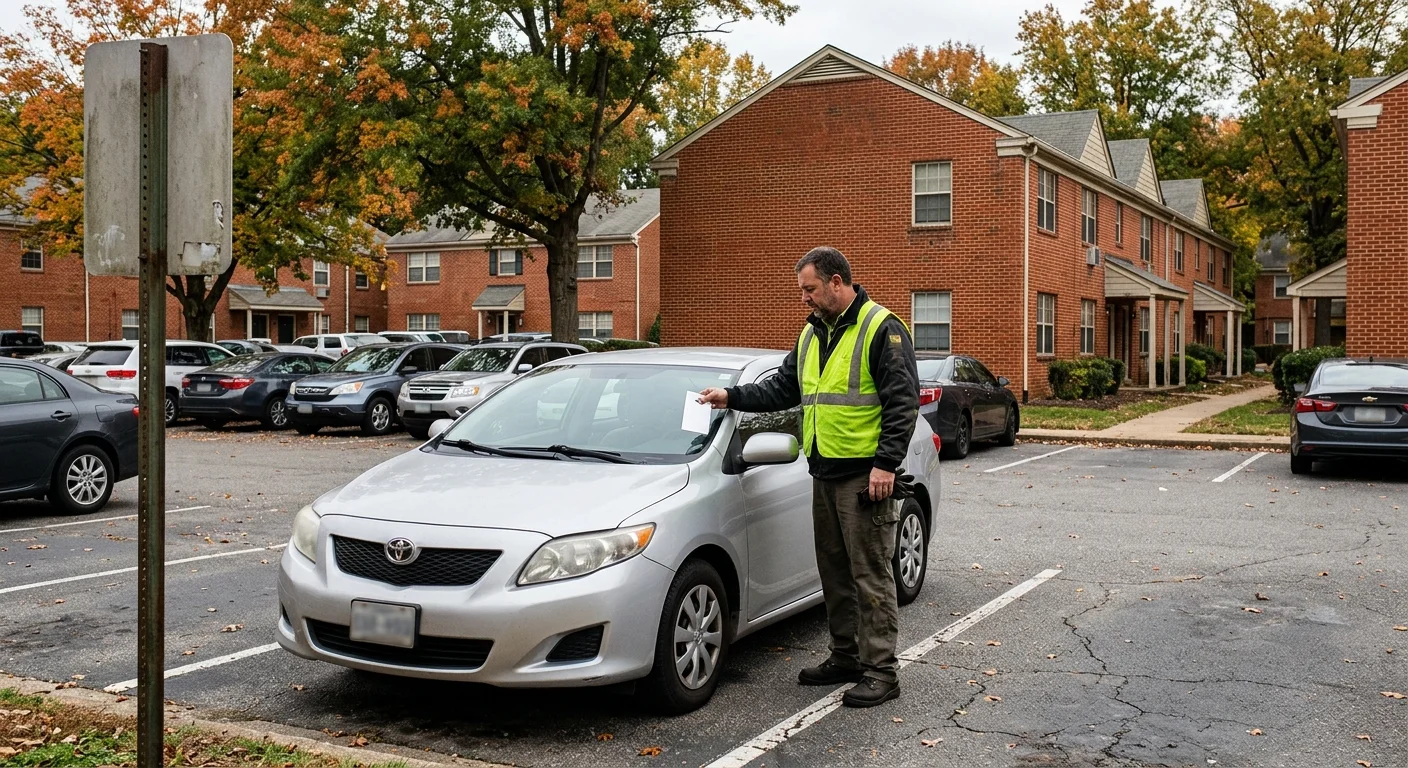
The short answer to “can an apartment tow a guest’s car in Virginia” is yes, when the car is parked without permission and Virginia’s posted-sign conditions are met. Whether one specific guest had permission can’t be settled from state law alone. Check the space markings, entrance signs, guest permit, lease rules, and property manager’s records.
Start with where the guest parked: can an apartment tow a guest’s car in Virginia?
Begin with the exact parking space. A marked visitor space presents a different issue from an assigned resident space. The same applies to a loading area, reserved space, or unmarked corner of the lot.
Don’t assume an empty space was open to every visitor. Also, don’t assume a guest permit authorized parking anywhere on the property. The permit, posted rules, and instructions from the apartment management control that property-level question.
Look for details such as:
- Whether the space was marked for visitors or residents
- Whether the permit matched the vehicle and parking area
- Whether the permit had a date, time, or placement condition
- Whether temporary parking required registration through an app or office
- Whether management gave the resident different instructions in writing
Virginia law doesn’t supply one universal apartment guest-parking policy. It also doesn’t confirm whether a particular permit was valid. The apartment’s lease, parking addendum, posted rules, and management records are the places to check.
This distinction matters across the Richmond metro. A complex inside Richmond city may use different guest procedures from one in Henrico or Chesterfield. The state towing rules still apply, but each property may define its own parking permissions.
If the guest followed instructions given by management, save that evidence. A text, email, permit screenshot, or written parking notice may help establish what permission the guest received. Ask the property manager to identify the rule they believe was violated.
Check the posted rules and guest permit
Virginia Code § 46.2-1231 allows a property owner to remove a vehicle parked without permission only when required warning signs are in place. Signs must appear at all entrances to the parking lot or parking area. They must clearly disclose that unauthorized vehicles may be removed, towed, or immobilized.
The sign must also include contact information for local law enforcement or the responsible towing operator. You can read the relevant rules in Virginia’s towing and trespassing-vehicle laws.
Virginia doesn’t specify sign dimensions, lettering height, or font size in Title 46.2. The legal focus is whether signs were posted at every entrance and clearly disclosed the towing policy. Our guide to Virginia tow-away sign requirements explains that distinction.
Then compare the entrance notice with the guest permit. A sign may establish the property’s general towing policy. It doesn’t, by itself, answer whether this guest had valid permission for that space.
Ask management to explain the permit process that applied that day. Confirm whether the resident had to register the vehicle, display a paper permit, or use a particular visitor area. If the rule isn’t visible, request the current written parking policy.
Virginia provides a separate notice rule for certain resident vehicles at multifamily dwellings. A resident’s vehicle facing removal for expired registration or inspection must receive written notice on the vehicle at least 48 hours before towing. That protection is limited to residents and those two conditions. It shouldn’t be treated as a general notice period for guest-permit violations.
Separate property authorization from towing law
Two questions often get mixed together. First, did the apartment consider the guest authorized to park there? Second, did the property owner and towing operator follow Virginia’s towing requirements?
The first answer usually comes from the property’s documents. Review the resident’s lease, parking addendum, guest instructions, permit, and messages from management. State law doesn’t confirm whether a resident’s verbal invitation overrides the property’s guest-parking process.
The second answer comes from Virginia towing law. Section 46.2-1231 conditions a private property’s towing authority on clear signs at all entrances. Once a vehicle is removed without the owner’s consent, the towing operator must immediately notify State Police or the local law-enforcement agency.
That notification can help locate the vehicle. It doesn’t prove whether the apartment correctly classified the guest as unauthorized. Likewise, a valid entrance sign doesn’t establish that the guest violated a particular permit rule.
The locality where the vehicle was removed also matters. Virginia law allows localities to regulate private-property towing. The ordinance of the towing locality governs even if the vehicle is stored somewhere else.
Richmond city rules shouldn’t be applied automatically to Henrico or Chesterfield. No verified Henrico or Chesterfield fee figure is available in this site’s approved sources. If the tow occurred outside Richmond city, ask the applicable locality and tow yard for the current rules and charges.
Our Chesterfield apartment towing guide covers that county’s recovery path. Quick Tow Richmond can explain the referral process, but it doesn’t decide whether an apartment tow was lawful.
Document the space before the car moves
If the car is still present, photograph the parking area without interfering with anyone. Start at each vehicle entrance. Capture the signs as a driver would see them while entering.
Then photograph the space, pavement markings, nearby notices, permit, and vehicle position. Save the original files with their timestamps. Take wider photos for context and closer photos for readable details.
If the parking authorization came through an app, save screenshots of the registration confirmation. Preserve texts or emails between the guest, resident, and property manager. Don’t edit the images or discard an expired permit. The full record may matter more than one favorable screenshot.
Ask management to identify the parking rule and the person or role that requested removal. They may or may not provide internal records. This request still helps clarify whether the dispute concerns property permission, the posted towing policy, or the operator’s conduct.
If the vehicle has been hooked up but hasn’t left the Richmond property, a specific local rule may apply. Richmond permits a drop fee of up to $40 when the owner or the owner’s agent arrives, claims the vehicle, and pays before removal. That is a ceiling, not a Quick Tow Richmond price or a guaranteed charge.
Don’t apply Richmond’s drop-fee figure to a tow in Henrico or Chesterfield. The approved sources don’t confirm those counties’ current amounts. Ask the operator for the applicable posted fee and confirm which locality’s ordinance controls.
Confirm the recovery process after a tow
First, confirm that the car was towed rather than stolen. For a vehicle removed inside Richmond city, check the city’s official towed-vehicle information. Richmond recommends checking its listing before filing a stolen-vehicle report.
If the vehicle doesn’t appear, call the local law-enforcement non-emergency line. The operator handling a nonconsensual removal must notify State Police or local law enforcement immediately. Have the plate, VIN, vehicle description, parking location, and approximate removal time ready.
Ask the tow yard for its address, current total, accepted payment methods, and release procedure. Towing businesses must display a full fee list at their main office and recovery sites. Inside Richmond, anyone taking payment must provide an itemized receipt.
Fee limits depend on the towing locality. Richmond caps the hookup fee at $195 for a nonconsensual private-property tow involving a vehicle under 10,000 pounds. Virginia’s statewide ceiling for a passenger car is $210, but localities may set lower limits. Neither figure is Quick Tow Richmond’s rate or a promise about the final bill.
Virginia doesn’t allow a storage or safekeeping charge for the first 24 hours or less. Richmond also bars storage charges for periods when recovery was prevented because the towing business was closed.
Request and keep the receipt, fee list, photographs, parking rules, and communication with management. If you believe the operator violated Virginia towing law, the Office of the Attorney General accepts towing complaints. That process is complaint intake, not a guaranteed hearing or outcome. Our guide to Richmond towing rights explains the available protections.
Vehicle owners may also retrieve personal belongings without recovering the entire vehicle or paying a fee for the retrieval visit. Call ahead because Virginia law doesn’t establish statewide access hours.
When to call us
If a property representative has confirmed authority and needs a vehicle removed, an independent licensed towing pro handles the work. Quick Tow Richmond can match callers with local operators through our recorded line, which takes calls 24/7 and plays a recording notice. Learn about private-property towing referrals or call us at (804) 701-6752.