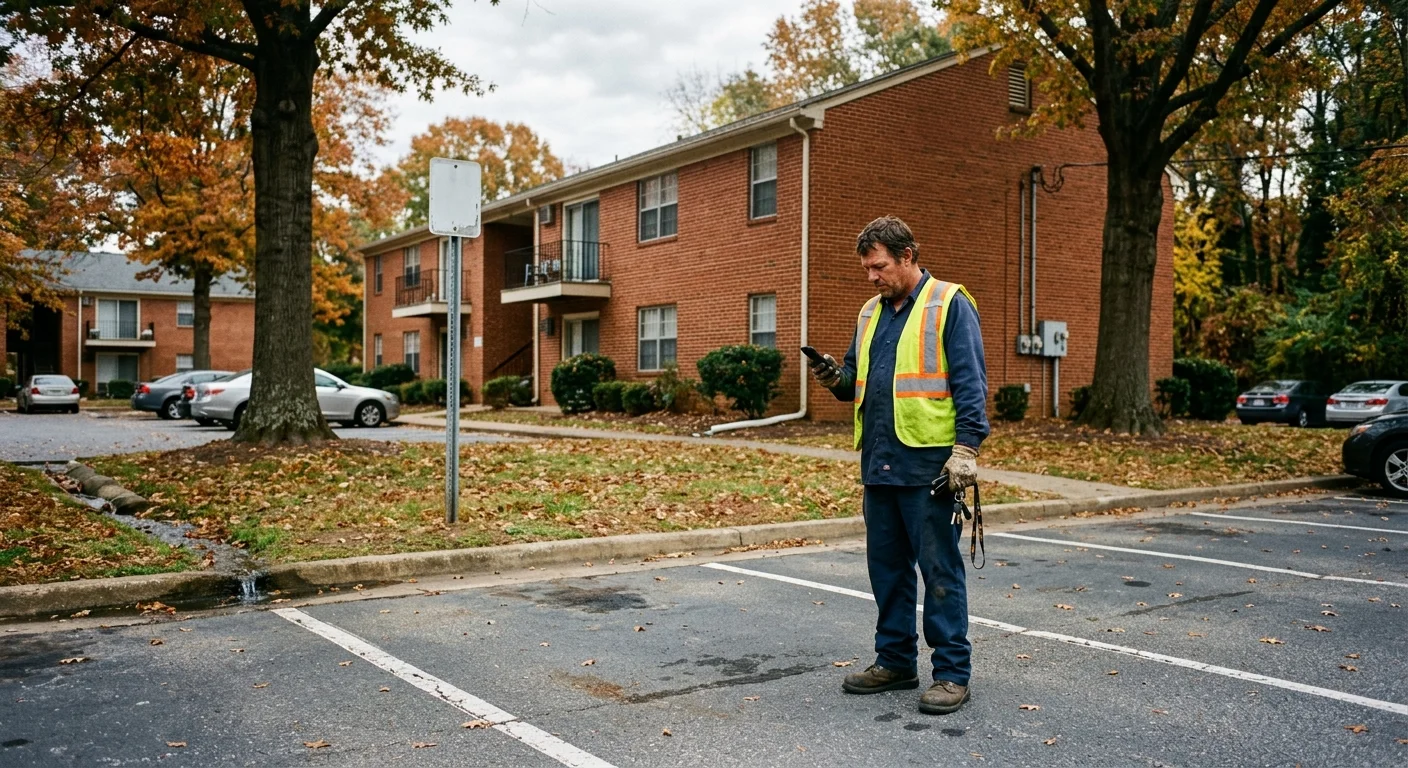
In an apartment towing Chesterfield VA situation, call the leasing office, photograph the entrance signs, then contact Chesterfield Police through its non-emergency channel. Get the operator’s name and recovery lot address before leaving the property. Bring proof of ownership, request an itemized total, and keep every document.
Use this short recovery checklist:
- Ask whether apartment management or police requested the tow.
- Photograph the parking space, entrances, signs, permit, and nearby markings.
- Get the towing operator’s name, lot address, and release instructions.
- Confirm the documents and payment method required for release.
- Save the receipt, photographs, messages, and names of everyone contacted.
Apartment towing Chesterfield VA: confirm who ordered the tow
Start with the apartment’s leasing office or property manager. Ask whether management requested the removal and why. Write down the person’s name and the explanation given. If the office is closed, photograph the towing signs at every parking-lot entrance.
Virginia permits a property owner to remove a trespassing vehicle only when clear warning signs appear at all entrances. Those signs must disclose that unauthorized vehicles may be removed, towed, or immobilized. They must also provide contact information for local law enforcement or the responsible operator. Virginia doesn’t set a statewide sign size, font, or lettering height.
The towing operator must immediately notify State Police or local law enforcement after removing a vehicle without consent. That makes Chesterfield Police’s non-emergency channel an important next step. Ask whether the removal was reported and which operator has the car. Have the plate, VIN, vehicle description, apartment address, and approximate parking time ready.
One apartment-specific protection may matter. When a resident’s vehicle is removed from a multifamily property for expired registration or inspection, written notice must be posted on the vehicle at least 48 hours before removal. Skipping that notice requires reimbursement of the towing charges and may bring a civil penalty of up to $100. That protection applies to this specific reason for removal, not every apartment tow.
These rules come from Virginia’s towing and trespass-removal laws. Our private-property towing guide explains how this type of removal differs from a driver-requested tow.
Find the operator and recovery lot
Chesterfield doesn’t appear to use one centralized county impound lot. For county-directed removals, Chesterfield Police maintains an approved-company list. The vehicle goes to the company serving that rotation. A private apartment tow may involve the operator identified on the property’s signs.
No public online towed-vehicle lookup was found for Chesterfield. That doesn’t prove one doesn’t exist. It means the most reliable verified route is the county police non-emergency channel, followed by the apartment office and the operator shown on the entrance sign.
Ask for the operator’s full business name, recovery address, and instructions. Confirm that the vehicle is physically at that location. Don’t travel based only on a company name, since an operator may use a different recovery site. Ask when the vehicle can be released, what ownership proof is needed, and which payment methods are available.
If police have no record, give them the plate and VIN. The operator’s immediate reporting duty makes that check useful. You can also compare the entrance sign with information supplied by apartment management. Save photographs before a sign, permit notice, or parking-space condition changes.
County lines matter here. Chesterfield’s process isn’t the same as Richmond city’s system. Richmond publishes an online listing, while no equivalent Chesterfield tool was found during the verified research for this page. If the vehicle was actually removed inside Richmond city limits, use our Richmond towed-vehicle finder steps instead.
Quick Tow Richmond can connect drivers with independent tow operators for new towing work. It doesn’t operate an impound lot and can’t authorize another company to release a vehicle.
Bring proof of ownership and accepted payment
Ask the operator exactly what it accepts as proof of ownership. Bring the available ownership document and any identification the lot requests. If someone else owns the car, ask what authorization the operator requires before you travel.
Virginia law says towing operators may not refuse release when the owner tenders cash, an insurance-company check, a certified check, a money order, or a credit card. Confirm the operator’s process before arriving, especially when using a check or card. Don’t rely on an unverified office schedule.
The operator must prominently display its full fee list at its main office and recovery sites. Ask for an itemized bill before paying. Virginia operators must preserve towing records, including itemized fees, for one year. Check the tow date, location, hookup charge, storage period, surcharges, and any administrative line.
We couldn’t confirm a Chesterfield-specific towing fee figure from the verified sources used for this page. Ask the operator which local schedule it applied. If necessary, confirm that schedule with Chesterfield County before treating it as the governing limit.
Virginia’s statewide ceiling for a nonconsensual passenger-car hookup and initial tow is $210. An after-hours or weekend surcharge can be up to $30, with no more than two such surcharges per vehicle. Storage or safekeeping can’t be charged for the first 24 hours or less. Localities may adopt lower limits, so these statewide figures aren’t a quote or guaranteed total. The current ceiling appears in Va. Code § 46.2-1233.1.
Before leaving, inspect the receipt for unclear or duplicated charges. Keep proof of payment and photograph the vehicle’s condition. Our guide to Virginia towing rights covers the statewide protections in more detail.
Retrieve personal belongings without a fee
You don’t have to retrieve the entire vehicle to recover personal belongings. Virginia law bars an operator from refusing access once you provide proof of ownership. The operator also can’t charge a fee for that belongings-retrieval visit.
Call ahead because Virginia doesn’t set statewide access hours. Ask when someone can provide access and which proof of ownership to bring. Make a written list of anything important inside, such as medication, work equipment, house keys, documents, or a child’s car seat.
A towing or storage operator may hold a lien for towing, recovery, storage, and vehicle care. That lien doesn’t extend to personal property or cargo that isn’t attached to the vehicle or necessary for its operation. The applicable lien rule appears in Va. Code § 46.2-644.01.
There’s a separate timing rule when a vehicle is approaching a lien auction. In that situation, the owner must claim and retrieve personal property at least two business days before the auction. This isn’t a general deadline requiring you to empty a car within two days of the tow.
Document the retrieval visit. Note who provided access, when it happened, and whether any item was missing. Don’t sign a statement saying you recovered everything unless you checked carefully. If access is denied or a fee is demanded, request the refusal in writing and keep the operator’s posted fee list.
Our guide on recovering belongings from a Virginia tow yard explains the personal-property and lien rules separately.
Send a complaint through the right channel
Build a clear record before disputing the tow. Save photographs of every parking entrance, the vehicle’s former space, curb markings, permits, and posted notices. Keep communications with apartment management, the operator’s fee list, your itemized bill, and payment proof.
For an expired-registration or inspection tow from a multifamily property, include any evidence about the required 48-hour vehicle notice. For another alleged parking violation, preserve the permit terms and the sign that applied to the space. Don’t assume one apartment rule applies to every removal.
Ask Chesterfield Police whether the nonconsensual removal was reported. Virginia requires immediate notice to State Police or the local law-enforcement agency. Failure to provide that notice is a traffic infraction with a fine of up to $100, and it limits storage charges to one day.
Start a billing dispute by asking the operator to explain each charge in writing. Compare the answer with its displayed fee list and your receipt. If the issue concerns authorization, ask apartment management to identify the parking rule and confirm who requested removal.
A consumer aggrieved by a towing operator’s conduct may file a complaint with the Division of Consumer Counsel in Virginia’s Office of the Attorney General. A specific towing complaint form is available. Virginia doesn’t run a formal towing hearing, and the statute sets no filing or resolution deadline. The Attorney General may choose to pursue relief in circuit court, but filing a complaint doesn’t guarantee that action.
Keep the complaint factual. Include dates, documents, exact charges, and the response received. Separate what you personally observed from what someone told you. That makes it easier for the reviewing office to understand the dispute.
When to call us
Call when the released car can’t be driven and needs a licensed towing pro for relocation. Quick Tow Richmond can match you with an independent operator, but it doesn’t control the impound release. Call us at (804) 701-6752.