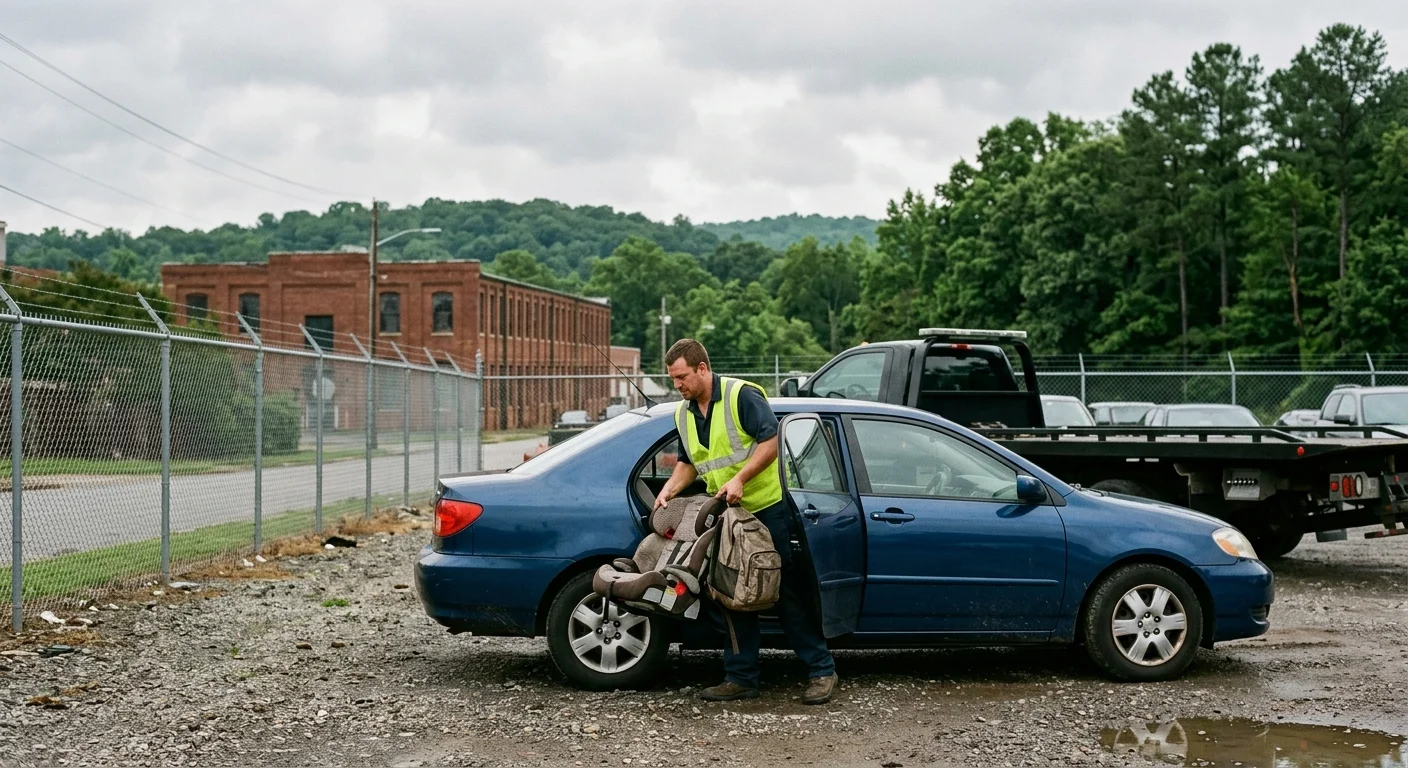
Your work bag, medication, or child’s car seat may still be inside a towed vehicle. If you’re asking “can a tow yard keep your belongings in virginia,” the answer is no. Once you prove ownership, Virginia law lets you access the vehicle and recover personal items without retrieving the car or paying a fee for that visit.
Can a tow yard keep your belongings in Virginia? No, and no fee may be charged for the visit
Virginia treats your vehicle and your loose personal belongings differently. A towing operator can’t refuse access to your personal items once you provide proof of ownership. The operator also can’t make you recover the whole vehicle first.
That means an unpaid towing or storage bill doesn’t remove your right to collect personal belongings. The yard can’t charge a separate fee for the retrieval visit, either.
Start by confirming which operator has the vehicle. Then call the lot before leaving home. Ask when belongings can be collected and what it accepts as proof of ownership. Virginia law establishes the right of access, but it doesn’t establish statewide retrieval hours.
Tell the operator that you’re collecting personal items only. Be clear if the vehicle will remain at the lot. If the tow followed a parking dispute, you can still collect your belongings without resolving the entire dispute during that visit.
A vehicle removed from an apartment complex, store lot, or another privately controlled property may involve additional questions about the tow itself. Our guide to private-property towing in Richmond explains that setting. Your right to recover personal items still comes from Virginia law.
Keep the request focused. Ask for access, present proof of ownership, and remove only personal property covered by the statute. Questions about attached equipment or items needed for the vehicle’s operation require a closer look at the lien rules.
The same right, written into two different statutes
Virginia protects access to belongings through two parts of the Code of Virginia’s towing chapter. Each approaches the problem from a different direction.
Virginia Code § 46.2-118(B)(19) regulates towing operators and tow truck drivers. It makes refusal a prohibited act when an owner proves ownership and asks to recover personal items. The owner doesn’t have to retrieve the vehicle. No fee may be charged for recovering those belongings.
That rule applies to Virginia towing operators generally. It isn’t limited to one Richmond neighborhood or only to private-property removals.
Virginia Code § 46.2-644.01(E) reaches the same result through the keeper’s-lien rules. It says the lien doesn’t extend to personal property or cargo that isn’t attached to the vehicle or considered necessary for its proper operation. The keeper must allow the owner to access the vehicle and recover that property, subject to the statute’s pre-auction timing rule.
One statute governs operator conduct. The other defines what the keeper’s lien can reach. Together, they prevent ordinary personal belongings from becoming collateral for a towing or storage balance.
If the operator disputes your request, identify both sections and ask for the reason in writing. For a wider view of payment, receipts, release, and complaint options, read our guide to Richmond towing rights.
What the keeper’s lien does and does not reach
A towing or storage operator may hold a keeper’s lien for towing, storage, recovery, and care until those charges are paid. That lien can affect the vehicle. It doesn’t automatically reach every item sitting inside it.
The personal-property exception covers property or cargo that isn’t attached to the vehicle and isn’t considered necessary for its proper operation. That distinction is why owners can retrieve ordinary loose belongings without paying a retrieval fee or taking the vehicle home.
Don’t treat the visit as permission to remove vehicle parts or attached equipment. The statute draws a line between personal property and items attached to, or necessary for operating, the vehicle. If there’s disagreement about a particular item, ask the keeper to explain its position before removing it.
The lien process also carries separate notice deadlines. The keeper must notify Virginia DMV within seven business days after taking possession. Once DMV notifies the owner or lienholder, that person has ten business days from the notice to reclaim the vehicle before the keeper may enforce or relinquish the lien.
Those deadlines concern the vehicle and lien process. They don’t create a waiting period before you can request your personal property. Storage charges on a lien-titled vehicle also can’t exceed $500.
The keeper’s lien itself is set out in Va. Code § 46.2-644.01. Keep any notice you receive. It may become important if the vehicle is approaching a sale.
Hours are the real obstacle, not the law
Virginia gives owners the right to recover belongings, but it sets no statewide hours for access. The individual lot determines when it opens for retrieval visits. Calling ahead can prevent a wasted trip across Richmond.
For a Richmond police-directed tow, the vehicle goes to Seibert’s Towing at 642 W. Southside Plaza Drive. It operates the city’s secured tow lot. Richmond also publishes a live towed-vehicle lookup with the make, model, color, partial VIN, partial plate, tow time, and lot address. Entries remain available for 14 days.
Our Richmond towed-car guide walks through that lookup process. Check it before treating the vehicle as stolen. Then contact the listed lot to arrange access.
The process differs outside Richmond city limits. No public online towed-vehicle lookup was found for Henrico or Chesterfield. That doesn’t prove no tool exists. In either county, call the local police non-emergency line with the plate, VIN, or case number.
Chesterfield police-directed tows use companies from the county’s approved rotation rather than one centralized county lot. A private-property tow may also go to a different operator. Confirm the location before traveling.
Once you reach the correct operator, ask about access hours and proof requirements. The law doesn’t force every lot to remain open around the clock. It does prevent the operator from charging you merely to recover personal belongings.
The pre-auction deadline that is not a general rule
The keeper’s-lien statute includes an important deadline when a vehicle is heading toward auction. The owner must claim and retrieve personal property at least two business days before the auction date. After that window, the keeper may dispose of unclaimed personal property.
That doesn’t mean every owner has only two days after a tow. The deadline is measured backward from an auction. It applies during the pre-sale lien process, not to an ordinary belongings request made shortly after removal.
If nobody has mentioned an auction, don’t invent one from the age of the tow. Ask the keeper whether a sale has been scheduled. If it has, ask for the date and arrange the retrieval visit before the statutory cutoff.
Act promptly when you receive a DMV or keeper notice. The keeper must notify DMV within seven business days of taking possession. After DMV sends its notice, the owner or lienholder has ten business days to reclaim the vehicle before lien enforcement may proceed. That vehicle-reclaim window and the two-business-day belongings deadline serve different purposes.
You don’t need to recover the entire vehicle to collect covered personal property. You also don’t need to pay a fee for the retrieval visit. The practical risk comes from waiting until the pre-auction window closes, not from an operator having a general right to keep your loose belongings.
When to call us
Call when a released vehicle needs relocation by a licensed towing professional, or when you need help finding an independent operator. Our recorded line takes calls 24/7 with a recording notice, and the operator contracts with and bills you directly. Call us at (804) 701-6752.