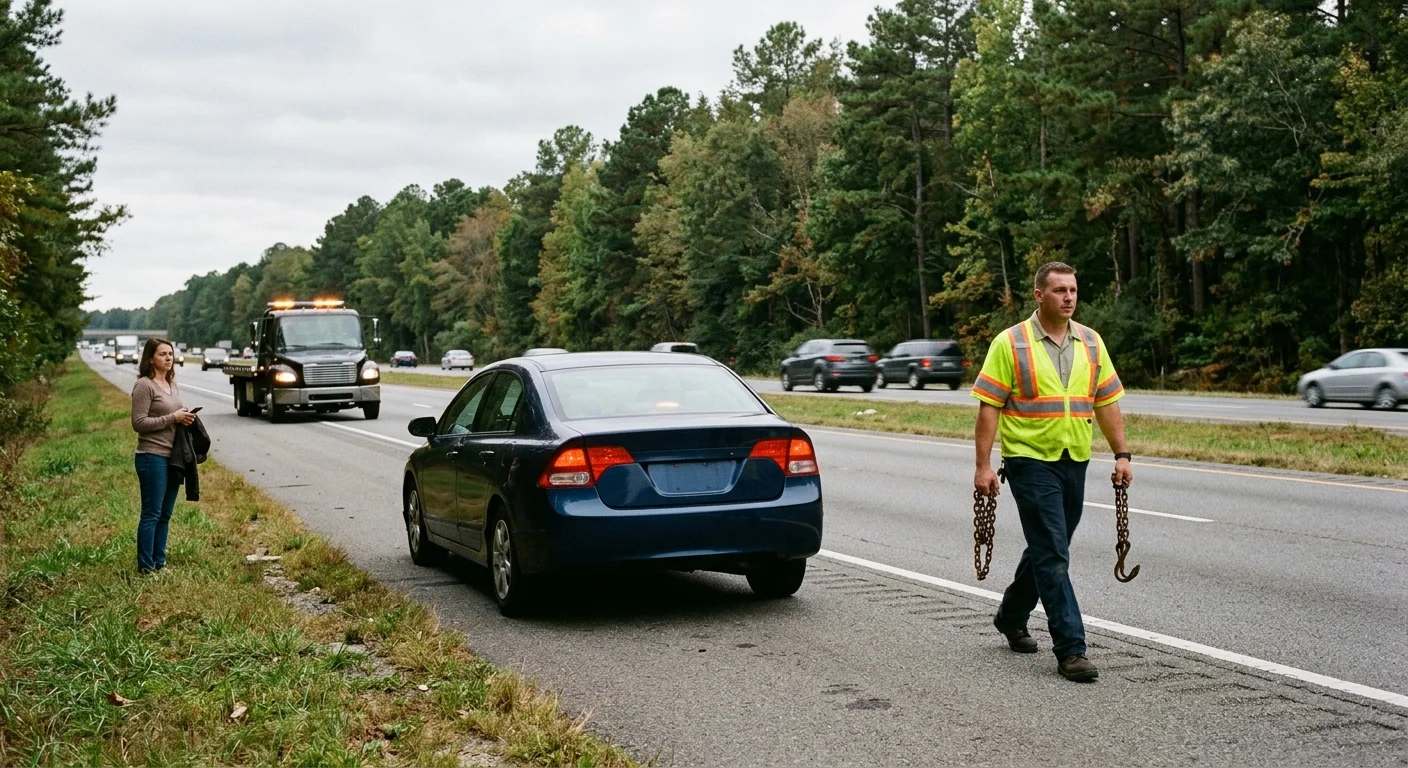
For towing Ashland VA is the starting point, not the full location. After an I-95 breakdown, get away from moving traffic if you safely can, turn on your hazards, and identify your direction and nearest exit before calling. Those details help an operator understand where you’re waiting.
Pinpoint your direction and nearest exit for towing Ashland VA
Start with the road and your direction of travel. “I-95 near Ashland” still leaves two directions and several possible access points. Say northbound or southbound, then give the closest exit or mile marker you can confirm.
Tell the operator whether you’re on I-95, an interchange ramp, Route 1, or a town street. A ramp matters because the entrance may come from a different road. If you’ve already left the interstate, provide the street name and a nearby address or landmark.
The I-95 and I-295 interchange is at mile 84 in Hanover County. Mention it if that’s the closest confirmed reference. Don’t guess an exit number from memory. Check your phone’s map, a roadside marker, or the last sign you passed.
A dropped map pin can help, but add plain directions too. State which side of the road you’re on. Explain whether the vehicle is fully on the shoulder, beside a ramp, or still close to a travel lane. If you moved away from the vehicle, say where you’re waiting.
Check 511 Virginia for current incidents and road conditions. A closure or traffic backup may affect which direction an operator can approach. Don’t leave your safe waiting place just to find a better landmark.
Decide whether roadside help may be enough
Not every breakdown requires a tow. A flat tire, empty fuel tank, drained battery, or overheated radiator may be handled with basic roadside help. The safest choice depends on the vehicle’s condition and where it stopped.
VDOT’s Safety Service Patrol provides free roadside assistance on covered interstates, including Richmond-area sections of I-95, I-64, and I-295. Patrol services can include a tire change, fuel delivery, jump start, radiator water, directions, or help arranging a tow.
The patrol doesn’t make mechanical repairs or act as a tow company. Its role is roadside assistance and incident management. A vehicle that still can’t be driven safely will need an independent towing operator.
Verified daytime patrol hours are 5:00 a.m. to 9:00 p.m. The overnight I-95 route runs from the I-295 interchange at mile 84 south to Route 10 at mile 61. Don’t assume that overnight segment covers a location north of mile 84 near Ashland.
You can’t treat the patrol like a scheduled towing appointment. If help arrives and resolves the immediate problem, you may not need a tow. If the car still won’t move, continue arranging emergency towing.
Our broader I-95 breakdown guide covers the general roadside checklist. Near Ashland, the immediate priority is giving a precise location and deciding whether simple roadside help can make the vehicle roadworthy.
Describe the vehicle and what stopped it
Give the operator a short, factual description. Start with the vehicle’s year, make, model, and color. State whether it’s a passenger car, pickup, van, motorcycle, or another vehicle type.
Describe what happened without trying to diagnose it. Useful details include:
- The engine stopped while driving.
- The vehicle won’t restart.
- A tire or wheel appears damaged.
- The car was involved in a collision.
- The vehicle left the pavement.
- The steering, brakes, or transmission aren’t working normally.
- The keys are present or unavailable.
Mention visible damage and anything hanging beneath the vehicle. Tell the operator if a wheel won’t turn or the vehicle can’t roll. The independent operator can use that information to determine the appropriate towing method and equipment.
Location conditions matter too. Explain whether the vehicle is on a paved shoulder, grass, soft ground, a slope, or against a barrier. Say if it faces the wrong direction or sits at an angle. Don’t attempt to reposition a disabled vehicle beside moving traffic.
Tell the operator whether anyone remains with the car. Mention passengers, children, or animals who may need a safer waiting arrangement. If there’s an immediate danger, prioritize emergency assistance before arranging the tow.
Clear information prevents avoidable confusion. It also lets the operator discuss the job before accepting it. Don’t accept an arrival promise based on incomplete vehicle or location details.
Choose a destination before the operator leaves
Decide where the vehicle should go while you’re arranging the tow. Common choices include a nearby repair shop, your home, a dealership, or another place you control. Have the full destination address ready.
Call the destination before committing when possible. Confirm that it can receive the vehicle and ask where it should be placed. An open business may use a different entrance for disabled vehicles. After-hours delivery may also require instructions from the property.
A nearby shop can reduce travel distance, but proximity isn’t the only concern. The shop must handle the problem and accept the vehicle. Taking the car home may give you more time, though it could require another tow later.
Our guide on whether to tow to a nearby shop or take the car home compares those choices. If the destination sits well beyond Ashland or Richmond, review the details of long-distance towing before agreeing.
Tell the operator about access at the destination. A narrow driveway, parking garage, locked gate, steep grade, or restricted lot may change the plan. Don’t assume the operator can leave a vehicle anywhere on private property.
The operator should know the destination before departing the pickup point. Mileage and destination affect the full charge, so changing the address during the trip can change the total.
Confirm the full charge before dispatch
Ask the independent operator for the full expected charge before accepting service. The answer should address the hookup, mileage, destination, roadside access, vehicle condition, and any recovery work. Ask which circumstances could change that amount.
A public Ashland or Hanover County price for a driver-requested breakdown tow couldn’t be confirmed. That means a local government figure shouldn’t be presented as your expected charge. The independent operator contracts with you and bills you directly.
Virginia’s $210 statewide hookup ceiling applies to a passenger car towed without consent from private property. It isn’t a quoted price for a driver-requested I-95 breakdown tow. The statute also permits localities to set lower limits for the nonconsensual towing covered by that law.
Keep those legal ceilings separate from the service quote. Ask the operator to state the full total with mileage included. If part of the job can’t be priced until the vehicle is inspected, ask what condition would trigger an added charge.
Confirm the destination address again. Make sure the operator understands whether the vehicle is on I-95, Route 1, a ramp, or a town street. Ask what payment methods the operator accepts before the vehicle moves.
Quick Tow Richmond doesn’t perform the tow or set the operator’s total. We connect callers with independent licensed towing operators. The operator then confirms the job, contracts with the driver, and handles payment directly.
When to call us
When roadside help can’t make the vehicle roadworthy, a licensed towing operator should move it. Quick Tow Richmond’s recorded line takes calls 24/7, and a notice plays before your message is recorded. We’ll connect you with an independent operator who contracts with and bills you directly. Call us at (804) 701-6752.