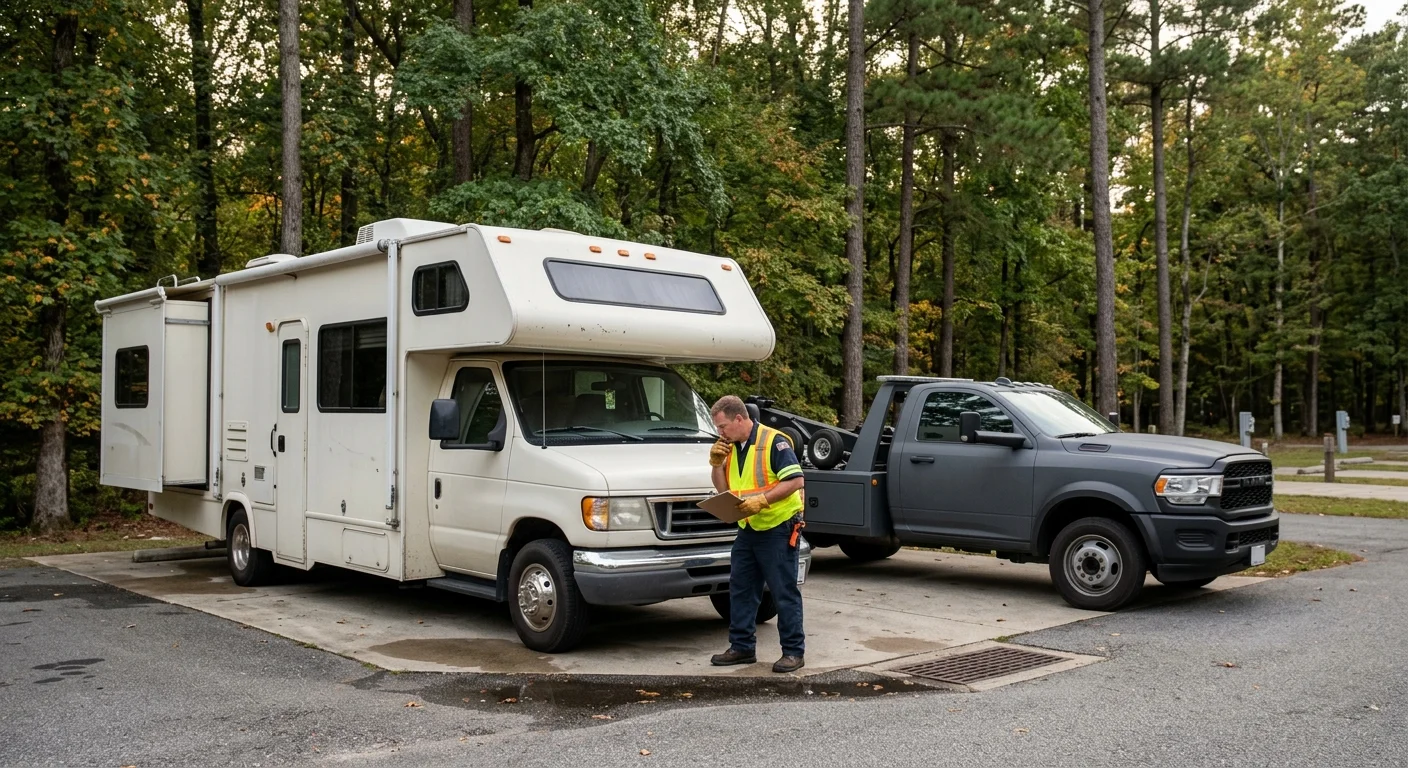
A slide-out that won’t retract changes the towing decision immediately. The answer to “can an RV be towed with slide-outs stuck” depends on an operator assessing that exact RV. The operator may approve movement, require another step, or decline the tow as presented.
Tell the operator which parts won’t retract: can an RV be towed with slide-outs stuck?
Start by describing the RV and the stuck section clearly. Say whether it’s a motorhome, fifth-wheel, or travel trailer. Identify each slide-out that won’t close and which side it’s on.
Describe the position without trying to diagnose the failure. Is the slide fully extended, partly retracted, or sitting unevenly? Mention loose panels, visible damage, or anything hanging from the body. Tell the operator whether the problem followed an impact, a power issue, or ordinary campsite use.
Your location matters too. Give the full pickup address or your position along the highway. On I-95, I-64, or I-295, include your direction and nearest known exit. A northbound shoulder near Chester requires different access information than a storage property in Richmond.
Send clear exterior photos if the operator accepts them. Capture the slide from the front, side, and rear. Include nearby fences, trees, parked vehicles, gates, and buildings. Photos provide context, but they don’t replace the operator’s assessment.
Our RV and trailer towing service connects callers with independent operators. Explain the condition completely before accepting a plan. “The slide is stuck” alone doesn’t give the operator enough context.
Check the RV manual before changing anything
Find the manufacturer’s manual for the exact RV and slide-out system. Look for sections covering travel, towing, emergency operation, or a slide that won’t retract. Use the manufacturer’s wording when you describe any warning or procedure.
Don’t treat a generic online repair tip as instructions for your RV. Avoid cycling controls, removing hardware, or pushing the slide solely to prepare for a tow. A procedure written for another model may not match your unit.
If the manual provides model-specific directions, note the page and share them with the operator. You can also photograph relevant warning labels and model information. That gives the operator material tied to the RV in front of you.
When the manual isn’t available, say that plainly. The manufacturer or an RV dealer may be able to identify the correct document. Don’t guess at a clearance limit, retraction method, or transport position.
The manual doesn’t replace the towing assessment. It explains what the manufacturer says about that unit. The operator still decides whether the RV can move in its current condition. They may also require a repair technician to address the slide before towing begins.
Why the vehicle’s condition changes the plan
The tow decision isn’t only about the extended slide. Give the operator a complete picture of the RV’s current condition. Small observations can prevent confusion when the equipment reaches the pickup site.
Say whether the wheels appear straight and whether any tire looks damaged. Mention visible body damage, leaning, leaking fluid, or debris around the RV. For a towable camper, describe the hitch area and its condition. For a motorhome, say whether the keys are available and whether the steering and parking controls respond.
Don’t choose the towing equipment yourself. The operator needs to classify the vehicle and decide what can handle the job. If the operator places the RV in a heavier service category, our heavy-duty towing page explains how to request that connection.
A clear assessment may end with a firm “not yet.” That means the RV needs another step before movement, not that every stuck slide-out creates the same result. Ask what condition must change before the operator will proceed.
If you’re stopped on I-95, I-64, or I-295, VDOT Safety Service Patrol provides free roadside assistance and incident management. It doesn’t perform mechanical repairs or act as a towing company. Patrol staff can help move a disabled vehicle from the roadway and help arrange a tow.
Describe access at pickup and destination
The operator needs to understand both ends of the trip. A Richmond storage lane, a Chester campground, and a Colonial Heights driveway raise different access questions.
Describe the pickup surface and entrance. Mention gates, tight turns, overhead branches, utility lines, parked vehicles, soft ground, and sloped pavement. State which direction the extended slide faces. If a posted clearance or gate measurement is visible, photograph it. Don’t offer a guessed measurement as fact.
The destination needs the same attention. Confirm that it can receive the RV in its current condition. Ask the property contact about its entrance, operating hours, and intended unloading spot. Tell the operator about those details before the RV leaves.
Route information also matters. Trips through Richmond may encounter the I-95 and I-64 overlap near the Bryan Park interchange. Check 511 Virginia for current traffic, incidents, and road conditions. Let the operator decide whether the slide’s position affects route selection.
For a camper near the Tri-Cities, our guide to a camper-trailer breakdown in Colonial Heights covers the information worth gathering before requesting help. The same principle applies here: describe the actual location, not just the nearest city.
Confirm the operator’s plan before dispatch
Ask for a clear decision about the RV as it sits. Will the operator accept it in the current configuration? Does the slide need attention first? Who is responsible for that step?
Confirm the pickup point, destination, RV type, and affected slide-out. Ask what equipment category the operator plans to use. Repeat any access restrictions and manufacturer instructions you’ve found. If something remains uncertain, resolve it before agreeing to movement.
Discuss price directly with the independent operator. Ask for the full quoted total, including mileage and any work related to the RV’s condition. Our Richmond RV towing cost guide explains the questions to ask, but it can’t quote a specific stuck-slide job.
Quick Tow Richmond is a referral service. We connect callers with independent towing operators who contract with and bill drivers directly. The operator controls the technical plan, equipment choice, and final quote.
Leave room for the operator to decline the job after reviewing new information. A phone description or photo may not reveal every condition at the site. The useful answer is a clear plan tied to the actual RV, not a blanket promise about every extended slide-out.
Frequently asked questions
Can I retract the slide-out manually before towing?
Check the manufacturer’s manual for instructions tied to your exact RV. Don’t improvise a procedure from another model. Tell the operator what the manual says and ask whether another professional must handle the slide first.
Will every stuck slide-out require heavy-duty towing?
There isn’t one equipment answer for every RV. The operator must consider the vehicle, its condition, the slide position, and site access before selecting a service category.
Are photos enough to approve the tow?
Photos help explain the RV and its surroundings. They aren’t a substitute for the operator’s assessment. Include wide views of the site and close views of the affected slide without guessing at dimensions.
When to call us
Call a licensed towing pro when the slide won’t retract and you need a towing decision for the RV in its current condition. Quick Tow Richmond connects you with an independent operator, and our recorded line takes calls 24/7 with a recording notice. Call us at (804) 701-6752.