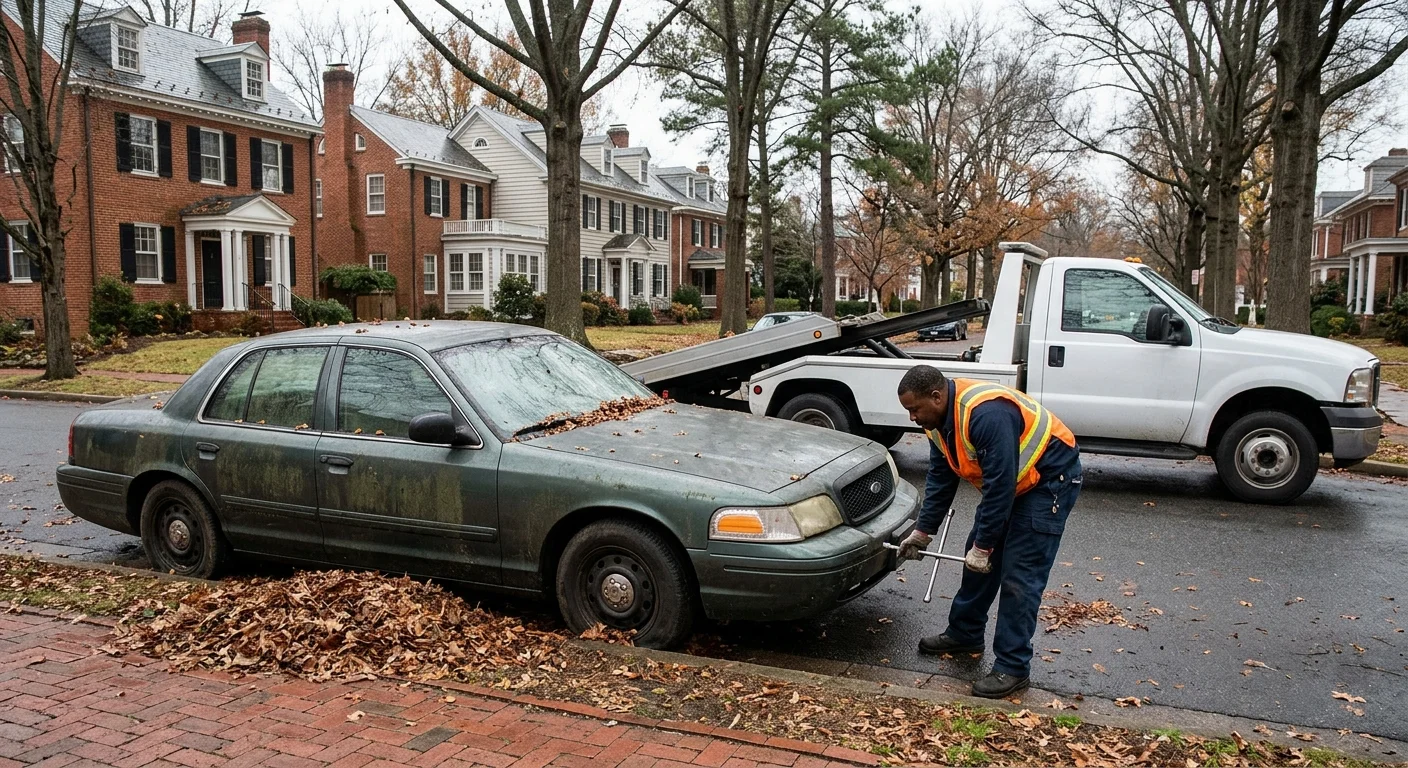
For abandoned vehicle removal in Richmond, report a street vehicle to local government or law enforcement. A private towing company can’t decide alone that a vehicle on public property is abandoned. The correct process depends on its location and why removal is needed.
Abandoned vehicle removal in Richmond: what Virginia counts
Virginia’s definition starts with the vehicle and its location. Under Title 46.2, Chapter 12, an abandoned vehicle can be a motor vehicle, trailer, or semitrailer weighing at least 75 pounds.
On public property, it must sit unattended for more than 48 hours. It must also violate a law or ordinance. On private property, it must remain more than 48 hours without the property owner’s consent. A vehicle left unattended on the shoulder of a primary highway also falls within the definition.
Those details matter around Richmond. A car at the curb isn’t handled like one left behind a private building. A vehicle on a highway shoulder follows a different part of the definition from one sitting on public property beyond the 48-hour line.
The City of Richmond includes abandoned vehicles among its published reasons for city-directed towing. If the vehicle disappears after being reported, check the city’s Towed Vehicles lookup before treating it as stolen. The listing includes the make, model, color, partial VIN, partial plate, tow time, and lot address. Entries remain online for 14 days after a tow.
The 48-hour definition doesn’t give every person authority to remove a vehicle. It identifies the abandoned-vehicle pathway. The removal authority, notice process, and disposal steps still have to follow.
This is not the same pathway as a trespass tow
Virginia has several removal pathways with different thresholds. Mixing them can lead to bad instructions for property owners and vehicle owners.
The abandoned-vehicle process uses the definition in § 46.2-1200. Its key threshold is more than 48 hours in the qualifying public-property or private-property situations. It then moves through DMV search, notice, reclaim, and auction steps.
Section 46.2-1215 creates another private-property route. A locality may let a property owner request removal after a vehicle remains more than 72 hours. Lots normally open for public parking must display warning signs about that policy. An unclaimed vehicle must then be held at least 60 days after diligent search and notice before final disposal. Its disposition must be reported to DMV.
Those 72-hour and 60-day periods don’t replace the abandoned-vehicle timeline. They belong to a separate process. A nonconsensual private-lot tow may also rely on § 46.2-1231, which requires clear towing notices at every entrance.
Start by identifying the actual situation. A vehicle left in a posted customer lot may involve private-property towing. A vehicle that an owner wants to surrender follows the Virginia junk-car process. A suspected abandoned vehicle on a public street must go through the proper public authority.
Location isn’t a small detail here. It determines which process can apply.
Who is allowed to remove one from a public street
Section 46.2-1200.3 limits who may remove or sell an abandoned vehicle from public property. The person must act under an agreement with a local government entity or law-enforcement agency. That person must also have actual possession of the vehicle.
This means an ordinary private company can’t spot a car on a Richmond street, label it abandoned, and remove it on its own. The public authority comes first. Quick Tow Richmond can’t bypass that requirement by sending an operator after a caller reports the vehicle.
Richmond handles police-directed towing through its exclusive towing contractor. The city doesn’t operate its own municipal impound yard. Its public lookup helps owners determine whether a city-directed tow occurred and where the vehicle was taken.
Virginia also provides local removal authority under § 46.2-1213. A locality may authorize law enforcement or code-enforcement staff to direct removal when a vehicle creates a traffic hazard, is illegally parked, or sits unattended without permission for more than 10 days. The same section covers a vehicle immobilized on a public road by weather or an emergency.
That is a third mechanism, separate from the abandoned-vehicle definition and the private-property route. A stalled vehicle obstructing traffic near downtown isn’t handled solely by waiting through an abandonment period.
Report a public-street vehicle to the jurisdiction responsible for that street. Give its location, appearance, and identifying details you can see safely. The authority decides whether removal is permitted and which operator may perform it.
The DMV search, the certified notice, and the 15 days
Once a qualifying abandoned vehicle is possessed through the proper process, § 46.2-1202 requires a title and lienholder search through the Virginia DMV. The search fee is $40. That fee is waived for local-government agencies operating under a DMV agreement.
DMV then notifies the registered owner and lienholders by certified mail. For a standard vehicle, the owner has 15 days from the date of that notice to reclaim it. A manufactured or mobile home has a 120-day reclaim period.
If the standard 15-day period passes without reclamation, the owner waives all right, title, and interest in the vehicle. The clock runs from DMV’s notice date. It doesn’t run from when a neighbor first noticed the car, when someone reported it, or when a warning appeared nearby.
That distinction protects the process from guesswork. The person reporting the vehicle doesn’t perform the title search or declare that ownership has been lost. Those steps belong to the authorized possessor and DMV.
Vehicle owners should keep their registration, title information, and current mailing address in order. Anyone receiving a certified DMV notice should read it promptly and contact the listed possessor about reclamation.
Property owners shouldn’t treat an unanswered note under a windshield wiper as a substitute for DMV notice. The statutory process uses a records search and certified notice to reach owners and lienholders before disposal can continue.
The 21-day auction notice, and what happens if nobody buys
The end of the reclaim period doesn’t permit immediate disposal. Section 46.2-1202.2 adds another notice stage before an abandoned vehicle can be auctioned.
After the reclaim window passes, or after a diligent search fails, the possessor must post an intent-to-auction notice for at least 21 days. That notice is posted electronically in the manner prescribed by the DMV Commissioner. It must include the vehicle’s VIN and a description.
This 21-day auction notice follows the abandoned-vehicle reclaim process. It isn’t the same as the 72-hour private-property threshold or the 60-day hold under § 46.2-1215. Combining those periods would create a timeline Virginia law doesn’t provide.
If the vehicle doesn’t sell at auction, the possessor may apply for title. That application requires a Vehicle Removal Certificate, a receipt, applicable fees and taxes, and a written statement that the vehicle didn’t sell.
A Vehicle Removal Certificate is also known as Form VSA 40. Virginia uses that form when an owner voluntarily transfers a vehicle to a licensed demolisher or scrap metal processor. However, voluntary junk car and abandoned vehicle removal isn’t a shortcut around the public abandoned-vehicle procedure.
The practical dividing line is ownership and authority. An owner surrendering a vehicle can start the proper transfer process. Someone dealing with an unknown vehicle on a street or another public area must begin with the responsible government or law-enforcement agency.
Henrico’s Tag N Tow, and what Chesterfield does instead
Henrico uses its Tag N Tow Program for abandoned or inoperable vehicles on public rights-of-way. Community Maintenance or Police place a brightly colored warning tag on the vehicle. They reinspect after 48 hours and arrange towing if it hasn’t moved.
Henrico also limits outdoor inoperable vehicles on private property. Only one is allowed, and it must be screened from view. A tarp doesn’t qualify as screening. A violation can carry a civil penalty of up to $500.
The Tag N Tow process gives Henrico residents a clear local starting point. Contact Community Revitalization through the county’s published hotline or online information. If you can’t find a public Henrico towed-vehicle lookup, use the county’s current contact instructions rather than assuming a vehicle’s location.
Chesterfield works differently. The county doesn’t appear to operate one centralized impound lot. Chesterfield Police maintains a list of approved towing companies, and county-directed tows go to the company serving on that rotation.
There’s no Chesterfield lookup we can point you to either. Call the county’s published police non-emergency contact with the plate, VIN, or case number. That route is more reliable than calling individual lots without knowing which company received the tow.
These jurisdictional differences matter across the Richmond metro. Richmond uses its city contractor and online listing. Henrico has Tag N Tow. Chesterfield uses an approved-company rotation. Start with the city or county where the vehicle sits, not the owner’s mailing address.
When to call us
Call after you have authority to remove the vehicle, or when you own it and need a licensed towing operator. Quick Tow Richmond matches callers with independent licensed operators who contract with and bill drivers directly. The recorded line takes calls 24/7, with a recording notice before your message: Call us at (804) 701-6752.