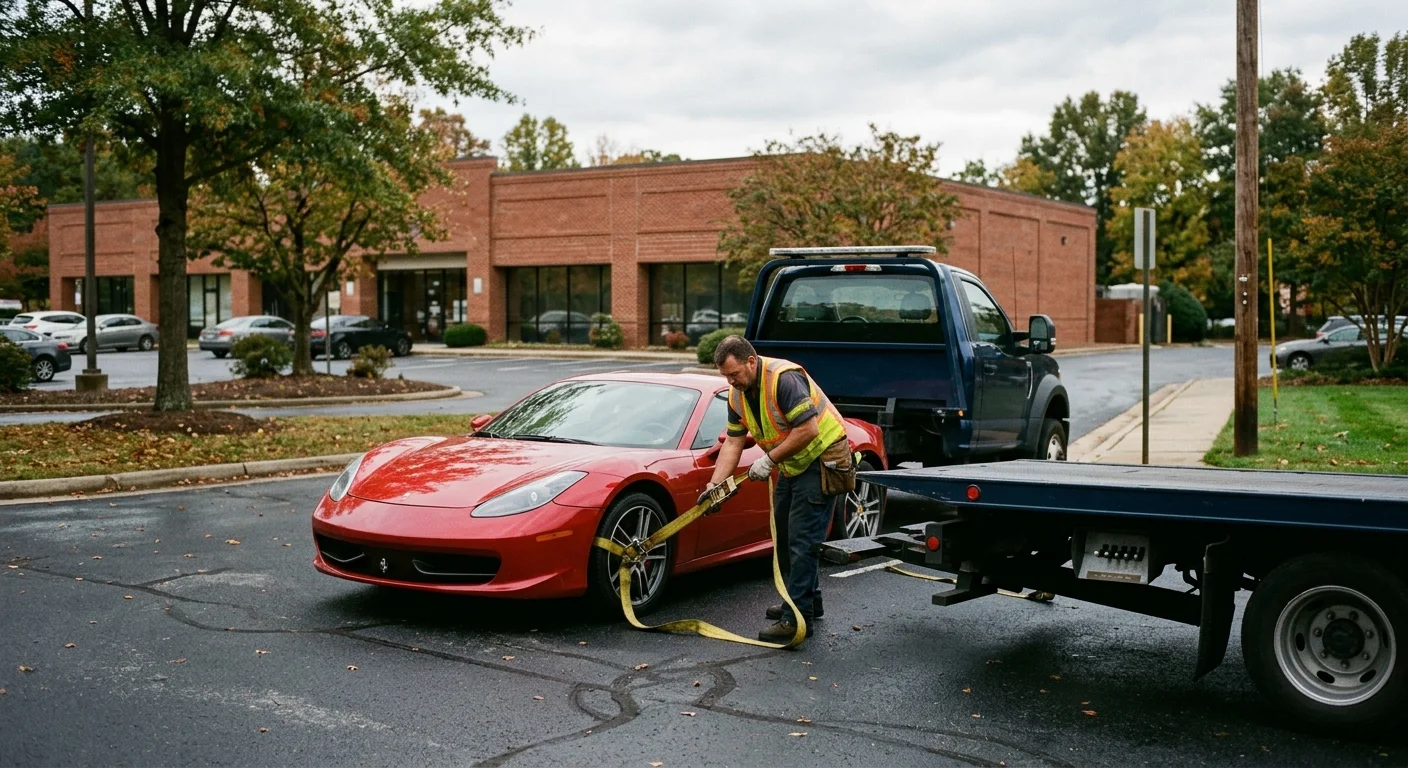
For exotic car towing Midlothian VA, start by giving the operator exact facts about the car, its clearance, its wheels, and the pickup space. The owner’s manual should guide every model-specific towing decision. Quick Tow Richmond refers the request to an independent operator, who handles the tow and bills you directly.
Report the vehicle’s exact condition for exotic car towing Midlothian VA
Begin with the make, model, model year, and exact pickup location. Then describe what happened before the car stopped moving. Don’t try to diagnose the problem for the operator.
Share what you can observe. Say whether the engine turns over, warning lights appear, or the electrical system responds. Mention any visible fluid, body damage, flat tires, or loose parts. If you already know a wheel won’t turn, say which wheel. Don’t test anything the owner’s manual tells you to leave alone.
The operator also needs to know whether you have the key. State whether the steering, transmission controls, and parking brake respond normally. An electrical failure may change what the car allows you to operate. Follow the manual instead of forcing a control.
Give the exact location within the property. “A Midlothian parking deck” isn’t enough. Include the level, entrance, nearby intersection, and whether the car faces a wall or curb. Photos of the car and surrounding space can make the layout clearer.
Our exotic and classic vehicle towing service connects owners with independent operators for these requests. If you’re deciding whether this job differs from an older collector vehicle, our guide to classic car towing in Richmond covers that separate situation.
Explain clearance and wheel concerns
Low bodywork changes the conversation before the operator reaches the car. Describe any front splitter, side skirt, diffuser, or other low component you can see. Mention aftermarket bodywork or suspension changes, since the factory manual may not account for them.
Don’t guess at the car’s ground clearance. If the manufacturer publishes a measurement for your exact configuration, share that source. Otherwise, send clear photos from the front, rear, and both sides. Include the pavement around the tires and the path toward the exit.
Wheel condition matters too. Tell the operator about flat tires, damaged wheels, locked steering, or controls that don’t respond. If you don’t know whether the wheels can roll, say that plainly. The operator can consider the condition when planning the job.
A request for flatbed towing should still include these details. The word “flatbed” doesn’t describe the parking space, the car’s current condition, or its model-specific transport rules. Ask the operator to explain the proposed loading plan after reviewing that information.
Don’t supply your own loading angle, strap arrangement, or attachment instructions. Those details must fit the vehicle, the towing equipment, and the manufacturer’s guidance. Your most useful role is providing accurate information and flagging anything unusual before work begins.
Check model-specific towing guidance
Open the owner’s manual before confirming the transport plan. Use the printed manual, the manufacturer’s official digital manual, or its customer-support channel. Search for sections covering towing, vehicle recovery, or emergency transport.
The instructions can differ by model and configuration. Look for guidance about transmission position, parking-brake release, steering, suspension settings, and any manufacturer-provided towing attachment. Some manuals also address what to do when electrical power isn’t available. Only follow features and procedures documented for your exact vehicle.
Send the relevant manual pages to the operator when possible. A screenshot is more useful than a description recalled from memory. Keep the manual available during pickup in case the car responds differently than expected.
If the car has been modified, identify those changes separately. Wheels, bodywork, suspension, and other additions may differ from the factory configuration. Don’t assume the manual covers a part that wasn’t installed by the manufacturer.
Electric vehicles need the same model-specific approach. Our explanation of whether Teslas can be towed normally shows why the exact model instructions matter. That article isn’t a substitute for the current manual in your car.
If the manual’s directions and the proposed plan don’t match, pause. Ask the operator to review the manufacturer guidance before proceeding. A clear answer before loading is better than making assumptions beside the car.
Describe access before the operator arrives
Midlothian pickups often begin in parking decks, shopping areas, office lots, and residential driveways. Each setting creates a different access problem. Describe the actual site instead of sending only a street address.
For a parking deck, note the posted entrance clearance, level, ramp layout, and gate arrangement. Say whether columns, curbs, parked cars, or a tight turn sit near the vehicle. If an attendant controls entry, confirm how the operator should enter.
In a shopping area along Midlothian Turnpike, identify the correct driveway and the car’s position within the lot. Large properties can have several entrances. A dropped map pin and current photos can prevent confusion about which side contains the car.
At a house, describe the driveway surface, slope, width, and nearby parked vehicles. Mention a gate, narrow turn, low branch, soft ground, or blocked exit if you see one. Don’t promise that equipment will fit. Give the operator enough information to assess access directly.
Traffic or an incident may affect the planned approach. 511 Virginia publishes current traffic and road-condition information for Virginia routes. Check it before the pickup, especially when the route crosses busy Chesterfield roads.
Keep your phone nearby after leaving a message. If access changes, update the operator. A delivery truck, closed gate, or newly occupied parking space can change the layout you first described.
Confirm the loading plan and destination
Before agreeing to the job, repeat the important details with the operator. Confirm the exact vehicle, current condition, wheel concerns, clearance issues, pickup location, and destination. Ask what equipment the operator proposes after reviewing those facts.
The plan should also account for the owner’s manual. Confirm that the operator has received any relevant pages or manufacturer instructions. If a control doesn’t work when the operator arrives, explain what changed. Don’t attempt an improvised workaround.
Choose the destination before loading begins. It may be your home, a dealer, or a repair facility that accepts the vehicle. Contact that destination directly. Confirm its address, entrance, receiving process, and availability when the car is expected.
Ask where the vehicle will be placed after delivery. A locked gate or unavailable receiving contact can complicate the handoff. Share any access instructions with the operator, but don’t send private entry codes until you know who needs them.
Discuss cost with the independent operator before agreeing. Ask for the estimated full total with mileage included. Also ask what vehicle condition, access issue, or destination change could alter that estimate. Quick Tow Richmond doesn’t set the operator’s total. The operator contracts with you and bills you directly.
Save the operator’s contact information and the destination details. Take current photos of the car if practical. These steps create a clear record of what you reported and where the vehicle should go.
When to call us
If your exotic won’t start, has limited clearance, or can’t be moved as its manual directs, the request needs a licensed towing pro. Quick Tow Richmond refers requests to independent operators, and our recorded line takes messages 24/7. Call us at (804) 701-6752.