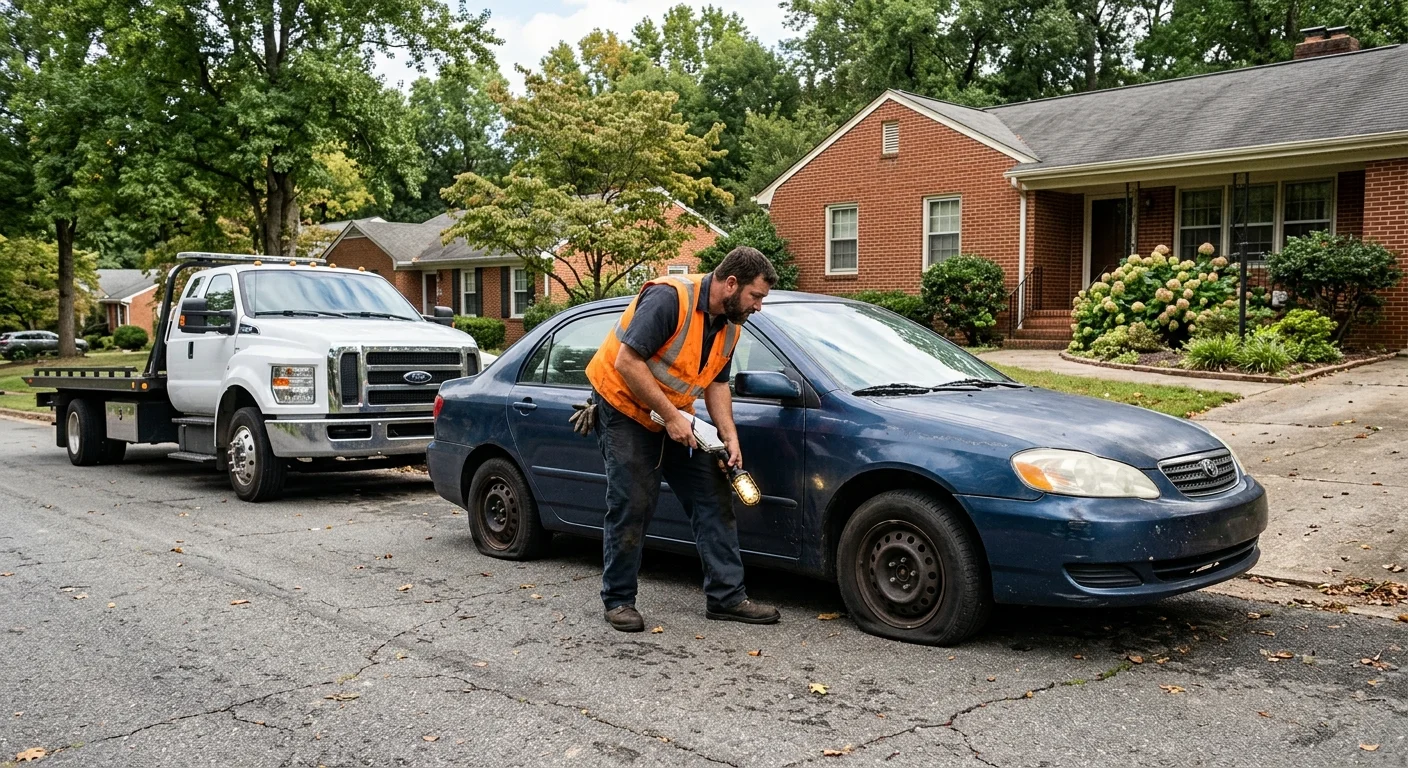
Yes. An independent operator can still take a junk car that sits on four flats, after looking at the vehicle and the path off the property. That is the real answer on junk car removal with flat tires in Richmond, Henrico, Chesterfield, and the Tri-Cities. Tell the operator the wheel condition, whether the car rolls or steers, who has authority to send it, and how a truck will reach it. The operator confirms a plan from those facts, then bills you directly.
Junk car removal with flat tires: report the tire and wheel condition
Start with the wheels. Four flats is a different job from one slow leak on Midlothian Turnpike. Say how many tires are down. Say whether any wheel is missing. Say whether the car sits on rims, on stands, or in dirt that has swallowed the sidewalls.
A sedan that sat through a Richmond freeze-thaw winter can look fine from the porch and still have dry, cracked rubber. A Church Hill alley car can sit so long that the rims have settled into brick or packed gravel. A Chesterfield cul-de-sac car may rest on a long paved driveway with room to work. Those are three different setups. The operator needs the one in front of you, not a generic “it won’t move.”
Give the year, make, and model if you have them. Add the color and where it sits: city driveway, Fan curb, Henrico ranch lot, Petersburg side street. If you can take photos of each corner, do it. Photos are not a legal requirement. They save a wasted trip when a wheel is gone or a fender is sitting on the pavement.
Say if the parking brake is set. Say if you still have the keys. Say if the steering wheel turns. None of that repairs the tires. It tells the operator whether the car will slide, drag, or need to come off the ground. Junk car and abandoned vehicle removal starts with that picture, because the load is planned around the wheels you actually have.
Leave the loading method to the person on scene. Do not assume a certain truck, a certain strap, or a certain number of extra hands. Four flats are common on cars that have been parked since last VCU move-out or since a storm sat over Shockoe Bottom. They are still a condition the operator has to see.
If the car is on a public street and you are not the one requesting a pickup, stop and treat it as a locality problem. Richmond lists abandoned vehicles among the reasons the city directs a tow. Henrico’s Tag N Tow path starts with a warning tag on an inoperable vehicle in the public right-of-way, then a reinspection after 48 hours. That is a different track from an owner asking to have a driveway car hauled to a demolisher.
Explain whether the car can roll or steer
The next fact is motion. Can anyone push it a few feet? Does the steering unlock? Do the wheels turn at all, even on shredded tires?
A car that rolls a short way on dead rubber is one plan. A car that is frozen in park on a slope off Patterson Avenue is another. A car with a locked steering column in a tight Oregon Hill space is a third. Say what is true. Guessing “it probably rolls” is how a truck shows up for a job it cannot finish from the street.
Four flats often mean the car will not travel on its own tires. Many of those pickups go on a flatbed, because the wheels never have to carry the car down the block. That is a common fit, not a promise. The operator still has to see clearance, height, and the angle out of the spot.
If you are still deciding whether to scrap it or send it to a shop, read how a non-running Chesterfield car can go to junk or to a tow. This page stays on the four-flat access problem. A dead battery in Short Pump is a different call from a car that has been sitting on rims beside a Hopewell mill house.
Do not try to inflate the tires unless you already know they hold air. Dry-rotted rubber can split. A space saver spare does not fix four corners. You are not being asked to make the car street-legal. You are being asked to describe how it will leave the pad.
Mention soft ground. A car in a Henrico side yard after spring rain can sink once the first pull starts. A paved Fan pad behind a brick row house usually gives a cleaner pull, if parked cars are moved. A gravel drive off Route 1 toward Colonial Heights can shift under a loaded truck. Those details belong in the same breath as “it doesn’t roll.”
If the car cannot steer, say that clearly. A locked column changes how the operator lines up the truck. If you have no keys, say that too. The operator plans around the car in front of them, not around a car that might roll after a jump.
Confirm ownership and removal authority
Only the person with legal authority should send a car to a demolisher. If the title is in your name, say so. If a lender is still on the title, say so. If the car belongs to a relative who left town after a year at VCU, get that person on the line before anyone hooks it.
Virginia’s standard junk path is simple to name and easy to mix up. The owner signs the Virginia title over to a licensed demolisher or scrap metal processor, or completes a Vehicle Removal Certificate, Form VSA 40. DMV calls VSA 40 “the standard form you will use for most vehicle transfers to demolishers or scrap metal processors.” The processor is not required to put the title in its own name. After the vehicle is demolished, that business must report the disposition to DMV within five working days. Details live on the Virginia DMV Vehicle Disposition FAQ.
Plates stay with you. They belong to the owner, not the car. On a junking, DMV’s own language is to surrender them immediately, online, in person, or by mail with Form FMS 210. A partial refund may apply if six or more months of registration remain and you surrender in person or by mail. Online surrender does not get that refund.
You also have a separate duty to notify DMV that the vehicle was sold or transferred. DMV runs a “Report a Vehicle Sold or Traded” tool for that. No numbered deadline for that notice is confirmed here, so treat it as a duty to do, and check DMV for the current steps.
Lost the title? Apply for a replacement with Form VSA 67, online or in person, with the registration card and a driver’s license. If more than one name is on the title, only one owner needs to apply. A substitute title voids the old ones. For the rest of the paperwork path, use how to junk a car in Virginia.
Do not send a car you do not own. A landlord can want a dead Camry off a lot in Chester. That does not, by itself, make the landlord the owner for a title transfer. Public-property abandonment is a third path, with its own 48-hour threshold and DMV notice rules under Title 46.2, Chapter 12. Keep that path apart from a driveway pickup you requested.
Henrico adds a property rule that bites people who wait. Only one inoperable vehicle is allowed outdoors per property, and it must be screened from view. A tarp does not qualify. The civil penalty can run up to $500. Community Revitalization is at (804) 501-4757. If the car is your junker on four flats in an unscreened Henrico yard, getting it gone is also a code problem, not only a storage headache.
Describe access around the vehicle
Four flats matter. The path to the street often matters more. An operator cannot confirm a plan until they know what sits between the car and the truck.
Say whether anything is parked nose-to-tail in a Fan alley. Say whether a fence, HVAC pad, or low maple branch hangs over the hood. Say whether the car is behind a locked gate in a Chesterfield HOA. Say the surface: concrete, brick, mud, grass, or gravel.
Downtown and the Fan punish wide equipment. Parallel parking, narrow lanes, and limited curb cuts are why city tows already run heavy in the Fan. A junk pickup there has the same geometry. Short Pump and western Henrico usually give more apron and a wider turn. Petersburg and parts of Manchester can look open until you hit a tight corner onto a one-way. Name the city and the cross street.
Measure with your feet if you can. How far is the car from the curb? Can a truck back straight to it, or does it have to jackknife past a trash pad? Are there cars that must be moved first? A neighbor’s Civic blocking the only pull line in Jackson Ward is part of the job.
Watch overhead lines and porches. Richmond Gas Works and Dominion hardware share a lot of older streets with low wires. You do not need to guess clearances. You do need to say “wires over the driveway” or “carport roof at the trunk.” The operator decides if the truck fits.
Soft yards after a James River rain week are a real limit. A car that sat in a side lot off Semmes Avenue can be boxed in by a fence on one side and a drop toward the alley on the other. Tell that story in one pass: surface, obstacles, distance to the street, and whether anyone else has to move a vehicle before the truck arrives.
If the car is in a deck or a gated garage, say the height and the stall number. Do not treat that as an apartment-policy question. The point here is physical access for a car that will not roll on four good tires.
Ask the operator for the full charge
Ask for the total before you agree. Include mileage. Include extra labor if the car will not roll. Include any after-hours or weekend piece the operator actually intends to bill. Get that number in one figure, then decide.
Quick Tow Richmond is a referral service. The recorded line takes the call. The brand matches you with independent licensed operators. Those operators contract with you and bill you. The brand does not set the operator’s total, and it does not own the truck that shows up.
The brand’s published standard light-duty hookup fee is $105. That is our published hookup figure. It is not a scrap payout, not a flat junk-removal package, and not a cap on what the operator may bill for a hard pull. Richmond caps a nonconsent private-property hookup at $195 under City Code § 27-302. Virginia caps that same class of passenger-car hookup at $210 under § 46.2-1233.1. A junk removal you request is a job you asked for. Ask what this pickup will cost with the four flats and the access you described.
Do not sign off on a partial quote that covers only the street in front of the house. A car 80 feet down a Chesterfield driveway, on rims, with a boat trailer in the way, is not the same charge as a car at the curb in Lakeside. If the operator needs a second piece of equipment, that belongs in the total before anyone hooks the car.
There is no confirmed cash-for-junk figure on this site, and no confirmed “free tow with scrap” offer. If a yard later pays you for metal, that is between you and that licensed demolisher. Treat removal cost and scrap value as two conversations. Get the removal total first.
Operators must accept cash, certified checks, money orders, or credit cards on the towing side of Virginia law, and they must give an itemized receipt in Richmond when they take payment on a covered private-property tow. For a requested junk pickup, still ask for the line items in writing: hookup, mileage, extra labor, storage if any, and where the car is going. If the destination is a demolisher, confirm that the title or VSA 40 will be handled before the car leaves.
If the quote changes on scene because the car was on stands, missing a wheel, or blocked by a second vehicle you did not mention, that is the cost of a bad description. A complete tire report, a clear yes or no on rolling and steering, proof you can authorize the removal, and a honest access picture are what keep the number stable.
When to call us
When a junk car is sitting on four flats and you need it off a Richmond, Henrico, Chesterfield, or Tri-Cities property, call so we can match you with a licensed operator who can assess the vehicle and the access. The line takes calls 24/7. A recording notice plays before you leave a message. Call us at (804) 701-6752.