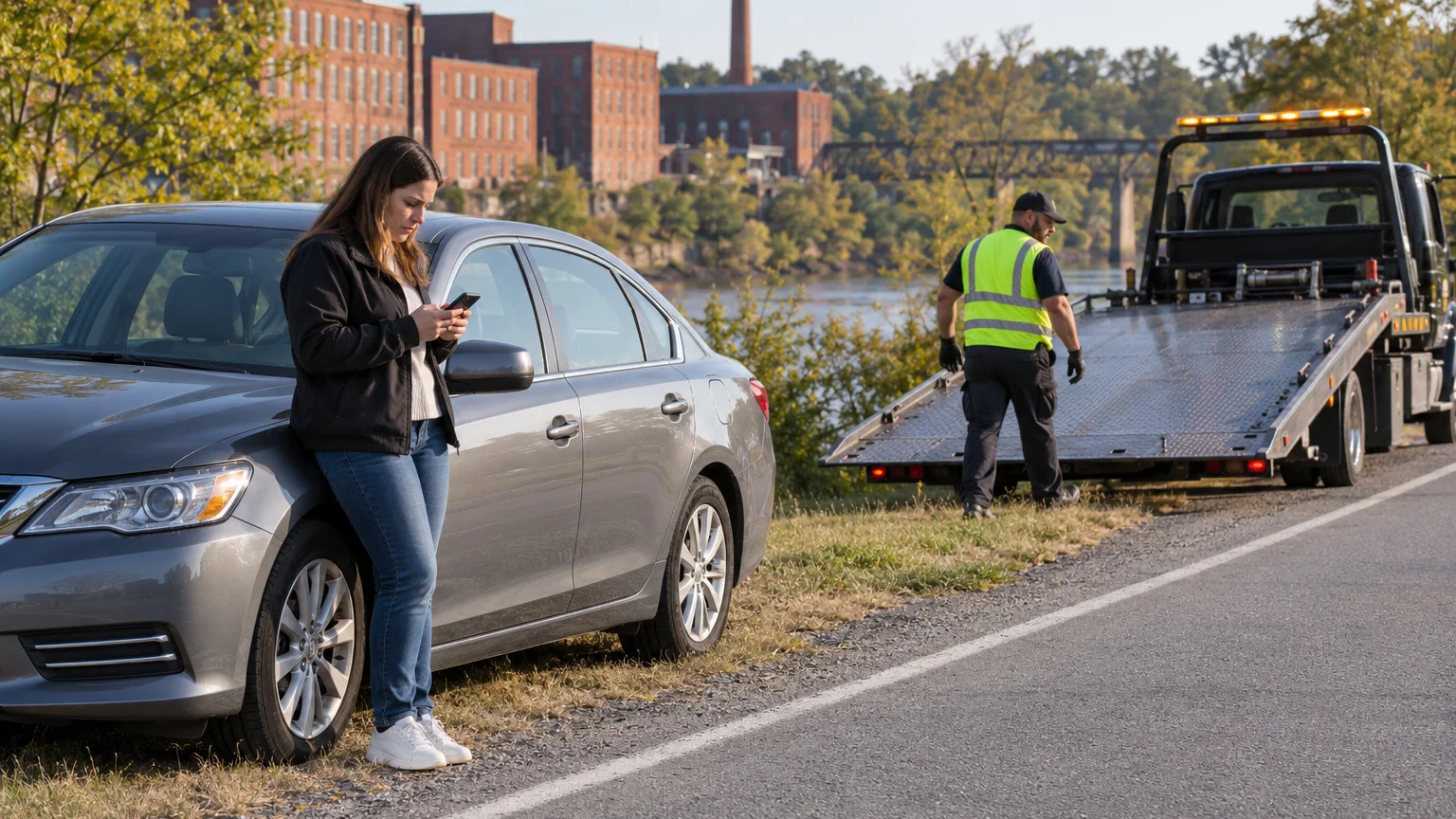
For hopewell towing after a passenger-car breakdown, start by sharing your precise location, the car’s condition, and where it should go. Quick Tow Richmond takes your recorded message and matches you with an independent operator who performs the work and bills you directly.
A routine sedan breakdown differs from a disabled work truck. If you’re dealing with a larger commercial vehicle, read our guide to heavy-duty towing in Hopewell.
Give your exact Hopewell location first for Hopewell towing
“Somewhere in Hopewell” doesn’t give an operator enough detail. Share the street, property entrance, parking area, or nearest visible landmark. If you’re using a map app, read the full location from the pin instead of relying on your memory.
Be clear about which side of the road holds the car. Mention whether it’s beside a curb, inside a parking lot, or near an entrance. A passenger car behind a building presents a different access situation than one beside an open roadway.
Hopewell is part of the Tri-Cities, but that label covers more than one destination. Don’t describe a Hopewell pickup as being “near Petersburg” unless the map confirms it. A precise pin helps prevent confusion between the pickup point and the place where you want the car delivered.
Also describe what surrounds the car. Note a gate, low clearance, narrow lane, soft shoulder, steep grade, or parked vehicles blocking direct access. Don’t guess whether those conditions require certain equipment. Give the operator the facts and let them assess the job.
Keep your phone available after leaving the message. The line takes calls around the clock, but it’s recorded rather than answered by a live dispatcher. A recording notice plays before your message is recorded and transcribed. No callback time or arrival window is promised.
If the location changes, provide the new pin before an operator is sent. Clear location details make the referral and pickup instructions easier to understand.
Decide whether roadside help may be enough
Not every disabled passenger car needs to be moved. First, identify whether the problem might be handled where the car sits. A flat tire, discharged battery, or empty fuel tank may point toward roadside assistance instead of towing.
Describe the situation without diagnosing it. You can say the engine won’t crank, the lights are dim, a tire is flat, or the car starts and then stops. Don’t call it a dead battery unless that has been confirmed. The same symptom can have more than one cause.
If roadside help gets the car running, check whether the original symptom remains. A temporary start doesn’t establish that the car is ready for a longer drive. When the car still can’t move normally, arranging emergency towing may be the clearer next step.
Drivers who break down after leaving Hopewell may be on a different road network. The VDOT Safety Service Patrol provides free help on covered interstates, including I-95, I-64, and I-295 in the Richmond area. It can assist with certain roadside problems and help arrange a tow, but it isn’t a towing company or a general call-out service.
Check 511 Virginia for current traffic and incident information. If your trip continues toward Petersburg, our guide to I-95 and I-85 breakdown towing covers that separate corridor.
Describe what stopped the car
A useful breakdown description begins with what happened immediately before the car stopped. Mention any warning light, unusual sound, smoke, fluid, impact, sudden loss of power, or steering problem you noticed. Report only what you saw, heard, or felt.
Tell the operator whether the engine starts. Say whether the transmission can shift into neutral and whether the steering wheel turns. If you tried a jump start, explain what changed. If you haven’t tested something, say that instead of guessing.
The car’s position matters too. State whether every wheel remains on a firm surface. Mention a locked wheel, damaged tire, low bodywork, collision damage, or a car that won’t roll. These details help the operator evaluate access and vehicle condition before accepting the job.
Keep passenger-car information specific. Give the make, model, and visible body style if you know them. Mention whether the keys are present. Don’t describe a sedan as a truck or use “heavy duty” simply because the vehicle feels difficult to move. Commercial work-truck recovery is a different service.
Avoid repeated attempts when the car makes a new grinding sound, produces smoke, or leaks fluid. You don’t need to identify the failed part. A direct description is more useful than an uncertain diagnosis.
If the car stopped after a crash, say so in the first message. The operator needs to understand that the request involves damage rather than an ordinary mechanical breakdown. Also explain whether another party has already directed where the vehicle must go.
Choose the destination before dispatch
Decide where the car should be taken before agreeing to the tow. Common choices include your home, a repair facility you selected, or another place where the vehicle may be received. Quick Tow Richmond doesn’t choose or recommend a repair shop for you.
Call the destination first when possible. Confirm that it can receive the car and ask where a tow operator should leave it. If the business will be closed, ask whether it accepts vehicles after hours and what instructions apply. Don’t assume a parking lot is an approved drop point.
Share the full destination address with the operator. A business name alone may be ambiguous, especially when several locations use similar names across Hopewell, Petersburg, and the wider Richmond metro. Confirm the street and city before dispatch.
Consider whether you need the car nearby for diagnosis or transported farther for an established mechanic. Distance can affect the complete charge, so settle the destination before asking for the total. Changing it after the operator begins the trip may change the work being requested.
Also decide where the keys will go. If you won’t travel with the car, arrange that detail with the destination and operator. Don’t leave keys in an unapproved location based on an assumption.
Finally, keep personal documents, medication, house keys, and other needed belongings with you. If something remains inside, tell the operator before the vehicle leaves. Clear destination and key instructions reduce avoidable confusion at the end of the tow.
Confirm the complete charge with the operator
The independent operator sets and bills the charge. Quick Tow Richmond makes the referral but doesn’t perform the tow, control the operator’s total, or collect the operator’s payment.
Before agreeing, ask for the complete amount based on the confirmed pickup and destination. Tell the operator the vehicle’s condition and access details again. Ask what the quoted amount includes and whether mileage, special access, after-hours work, or a destination change would affect it.
Don’t treat a hookup figure as the full towing total. The final amount can depend on the trip and the work required. Ask for the total with mileage included before authorizing dispatch. If a condition hasn’t been assessed yet, ask how it could change the bill.
This driver-requested breakdown tow is also different from a nonconsensual private-property tow. Virginia’s statutory fee ceilings address passenger cars removed without the owner’s consent from private property. They aren’t a quoted price for a tow you request after breaking down.
Ask who will bill you and which payment methods the operator accepts. Quick Tow Richmond’s referral model means you contract directly with that independent operator. Keep the operator’s name and the agreed destination with your trip notes.
If the details change, request an updated total before continuing. That includes a different destination, newly discovered wheel damage, or access that differs from your first description. Don’t rely on an advertised starting figure when you need the complete charge for your actual trip.
A clear agreement should identify the pickup, destination, vehicle, known condition, and amount being discussed. Take the time to confirm each item before the operator begins the tow.
When to call us
Call when a Hopewell passenger car can’t move normally and the job needs a licensed towing pro. Quick Tow Richmond’s recorded line takes calls day or night and refers callers to independent operators, without promising an arrival time. Call us at (804) 701-6752.