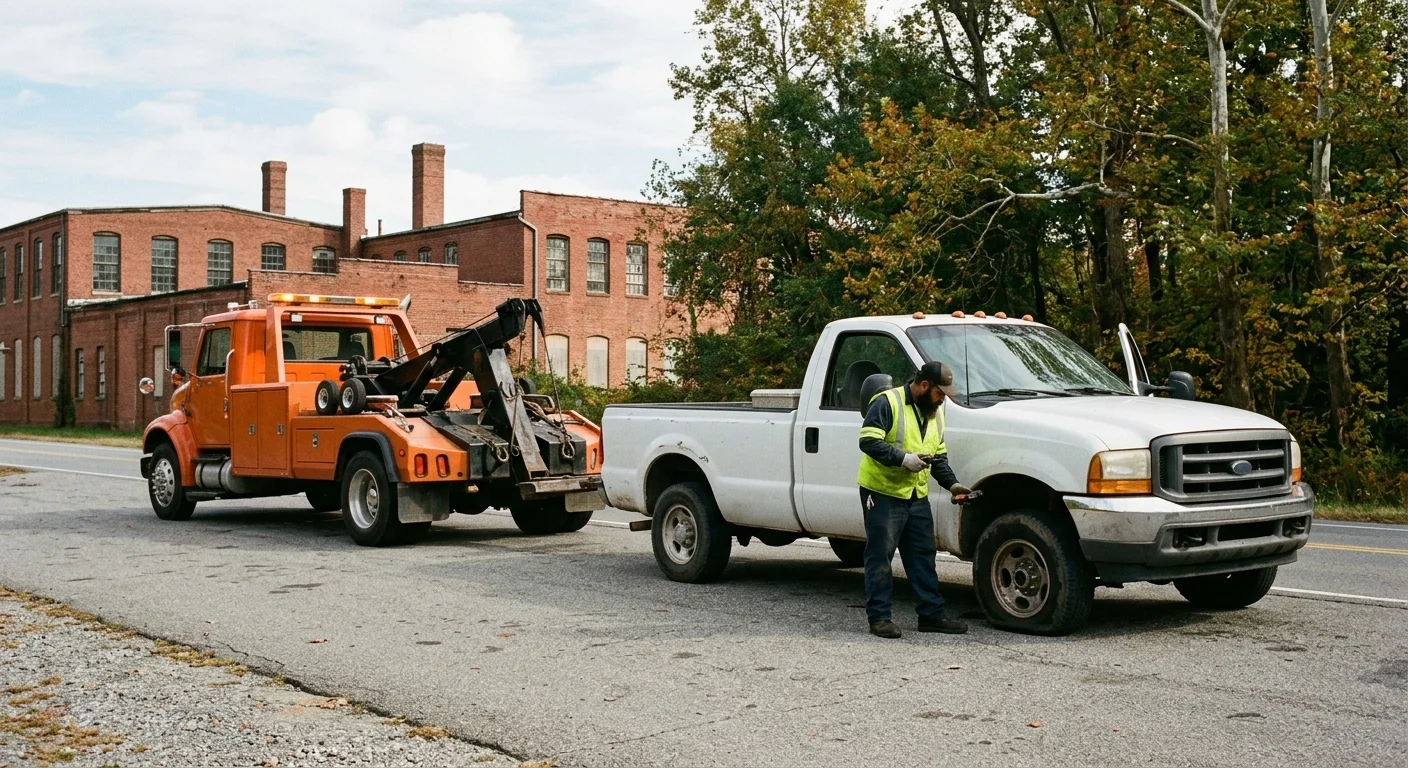
For heavy duty towing Hopewell VA, start by describing the work truck before an operator is sent. Share its configuration, load, visible damage, pickup access, and destination. Those details help an independent operator evaluate the job without guessing.
A work truck breakdown affects more than one driver. It can interrupt a route, delay a crew, or leave equipment sitting away from the fleet yard. Clear information makes the first call more useful.
Report the truck configuration before heavy duty towing Hopewell VA dispatch
“Work truck” can describe very different vehicles. Tell the operator what’s disabled, using the clearest description available. It might be a utility truck, dump truck, straight truck, box truck, tractor, service truck, or another commercial vehicle.
Report the manufacturer and model when you know them. Include the truck’s approximate overall length and height if those measurements are available from fleet records. Don’t estimate unfamiliar specifications. A photograph of the truck and its identification labels may answer questions more accurately.
Tell the operator about the complete configuration. Mention every axle, an attached trailer, mounted machinery, auxiliary tanks, tool compartments, racks, or body modifications. If the truck normally carries equipment outside its basic outline, explain where that equipment sits.
An attached trailer needs its own description. Report its type, load, wheel condition, and connection to the truck. Don’t assume one towing plan covers both units. Let the independent operator decide what can be moved and whether separate arrangements are needed.
Our heavy-duty towing referral service connects callers with independent operators. Quick Tow Richmond doesn’t own recovery equipment or perform the tow. The operator evaluates the vehicle and chooses the towing method.
Not sure how the truck should be classified? Our guide to medium-duty versus heavy-duty towing explains why the vehicle’s real configuration matters more than its everyday name.
Describe the load and visible damage
The truck’s load can change how the operator approaches the job. Say whether the cargo area is empty, partly loaded, or loaded. Identify what’s being carried in plain language. If the cargo has shifted, become loose, or moved toward one side, make that clear before anyone arrives.
Don’t promise that the operator can unload, secure, or transport cargo. Ask what the operator can handle under the circumstances. Cargo arrangements may need to come from the vehicle owner, fleet manager, shipper, or another qualified provider.
Describe visible damage without trying to diagnose it. Useful observations include a wheel sitting at an unusual angle, a lowered body component, damaged steering parts, a disconnected trailer, or a truck resting against an object. Report leaking fluid, smoke, heat, or loose material immediately.
Photos can help when they show the entire truck and its surroundings. Take wide views from a safe position. Include the front, rear, both sides, wheel positions, cargo body, trailer connection, and the path leading to the truck. Close photographs are useful, but they shouldn’t replace a view of the full scene.
Tell the operator whether the breakdown followed a collision, mechanical failure, soft-ground stop, or another event. Describe only what you observed. A dashboard warning or unusual sound doesn’t confirm the failed part.
If there’s immediate danger, injury, fire, or an active roadway incident, contact emergency services first. A towing referral doesn’t replace emergency response or scene control.
Explain whether the truck can roll and steer
The operator needs to know how the truck currently behaves. Report whether its wheels can roll and whether the steering still responds. If you don’t know, say that clearly. Don’t start, move, or test the truck solely to produce an answer.
Describe what happened during the last safe attempt to move it. Did the truck remain stationary, move briefly, pull toward one side, or stop after a wheel locked? State what you saw without naming a mechanical cause.
Mention any wheel or axle that appears damaged, blocked, turned sharply, or unable to move. Tell the operator if the truck is sitting low, leaning, or touching the pavement. Include the location of detached parts, loose equipment, or debris near the vehicle.
Brake condition also matters. Say whether the parking brake is applied and whether the service brakes responded during the last operation. If air pressure, warning indicators, or other systems showed a problem, report the displayed information exactly.
For a breakdown on I-295, 511 Virginia provides current traffic and incident information. Virginia’s Safety Service Patrol covers I-295 within its Richmond-area network. SSP provides free roadside assistance and incident support, but it doesn’t perform mechanical repairs or act as a towing company.
A commercial vehicle that can’t be handled through ordinary roadside assistance may need emergency towing coordination. Share the truck’s condition before the referral, then let the independent operator assess the required approach.
Pinpoint the pickup access in Hopewell
“Somewhere in Hopewell” doesn’t give an operator enough detail. Hopewell is part of the Tri-Cities area, not central Richmond or Chester. Provide the street address, business name, entrance, gate, and nearest visible cross street when available.
For a roadside stop, give the road name and direction of travel. Add the closest posted exit, mile marker, intersection, or recognizable public landmark. If the truck is on I-295 near Hopewell, specify which direction it was traveling before stopping.
A pin from your phone helps, but add written directions. Map pins sometimes identify the wrong side of a divided road, fence, building, or secured property. Tell the operator where the truck can actually be reached.
For a truck inside a yard or commercial property, describe the access path. Mention gates, check-in points, low entrances, sharp turns, soft ground, loading areas, parked vehicles, or anything blocking a direct approach. Confirm who can grant access if the site is secured.
Describe the truck’s exact resting position. Say whether it’s on pavement, gravel, grass, a shoulder, a loading area, or another surface. Note whether it faces toward or away from the exit. Photos showing the approach are often as useful as photos showing the truck.
Stay reachable after leaving a message. Quick Tow Richmond’s recorded line takes calls around the clock, but no live dispatcher answers it. A recording notice plays before your message is recorded and transcribed. Include your name, callback number, vehicle details, and exact Hopewell location.
Choose the destination and confirm the charge
Decide where the truck should go before the operator begins moving it. The destination might be a repair facility, fleet yard, dealer, storage location, or another site selected by the vehicle owner. Confirm that the receiving location can accept the complete truck configuration.
Share the destination’s full address and preferred entrance. Tell the operator about any known gate, access, or receiving restrictions. If the truck has an attached trailer or cargo, confirm that the destination expects those items too.
Ask the independent operator for the full total with mileage included before agreeing. Confirm what the quoted amount covers and what circumstances could change it. Quick Tow Richmond doesn’t set the operator’s price. The independent operator contracts with and bills the driver or vehicle owner directly.
Don’t treat passenger-car towing ceilings as a quote for a requested commercial tow. The statewide figure in Virginia’s towing statutes applies to a passenger vehicle removed without consent from private property. Richmond’s local ceiling also concerns nonconsensual private-property towing within Richmond, not a requested heavy-duty job in Hopewell.
A current Hopewell heavy-duty towing rate couldn’t be confirmed from the available primary-source record. Ask the operator to state the total and mileage before authorizing the move. Get approval from the fleet manager or vehicle owner when required.
If the disabled vehicle is closer to Chester, our I-95 box-truck breakdown guide covers that separate location and scenario. Giving the correct city, route, access point, and destination keeps the referral tied to the actual job.
When to call us
Call when a disabled work truck needs evaluation by a licensed independent towing professional. Leave the truck configuration, load, condition, Hopewell pickup point, and destination after the recording notice. Call us at (804) 701-6752.