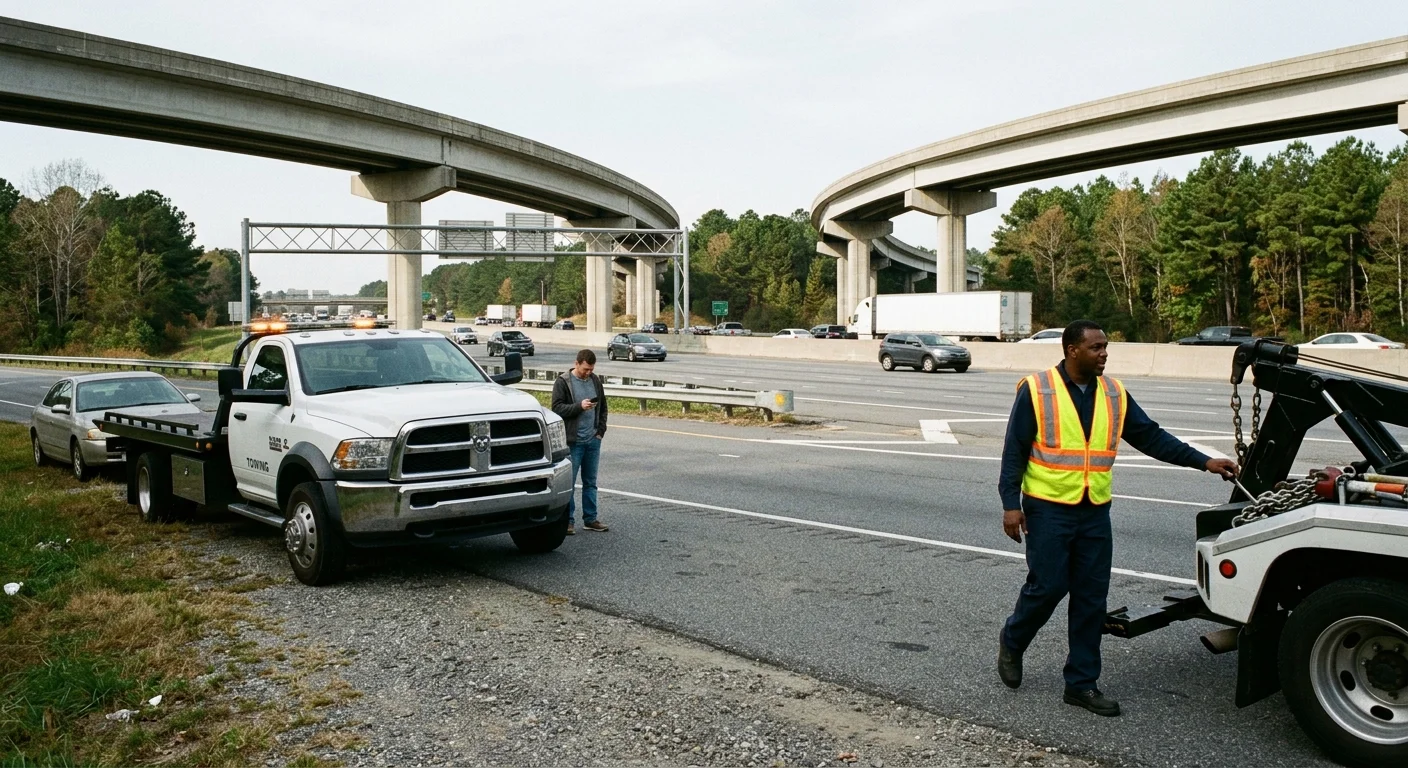
For 24 hour towing in Petersburg near the I-95 and I-85 split, start by naming the interstate, travel direction, and closest exit or ramp. Then describe whether the car can roll and steer, and name the destination you want. Quick Tow’s recorded line takes calls around the clock and matches drivers with independent towing operators.
Give your interstate and direction for 24 hour towing in Petersburg
Start with “I-95” or “I-85,” followed by your direction of travel. Add whether you’re on the main roadway, an exit ramp, or a nearby parking area. That information matters more than saying you’re somewhere near Petersburg.
The split creates an easy location mistake. Your phone may show Petersburg while your vehicle sits on a ramp between roadways. A location pin helps, but it shouldn’t replace a clear route description. Tell the operator which interstate you were traveling before the breakdown and which ramp you entered.
Look for details you can read from inside the vehicle. Useful landmarks include an exit number, mile marker, overpass, or nearby business name. If you passed the split before stopping, explain that sequence. A simple description might be: “I was southbound on I-95, entered the I-85 ramp, and stopped after the merge.”
You can also check 511 Virginia for current incidents and roadway conditions. If the map shows a closure or blocked ramp near you, include that detail in your message. Don’t guess when the interstate or direction remains unclear. Send the location pin and describe what’s visible.
Confirm the location once more before ending your message. The operator needs the correct roadway, direction, and side of the interchange. That avoids planning a route toward the wrong approach.
Explain whether the vehicle can roll and steer
Describe what the vehicle can do, not what you think failed. You don’t need to diagnose the engine, transmission, or suspension. The operator needs observations that help identify the appropriate towing setup.
Say whether the engine starts and whether the transmission shifts into neutral. Mention whether the steering wheel turns and whether every wheel can roll. If a tire is flat, a wheel is bent, or part of the vehicle touches the pavement, say that plainly. Also mention visible leaking fluid, collision damage, or an open hood or trunk that won’t latch.
The vehicle’s position matters too. Explain whether all four wheels remain on pavement. Tell the operator if the car rests against a curb, guardrail, ditch edge, or steep shoulder. If there’s very little room around the vehicle, include that detail.
Keep the keys available, but don’t promise the vehicle will move until you’ve checked. A car that starts may still have a locked wheel or damaged tire. A car that won’t start may still roll freely. Those are different loading situations.
Our emergency towing referral page explains how Quick Tow connects a roadside caller with an independent operator. The operator makes the service decision after reviewing the vehicle’s condition and position. Accurate details give that operator a clearer picture before traveling toward the I-95 and I-85 split.
Choose between a nearby stop and a longer tow
Pick the destination before accepting the tow whenever possible. An address is better than “somewhere nearby.” It gives the operator a defined route and lets you discuss the full charge before the vehicle moves.
A nearby destination may make sense when you’ve confirmed a repair facility can receive the vehicle. Contact that facility yourself before naming it as the destination. Check that it accepts your vehicle, has room for it, and explains what happens if you arrive outside its normal business process. We don’t recommend an unverified shop or promise that a particular property will accept a drop-off.
A longer tow may fit an out-of-town driver better. You may want the vehicle taken home, to a familiar repair facility, or to another address along your planned route. Distance affects the total, so provide the complete destination rather than deciding midway through the trip.
Our guide comparing a nearby shop with taking the car home can help you frame that choice. If you already know you need more distance, review the long-distance towing service and the guide to long-distance towing price factors.
Don’t choose solely from the first map result. Confirm the receiving address and any access instructions directly. If you’re traveling with another person, discuss where everyone will go after the vehicle leaves. The best destination is one that accepts the car and works for the rest of your trip.
Tell the operator about passengers and cargo
Include the number of people traveling with you. Mention children, older adults, mobility needs, pets, or anyone who needs separate transportation. Don’t assume every passenger can ride with the towing operator. Ask what passenger space is available and make another plan when needed.
Cargo changes the picture too. Tell the operator about heavy luggage, work materials, bicycles, a roof box, or anything extending beyond the vehicle. Mention a trailer or carrier attached to the disabled vehicle. The operator can then decide what service fits the full situation.
Separate the things you need now from items that can remain with the vehicle. Take identification, medication, phones, chargers, wallets, keys, and travel documents with you. If you plan to remove luggage before loading, say so during the call. That keeps the operator from expecting an immediate hookup.
Be clear about anything that can shift, spill, or block access inside the vehicle. Don’t hide a full cargo area or an attached load because you’re worried about the quote. The operator needs an accurate description before agreeing to move the vehicle.
Passengers also affect the destination decision. A nearby stop may solve the vehicle problem but leave your group without a workable place to wait. A longer tow might keep the car closer to your final destination, yet everyone still needs separate travel arrangements. Set those plans before the vehicle leaves the Petersburg interchange area.
Confirm the destination and full charge
Repeat the complete destination address before agreeing to service. Confirm the city, street, and any entrance instructions. Similar business names and chain locations can send a vehicle toward the wrong property.
Ask for the full charge with mileage included. Explain the vehicle’s condition and exact position before requesting that total. Ask what could change it, especially if the car can’t roll, sits away from the paved surface, carries extra cargo, or needs a second destination.
Quick Tow is a referral service. We don’t perform the tow, set the operator’s total, or bill for the work. The independent operator contracts with you and handles payment directly. Make sure you understand that operator’s terms before authorizing movement.
Don’t treat a published private-property towing ceiling as a quote for a driver-requested breakdown tow. Those ceilings address nonconsensual private-property towing. Your I-95 or I-85 service request needs its own total based on the job and destination.
Virginia operators must keep towing records, including itemized fees, for one year under Title 46.2, Chapter 12 of the Code of Virginia. Ask what written or electronic documentation you’ll receive. Keep the operator’s name, destination, charge details, and payment record together.
Before loading begins, confirm the address one last time. If your destination changed while you waited, discuss the new route and total before the vehicle moves.
When to call us
Call when a disabled vehicle can’t be driven from the I-95 and I-85 split, or when you need a licensed towing pro to move it to your chosen destination. The recorded line takes calls 24/7, and a recording notice plays before your message is recorded and transcribed. Call us at (804) 701-6752.