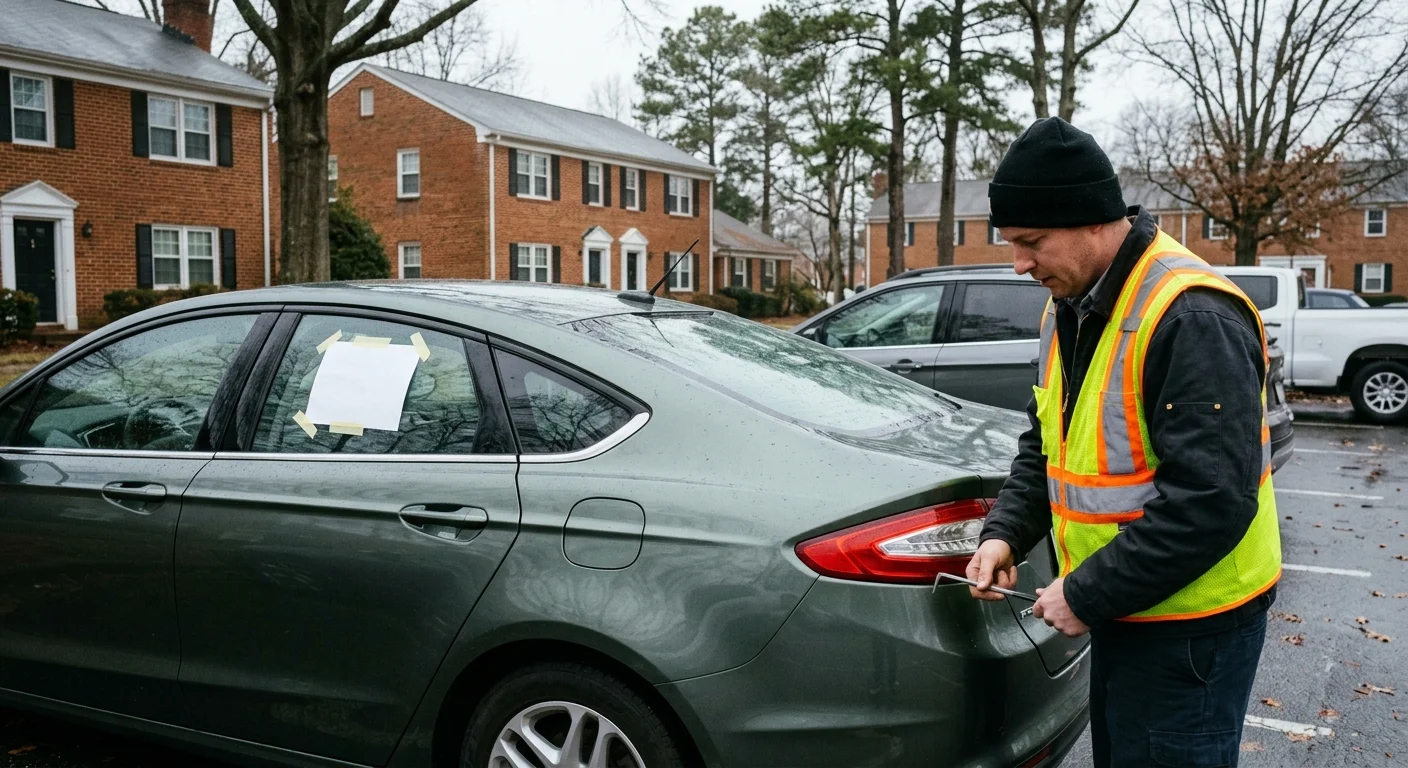
A car can be removed for expired registration in Virginia, but the parking location changes the notice rule. If you searched “towed for expired tags in virginia,” the short answer is yes, but only one setting comes with a statewide 48-hour warning. That protection applies to a resident’s vehicle in a multifamily-dwelling lot, not every street or private lot.
Towed for expired tags in Virginia: no statewide grace period
Virginia doesn’t provide one statewide grace period covering every expired-registration tow. The controlling rule is narrower than many drivers expect.
Virginia Code § 46.2-1150 says Title 46.2 doesn’t generally prohibit towing an unlicensed vehicle or one that hasn’t passed inspection. The exceptions are notice periods required by § 46.2-1231 or local ordinances adopted under § 46.2-1232.
That means the location matters as much as the expired registration. A car beside a Richmond apartment building isn’t treated exactly like one parked on a city street. A vehicle in an ordinary private lot follows another set of towing rules.
The rule can also change across the metro. Richmond, Henrico, and Chesterfield each control towing within their boundaries. Under Virginia law, the ordinance of the locality where the tow happens governs, even when the vehicle gets stored somewhere else.
Start by identifying the property and jurisdiction. Was the car in a multifamily complex, on a public street, or on another private lot? Was it inside Richmond or across the line in Henrico or Chesterfield? Those details determine which notice and removal rules apply.
The key limit is simple. Virginia guarantees a 48-hour posted-notice period for certain resident vehicles at multifamily dwellings. It doesn’t guarantee that period everywhere else.
The one place the law does protect you: a multifamily lot
Virginia provides a specific warning period for apartment and other multifamily-dwelling residents. It applies when a resident’s vehicle faces removal because of expired registration or an expired inspection sticker.
The operator must place written notice on the vehicle itself at least 48 hours before removal. A general towing sign at the parking-lot entrance serves a different purpose. The 48-hour rule requires notice on the affected car.
This distinction matters across apartment communities along Broad Street and in Southside. It also applies in multifamily complexes in Henrico and Chesterfield because the protection comes from Virginia law.
The rule is tied to three details. The vehicle belongs to a resident. It’s parked at a multifamily dwelling. The stated reason is expired registration or an expired inspection sticker. Don’t assume the same warning period applies after a different parking violation or at another type of property.
If you find a notice, photograph it before moving the car. Capture the entire vehicle and the notice together. Keep a closer image showing the notice clearly. Record when you first saw it, and save any messages from the property manager or towing operator.
Those records help establish whether the required period passed before removal. They also help separate an expired-registration tow from a tow based on another parking rule.
What skipping that 48-hour notice costs the operator
Skipping the required notice has a defined consequence. When a qualifying resident vehicle is removed without the required 48-hour notice, the resident must be reimbursed for the tow. The violation also carries a civil penalty of up to $100.
The narrow scope still matters. This remedy concerns a resident’s vehicle at a multifamily dwelling when the tow was based on expired registration or inspection. It isn’t a general penalty for every tow involving an expired tag.
Gather the facts before challenging the removal. Save photographs of the parking space, every lot entrance, and any paper left on the vehicle. Keep the tow receipt and other written records. Ask the operator to identify the stated reason for removal and when the vehicle was taken.
Virginia requires operators to retain towing records, including itemized fees, for one year. Richmond also requires an itemized receipt for covered private-property tows. Those documents can help show what reason and timing the operator recorded.
Virginia doesn’t run a formal towing hearing. A consumer who believes a tow operator violated state law may file a towing complaint with the Division of Consumer Counsel in the Office of the Attorney General. The Attorney General may pursue court action, but the statute doesn’t promise a filing deadline or resolution date.
The Virginia towing statutes contain the notice, private-property removal, and operator requirements.
On a Richmond street, a different set of rules applies
The apartment notice rule doesn’t control a car parked on a Richmond public street. City-directed towing follows Richmond’s own authority, parking rules, and published tow triggers.
Richmond’s published list doesn’t name expired registration as a city-tow trigger. The closest listed trigger is having three or more unpaid parking tickets, which is a separate issue. That list also includes designated tow-away areas, handicap and fire zones, abandoned vehicles, accidents, stolen vehicles, and evidence holds.
Peak Towing violations appear on the list during 7:00 to 9:00 a.m. and 4:00 to 6:00 p.m. The city says most routine removals involve street cleaning and special events. Towing is heaviest in the Fan because parking there is limited.
A 30-day Richmond hold also appears in the city’s towing program, but only for DUI or equipment violations. It isn’t a standard hold for every city tow.
These distinctions matter on the Fan’s permit blocks and around event restrictions. An expired tag doesn’t turn a separate parking violation into an expired-registration tow. Ask for the recorded reason instead of assuming the tag caused the removal.
If your car disappears from a Richmond street, check the city’s Towed Vehicles lookup before reporting it stolen. Richmond recommends checking that listing first. Entries include the vehicle’s make, model, color, partial VIN, partial plate, tow time, and lot address. They remain online for 14 days.
Our guide to finding a towed car in Richmond explains that process in more detail.
Ordinary private lots that are not apartments
A single-family driveway or ordinary private lot doesn’t receive the apartment-specific 48-hour protection. Expired registration instead falls back to Virginia’s general private-property towing rules.
Under § 46.2-1231, a property owner may request removal of a trespassing vehicle without its owner’s permission only when clear warning signs are posted at every entrance. The signs must clearly disclose the towing policy and include the non-emergency number for local law enforcement.
Virginia doesn’t specify sign dimensions, lettering height, or font size in Title 46.2. Placement and clear disclosure are the central requirements. Our guide to Virginia tow-away sign requirements explains how the entrance sign differs from the notice placed on an apartment resident’s vehicle.
A private-lot tow without the required entrance signage isn’t authorized under that statutory pathway. The statute doesn’t assign a separate fine for a defective sign. The problem is that the authority to conduct the trespass tow depends on proper signage.
The operator must also notify State Police or local law enforcement immediately after removing a vehicle. That notification can help you locate the operator and confirm that the removal was reported.
A missing 48-hour notice doesn’t decide whether a tow from an ordinary private lot was proper. Check the entrances, the disclosed parking policy, and the recorded reason for removal. Property owners seeking help with an unauthorized vehicle can also review how private-property towing referrals work.
What to do the day it happens
Start with the parking location. Your next step depends on whether the vehicle was at your multifamily residence, on a Richmond street, or in another private lot.
For an apartment or other multifamily property, ask whether expired registration or inspection was the recorded reason. Look for written notice on the vehicle, then determine whether at least 48 hours passed before removal. Save photographs and any dated communications.
For a Richmond street tow, search the city’s online listing. Use the plate or VIN details you have available. If the vehicle was in Henrico or Chesterfield, contact that jurisdiction’s police non-emergency line with the plate, VIN, and location. No public lookup was found during research for either county, so calling is the reliable next step.
For another private lot, photograph every entrance and posted towing sign. Record the exact property location. Ask the towing operator which parking rule supported the removal and whether law enforcement received notice.
Request an itemized bill. Virginia requires operators to keep towing records with itemized fees for one year. Anyone accepting payment for a covered Richmond private-property tow must provide an itemized receipt.
You may also retrieve personal belongings without recovering the whole vehicle. Virginia bars operators from charging a fee for that access when you provide proof of ownership. State law doesn’t set universal access hours, so call the storage lot before going.
Keep the apartment rule separate from the other pathways. A resident’s expired-registration tow from a multifamily lot carries the 48-hour vehicle-notice requirement. A public-street or ordinary private-lot tow requires checking the rules governing that location.
When to call us
When a vehicle needs lawful relocation, a licensed towing pro can handle the transport. Quick Tow Richmond’s recorded line takes calls 24/7, with a notice before recording, and we match drivers with independent licensed operators who bill drivers directly. Call us at (804) 701-6752.