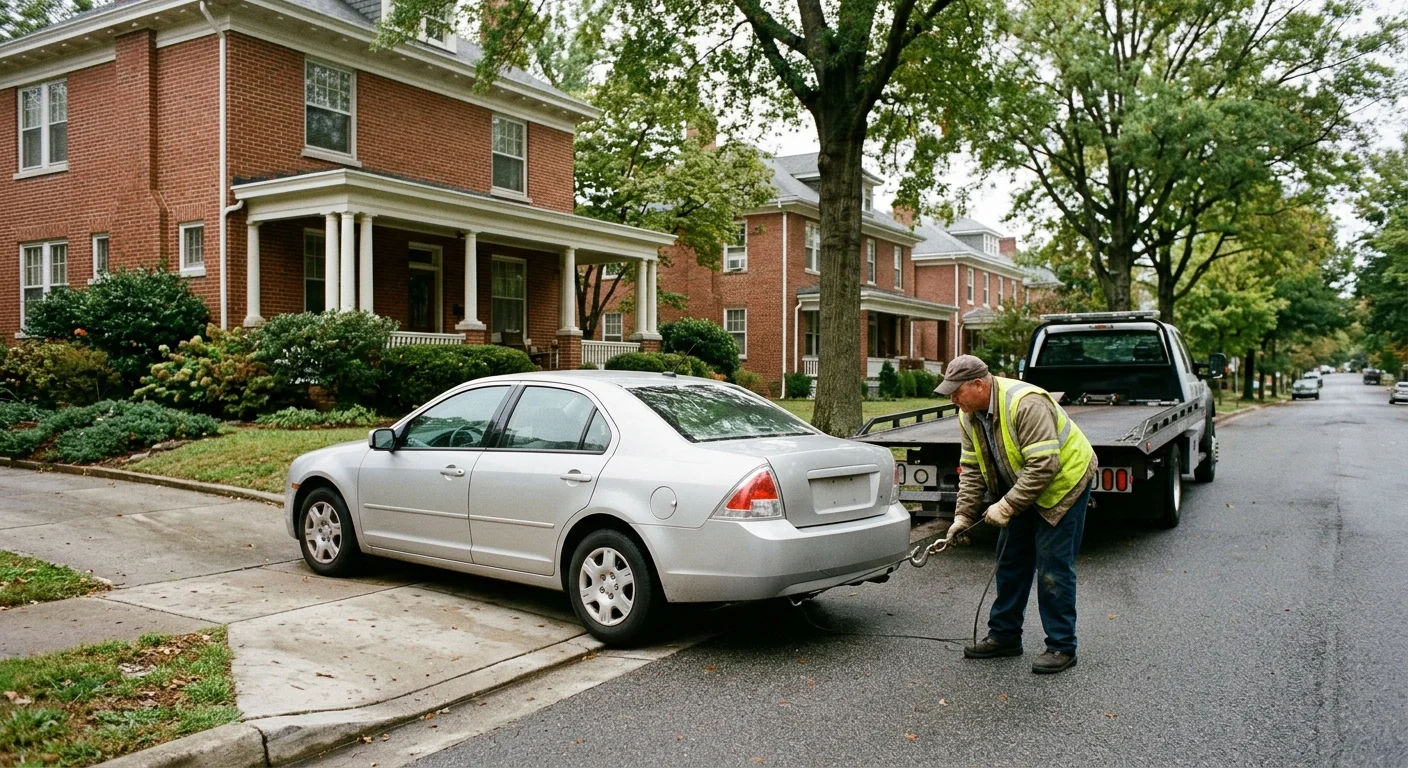
A car blocking driveway access in Richmond should first be reported through the local non-emergency police line when it sits on the public street. Parking enforcement or law enforcement must decide whether it can be moved. Don’t order a street removal from a private towing company yourself.
The answer changes when the entire vehicle is on your property. Virginia’s private-property towing rules then control whether an owner can authorize removal.
Where to report a car blocking driveway access
Start by locating the vehicle in relation to the street. If its wheels remain on the public roadway, contact the non-emergency line for the jurisdiction. That may be the City of Richmond, Henrico County, or Chesterfield County.
Metro Richmond crosses several local governments. A Richmond mailing address doesn’t always settle which agency controls the road. Give the call taker your exact address and nearest intersection. The agency can confirm whether the location falls within its authority.
Don’t treat the vehicle as yours to move. Avoid pushing it, entering it, or trying to drag it with another vehicle. Ask the agency whether an officer or parking-enforcement employee must inspect the blockage.
The specific citation or removal standard for a vehicle covering a driveway entrance couldn’t be confirmed from the available Richmond rules. The responsible city or county decides whether the position supports enforcement or removal. Ask the call taker what happens next and whether someone must remain at the property.
For locations inside Richmond city limits, the city provides a Towed Vehicles page. Its live listing includes vehicle details and remains available for 14 days after a tow. Richmond recommends checking that listing before reporting a vehicle as stolen.
When the vehicle is inside your property line
A vehicle sitting completely inside a private driveway or lot follows a different path. Virginia law allows a property owner to arrange certain nonconsensual removals, but that authority comes with conditions.
Virginia Code § 46.2-1231 requires clear towing signs at every entrance before a trespassing vehicle can be removed under that section. The signs must disclose the towing policy and provide the required contact information. Virginia doesn’t set a statewide sign size, letter height, or font requirement.
That rule can create uncertainty at a residential driveway without posted towing signs. Don’t assume that owning the property automatically permits an immediate private tow under every circumstance. Contact local law enforcement first and explain where the vehicle is parked. Ask whether the situation should follow a trespass, abandoned-vehicle, or another local process.
Our guide to Virginia tow-away sign requirements explains the entrance-sign rule in more detail. If the proper authority confirms that an owner-authorized removal is available, review how private-property towing referrals work before arranging service.
Quick Tow Richmond connects callers with independent operators. The operator performs the work, contracts with the customer, and bills directly. Our referral service doesn’t decide whether a specific vehicle may lawfully be removed.
Details to collect before removal is considered
Good documentation helps the agency understand the obstruction. It also gives an authorized operator enough information to identify the correct vehicle.
Have these details ready:
- The full street address and nearest cross street
- Whether the vehicle is in the roadway or on private property
- Its plate, state, color, make, and model
- The time you first noticed it
- Whether anyone appears to be inside
- Clear photos showing the vehicle and driveway entrance
- Any posted parking or towing signs nearby
Photograph the wider scene before taking closer images. One photo should show how the car sits against the driveway. Another can capture the plate without entering or touching the vehicle.
Stick to what you can observe. Don’t tell police that the vehicle was abandoned unless you know how long it has remained there. Don’t guess who owns it or why it was parked.
If the situation is recurring, keep a simple log. Record each date, the approximate arrival and departure times, and the report made to the appropriate agency. That record doesn’t create towing authority by itself. It can help enforcement staff see that the obstruction is repeated rather than isolated.
Before any private-property service begins, identify who is authorizing the removal. Ask the operator what documentation they require and who will be billed. Get that answer before agreeing to the job.
Why street removals need public authority
A private towing operator can’t independently decide that a vehicle on a public street is abandoned. Virginia Code § 46.2-1200.3 says someone removing an abandoned vehicle from public property must act under an agreement with a local government or law-enforcement agency and possess the vehicle.
That’s why the first report goes to the responsible public agency. The caller provides information, but the agency determines whether its legal authority applies. A neighbor’s request alone doesn’t replace that decision.
Virginia has several vehicle-removal pathways in Title 46.2, Chapter 12. They cover different situations and shouldn’t be blended together. A street obstruction, a trespassing vehicle on signed private property, and a vehicle meeting the abandoned-vehicle definition aren’t interchangeable.
The dividing line matters around older Richmond neighborhoods. In the Fan, Church Hill, and Northside, short front yards and curbside parking can make the public and private sides look close together. Describe where the tires sit instead of relying only on phrases like “in front of my house.”
If an operator arrives without clear authorization, pause the process. Confirm the location and the authorizing party before anyone attaches equipment. That protects against moving the wrong vehicle or treating public roadway space like a private lot.
After the vehicle is removed
For a qualifying private-property tow, Virginia requires the operator to notify State Police or local law enforcement immediately after removing the vehicle. The owner can then contact the relevant agency or towing business to locate it.
For a Richmond city-directed tow, the owner should check the city’s online vehicle listing. The listed details can help distinguish a tow from possible theft. Henrico and Chesterfield drivers should contact their county’s non-emergency police line with the plate and VIN. No public lookup could be confirmed for either county, so the agency is the reliable starting point.
The person who reported the blockage shouldn’t try to negotiate the vehicle owner’s release. The owner deals with the agency and the operator holding the vehicle. An itemized receipt is required for a Richmond private-property tow, and statewide rules require operators to maintain itemized towing records.
A single verified billing rule covering every driveway-blocking situation couldn’t be confirmed. Don’t assume the caller always pays, and don’t promise that the vehicle owner always pays. Ask the authorizing agency and operator who will be charged before approving private work.
If the owner disputes the removal, Virginia accepts towing complaints through the Division of Consumer Counsel in the Office of the Attorney General. That process is complaint intake, not an automatic towing hearing.
Common driveway-blocking questions
How long before the vehicle counts as abandoned?
Virginia’s abandoned-vehicle definition includes a vehicle left on public property for more than 48 hours in violation of law or ordinance. It also includes one remaining on private property for more than 48 hours without the property owner’s consent.
A separate private-property pathway uses a 72-hour period and carries different notice and holding rules. Don’t merge those timelines or use either as permission to tow a street vehicle yourself. Our Richmond abandoned-vehicle guide explains the separate processes.
A car obstructing access may require an enforcement decision before either abandonment period matters. Report the current blockage and let the responsible agency classify it.
Who pays for the tow?
No universal payment rule covering every driveway scenario could be confirmed. The answer may change with the location and removal authority. Ask who will be billed before authorizing private-property work.
The legal fee ceilings don’t answer that billing question. They limit certain charges instead of deciding which person receives the bill.
What if the same car blocks the driveway every week?
Document each occurrence and report it to the correct city or county agency. Provide dates, photos, the plate, and the exact location. Ask which enforcement process applies to repeated obstruction at that address.
If the vehicle is unwanted but belongs to you, that’s a different service. Review junk car and abandoned vehicle removal rather than reporting your own vehicle as a driveway blocker.
When to call us
Once public authorities or the property owner have confirmed that a private removal is authorized, the work belongs with a licensed towing professional. Quick Tow Richmond can match you with an independent operator who handles and bills for the job directly. Our recorded line accepts messages around the clock and plays a recording notice first. Call us at (804) 701-6752.