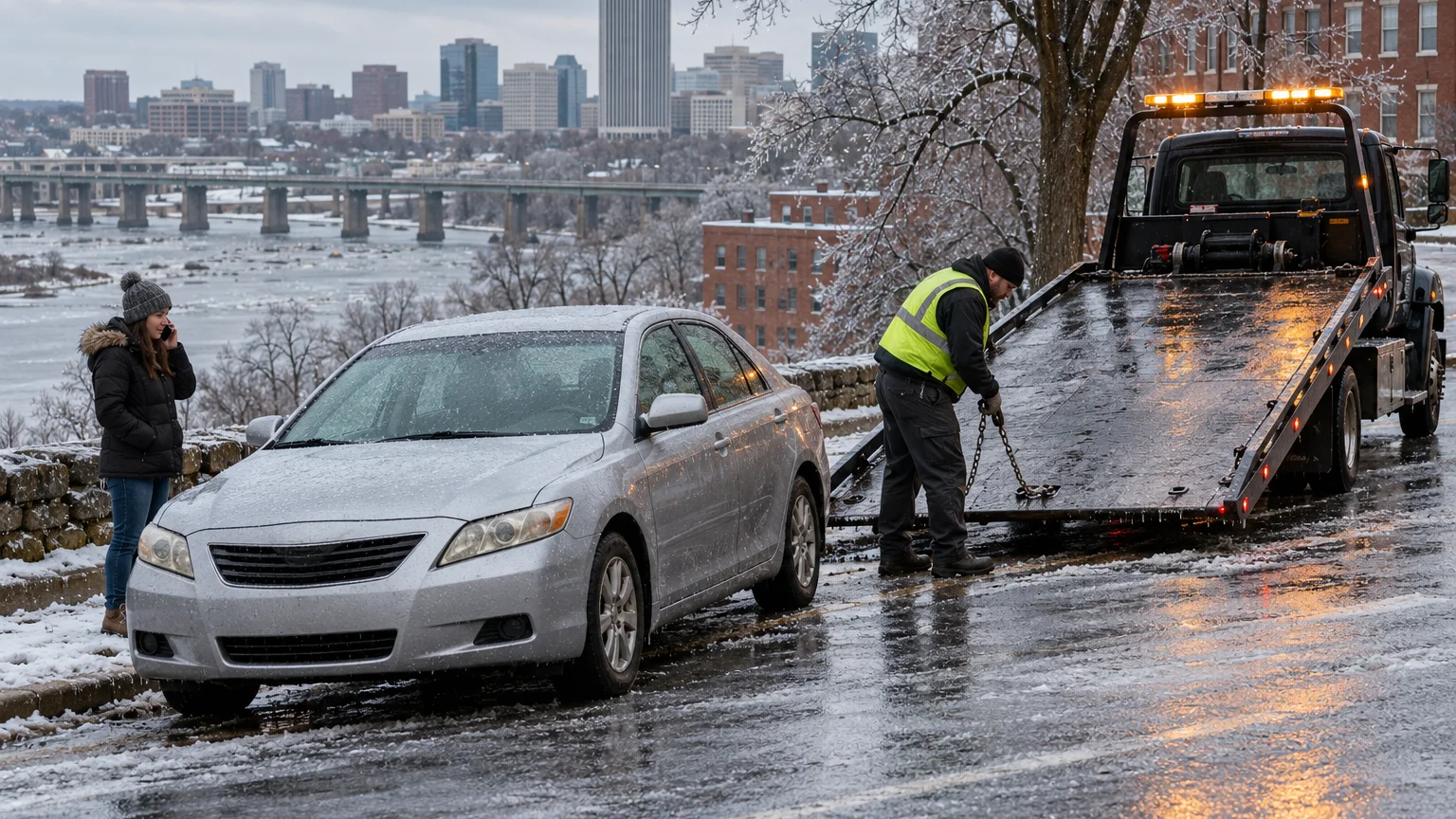
For towing after ice storm Richmond drivers should first get clear of moving traffic, report the exact conditions, and decide whether the vehicle needs roadside help or transport. If authorities are already responding, follow their directions before arranging an operator.
Ice changes more than road traction. It can block access, hide the vehicle’s condition, and limit safe working space. The right decision may be roadside help, a tow, or waiting until authorities clear the scene.
Stay clear of moving traffic first
Your first decision concerns people, not the vehicle. Move away from active traffic when you can do so without crossing an unsafe surface. Don’t stand between your car and approaching vehicles. If you can’t leave safely, remain where you’re protected and wait for responding authorities.
A disabled car on the downtown I-95/I-64 overlap presents a different problem from one parked in a Richmond lot. VDOT has described that overlap, from around Bryan Park toward the James River, as one of the region’s most congested and crash-prone corridors. An operator needs a controlled place to approach and work.
Tell public safety authorities if your car blocks a travel lane. Also report debris, a collision, leaking fluid, or another immediate road hazard. Don’t try to move a damaged vehicle simply to make towing easier.
Virginia’s move-over law covers stopped vehicles displaying hazard flashers on highways with four or more lanes. Approaching drivers must change lanes when safe or reduce speed. That protection doesn’t make a travel lane or narrow shoulder a safe waiting area.
Weather and incident control can delay access even when a tow has been requested. Police, fire personnel, or VDOT crews may control the scene first. A referral service can connect you with an operator, but it can’t override a road closure or an officer’s instructions.
For more corridor-specific guidance, read what to do when you’ve broken down on I-95 in Richmond.
Report the road and vehicle conditions
A street name alone may not identify a safe approach after freezing rain. Give the direction of travel, nearest exit or intersection, and which side of the road holds the car. Mention whether you’re on a ramp, shoulder, median, parking lot, or travel lane.
Describe what surrounds the vehicle. Note visible ice, standing water, packed snow, fallen branches, traffic control, or blocked pavement. Say whether an operator can reach the front and rear of the car. If police or VDOT vehicles are present, include that too.
Then describe the vehicle itself. Provide its make, model, color, and general size. Tell the operator whether it rolls, steers, starts, or shifts into neutral. Report collision damage, flat tires, locked wheels, low ground clearance, or missing keys. Don’t guess about mechanical damage you can’t see.
Share your intended destination during the first conversation. A repair shop, home, or other approved location may require a different route. Confirm that someone can receive the vehicle, especially outside normal business hours.
Check 511 Virginia for official traffic and road-condition information. It can help you identify incidents or closures affecting the pickup route. Don’t treat a clear map elsewhere in Richmond as proof that your specific shoulder or side street is accessible.
These details help an independent operator judge whether ordinary towing equipment can reach the car. They also reduce the chance of sending an operator toward the wrong carriageway or a blocked entrance.
Decide whether roadside help could be enough
Not every ice-related stop requires transport. A jump start, tire change, fuel delivery, or another limited service may get the car moving. The key question is whether the problem can be addressed where the vehicle sits without exposing anyone to moving traffic.
VDOT’s Safety Service Patrol provides free incident-management and roadside assistance on covered interstates. Richmond-area coverage includes I-95, I-64, and I-295. Patrol services can include jump starts, tire changes, fuel delivery, radiator water, and help arranging a tow.
The patrol isn’t a repair shop or towing company. Its role is to manage incidents, help move disabled vehicles from danger, and assist drivers with their next step. If a patrol reaches you, follow its instructions about where the vehicle should remain.
Roadside work may not be suitable when the car has collision damage, won’t roll, has a locked wheel, or sits where assistance can’t be performed safely. A battery that starts after a jump may also fail again. Our guide to a car that won’t start after a jump explains when transport becomes the practical next step.
When the problem appears limited and the location allows safe work, ask about roadside assistance first. If the vehicle can’t be made movable where it rests, request towing instead. Don’t attempt repeated roadside fixes while authorities are directing traffic or controlling the scene.
Towing after ice storm Richmond access details to share
Access often determines whether an operator can reach the vehicle. Describe the final approach, not just the neighborhood. A car in the Fan may sit on a street with limited working room. A vehicle on I-295 may require access from one direction and a specific interchange.
Tell the recorded line if the road is closed, untreated, gated, or partly blocked. Mention steep entrances, parking decks, narrow alleys, low branches, or vehicles surrounding the disabled car. State whether the car left the pavement or rests against a curb, barrier, or other object.
Photos can help when an operator requests them. Capture the whole vehicle, nearby pavement, and available working space from a safe position. Don’t walk into traffic or onto glazed pavement merely to get a better angle.
Be clear about the difference between towing and recovery. A car sitting normally on accessible pavement may need transport. A car off the road, lodged against an object, or unable to reach the tow vehicle may require recovery work before transport begins. Describe what you see without deciding what equipment is required.
Quick Tow Richmond is a referral service. The recorded line takes calls at any hour, plays a recording notice, and accepts a message. We match drivers with independent licensed towing operators. The operator contracts with you, performs the work, and bills you directly.
If the vehicle needs transport from a controlled location, review our emergency towing service. Give complete access details before an operator is sent, since conditions can differ sharply between downtown Richmond, the interstate system, and nearby county roads.
Confirm the destination and complete charge
Set the destination before dispatch whenever possible. Confirm its full address and whether it can receive the vehicle. If the repair shop is closed, ask the shop where the car may be left. Don’t assume its parking lot accepts unattended drop-offs.
Ask the independent operator for the complete charge before agreeing. The total may depend on vehicle condition, pickup access, mileage, recovery work, storage, and the destination. Ask whether the quoted amount includes mileage and any work needed before the vehicle can be loaded.
Also confirm accepted payment methods directly with the operator. Ask when payment is due and who must be present at delivery. Keep any written quote and request an itemized receipt after the work.
Don’t confuse a driver-requested tow with a nonconsensual private-property tow. Richmond’s legal fee ceilings apply to vehicles removed from private property without the owner’s permission. They aren’t a quoted price for the winter tow you request.
The brand doesn’t set an independent operator’s total. It also can’t promise an arrival time when ice, closures, or responding authorities restrict access. The most useful step is to provide accurate conditions and confirm the full charge with the operator.
Before the vehicle moves, verify the destination again. Make sure the operator has the correct address and delivery instructions. Remove essential personal items if you can reach them safely. Keep your keys and contact information available in case the receiving location needs authorization.
When to call us
Call when your disabled vehicle can’t be handled safely through basic roadside help and needs a licensed towing pro. Quick Tow Richmond can refer your recorded request to an independent operator, but road access and the operator’s complete charge still require confirmation. Call us at (804) 701-6752.