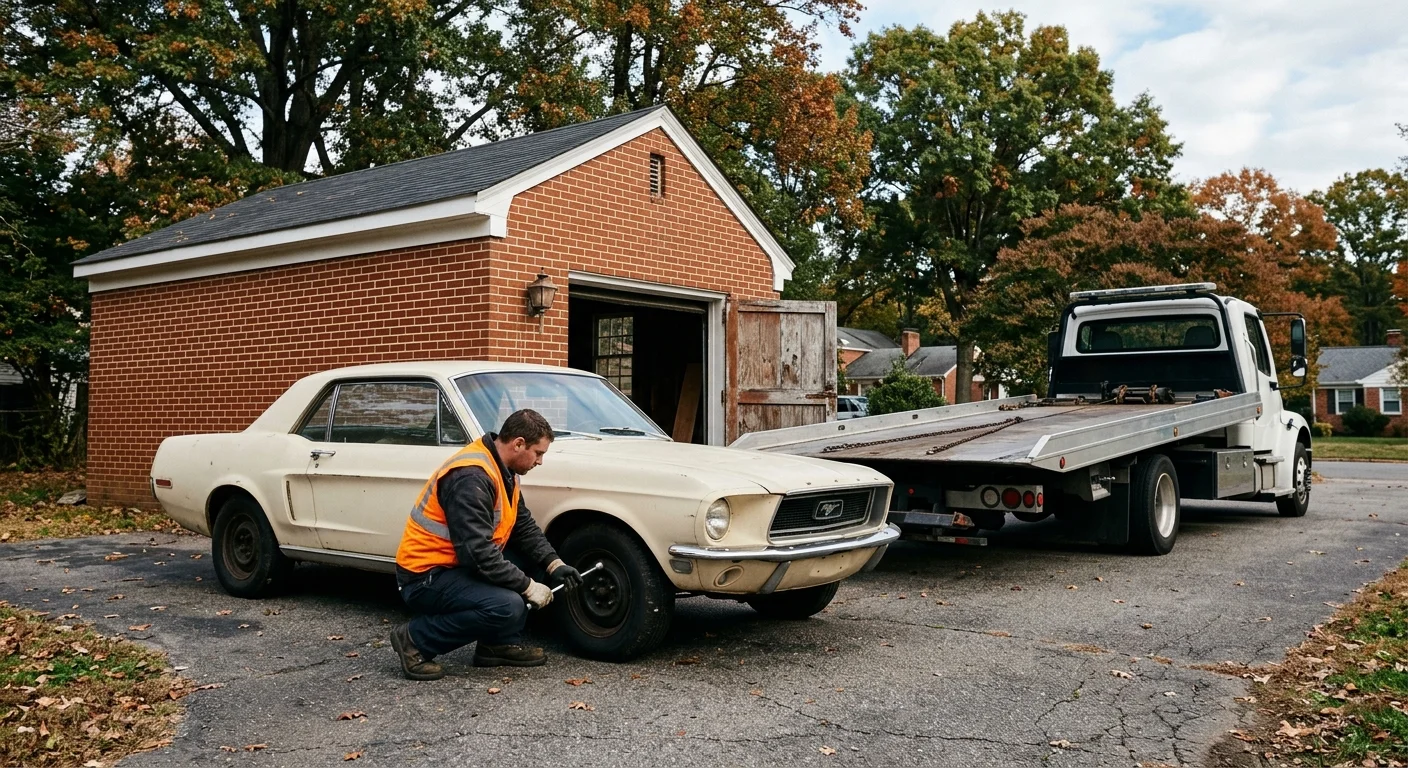
You can still tow classic car that won’t roll after a winter in a Fan garage or a Chesterfield shop bay. The operator needs which wheels are locked, how the truck reaches the car, and photos of the stance and the path. Skip the diagnosis. A referred, licensed, and insured operator plans the load from what you can see.
A stored classic in Richmond is rarely a highway call. It is a brick alley off Monument, a tight pad in The Fan during VCU move-in, a gravel pull-off in Hanover, or a warehouse bay near the Port of Richmond. Those places change the truck, the approach, and the time on scene. Give that picture first.
Report which wheels won’t move
Walk the car once. Name each corner: left front, right front, left rear, right rear. Say whether the tire is on the car, flat, or missing. Say whether the wheel turns by hand if you can check it without shoving the car. If you have not tried to roll it, say that. Forcing a stored classic across pavers or a cracked concrete apron in Church Hill can score a tire or a valance before help arrives.
Tell the operator about steering and the parking brake in the same pass. Do the keys live with the car. Does the column unlock. Will the shifter move. A car that will not steer is a different job from a car that simply will not start. A locked parking brake on one axle is a different job from all four wheels frozen in place. Missing wheels belong in the first sentence of the message, because the loading plan has to account for them.
Stay with what you observed. “The right rear will not turn” is useful. “The caliper seized” is a guess, and a guess can send the wrong truck. The same is true of bearings, drums, and a stuck parking-brake cable. A mechanic at the destination can sort the cause. The operator on the driveway needs the current state of each wheel.
If the car sat through Richmond’s freeze-thaw season, mention how long it has been still. The official seasonal snowfall average here is 8.8 inches, and ice after a storm like Christmas Eve 1998 is part of local memory. A car that has not moved since fall is a different conversation from one parked last week. You still do not need a theory. Time in storage is a fact.
If the classic is on a public right-of-way instead of a garage, say so. Henrico’s Tag N Tow path starts with a warning tag on an abandoned or inoperable vehicle on a public right-of-way, then a reinspection after 48 hours. That is a county process, separate from a job you are arranging. For a private garage or a shop, the operator only needs the address, the surface, and the wheel report.
Describe the car without guessing the cause
Start with year, make, model, and body style. Then list what is no longer stock. Lowered springs, air bags sitting on the stops, wider wheels, side pipes, a chin spoiler, or a valance close to the pavement all change how a truck approaches the car. A name like “Chevelle” does not describe the current stance. A side photo at wheel height does.
Say whether it ran when it went into storage. Say if parts are off: a bumper in the corner, a battery on the bench, a disconnected exhaust. Mention loose trim, a convertible top that will not latch, or a jack still under a frame rail. Those are load hazards. They are not a repair list.
Leave the failure mode to the shop. “It cranks and nothing happens” is enough if you tried a start. “I have not tried to start it” is enough if you have not. Visible fluid under the engine or the rear axle is worth a photo. Smoke, a sharp smell, or damaged wiring is worth a sentence. You are matching the job to exotic and classic vehicle towing, not writing a work order.
Richmond jobs split by place. A coupe in a Fan alley with parked cars on both sides is a different access problem from a Midlothian shop with a wide apron. A Mechanicsville barn with a dirt floor is a different surface from a Short Pump HOA pad. Petersburg and the Tri-Cities add distance on I-95 and I-85. Name the city or county, the street, and where the car sits on the lot. Henrico, Chesterfield, and the City of Richmond are not interchangeable for a recovery run.
If you already have a destination, give it. A restoration shop in Chesterfield, a storage unit in Henrico, or a home garage in the West End each needs its own unload path. The operator bills you directly. Ask for the full total with mileage before you agree. The published standard light-duty hookup fee on this site is $105. A non-rolling classic is a specialty load, so treat that figure as a light-duty reference, not this job’s quote.
For the broader local picture on vintage pickups, see classic car towing in Richmond.
Send photos of the vehicle and access
Photos do more than a model name. Take a full side shot from wheel height so the operator can see ride height. Add the front valance, rocker panels, and the lowest exhaust or suspension piece you can see without crawling under the car. Include each wheel, especially any that will not turn or any that is missing. A clear shot of a scraped air dam or a packed fender matters more than a paragraph.
Then photograph the path. Garage door opening, the space in front of the bumper, shelves, bikes, a second car, a gate, a sharp turn, and the narrowest point between a wall and a fence. Say which way the classic faces. A car backed in against a workbench in Manchester is a different pull from one nosed toward the street in Lakeside.
Name the surface: concrete, asphalt, gravel, dirt, or decorative pavers. A slope toward the street in Church Hill, a crowned alley in The Fan, or a rutted farm lane in Hanover all change how a truck sets up. If landscaping, a brick pillar, or a low tree limb pinches the approach, put that in the frame. For a business lot, give the name, the closest entrance, and a dropped pin when the property has more than one driveway.
A public street or a shoulder is its own case. If the car is near I-95, I-64, or I-295, name the direction of travel and the nearest exit or cross street. VDOT’s Safety Service Patrol covers those Richmond-area interstates with free roadside help: a tire change, fuel, a jump, or help arranging a tow. It does not act as a tow company and it does not make mechanical repairs. Check 511 Virginia for incidents on the I-95/I-64 overlap, the stretch VDOT has called one of the highest crash, heavily congested corridors in the region.
If the car sits low, send the same clearance photos you would for a slammed daily driver. Our notes on how to tow a lowered car without scraping cover stance and approach. Share those pictures with the operator. They still choose the equipment after they see this car.
Check model-specific towing guidance
Open the owner’s manual, a factory towing supplement, or notes from a marque specialist if you have them. Some cars specify a preferred lift point, a warning about the transmission, or a note about the parking brake. Photograph that page and send it with the wheel report. If you do not have the book, say so. The operator can still plan from the photos and the year, make, and model.
A club forum or a restorer who knows this chassis can flag a brittle fuel line, a fiberglass nose, or a frame horn that is a poor tie point. Pass that along as a caution from the owner. It is not a loading spec the operator must follow sight unseen. The person on scene still chooses how to move this car.
Do not treat a dolly, a wheel-lift, or a particular strap pattern as mandatory because an article on another site said so. You can ask for flatbed towing. A flatbed is a common request for a classic that will not roll. It is still a job-specific decision once the operator sees clearance, wheel condition, and steering. Soft straps, wheel nets, and winch use belong in that on-site plan. This page will not invent an angle, a strap count, or a damage promise.
If the classic is unregistered, say that in the first message. Virginia’s 48-hour posted notice for expired registration or inspection applies to a resident’s car in a multifamily-dwelling lot before a nonconsent tow. It does not write the rules for a tow you are hiring. Ask the operator and the receiving shop what they need for a private, owner-requested move. Keep the plates with you. On a sale or when the vehicle is no longer operated, Virginia DMV says plates belong to the owner and must be surrendered.
Towing coverage on an auto policy is an optional add-on in Virginia, not a mandated coverage. Whether this move is reimbursed is a question for your insurer, not a state-law answer.
Confirm the loading plan before you tow classic car that won’t roll
Before anyone is sent, ask the referred operator to walk the plan out loud. How will the truck reach the car. How will a locked wheel be handled. Where will the car sit on the bed. What is the unload at the shop or the home garage. If a second person is needed to spot a tight Fan alley or a low door, ask that now.
Request the equipment in plain words, then listen to the answer. “I want a flatbed” is a preference. “The right rear will not turn, the car faces the workbench, and the door is a standard single-bay” is the information that lets the operator agree or propose another setup. Confirm that the destination can accept a truck of that size. A bay on Midlothian Turnpike is not the same as a dirt pad behind a Hanover barn.
Ask for the full total before you agree, mileage included. Richmond caps a nonconsensual private-property hookup at $195 under City Code § 27-302, and Virginia caps that class of passenger-car hookup at $210 under Va. Code § 46.2-1233.1. Those are legal ceilings on a tow without the owner’s permission. They are not this brand’s rate, and they are not a quote for a stored classic you are moving on purpose. The operator you are connected with sets the bill for this job.
Quick Tow Richmond is a referral service. The line matches you with an independent licensed operator, who contracts with you and bills you directly. The brand does not run the truck, own a yard, or set the operator’s total. Accurate photos and a clear wheel report are how you get a plan that fits the car sitting in front of you.
When to call us
Call when a stored classic will not roll and you need a licensed operator to plan the pickup, not a guess at the mechanical cause. The line takes calls 24/7. A recording notice plays, then you leave the year, the wheel report, the address, and the destination. Call us at (804) 701-6752.