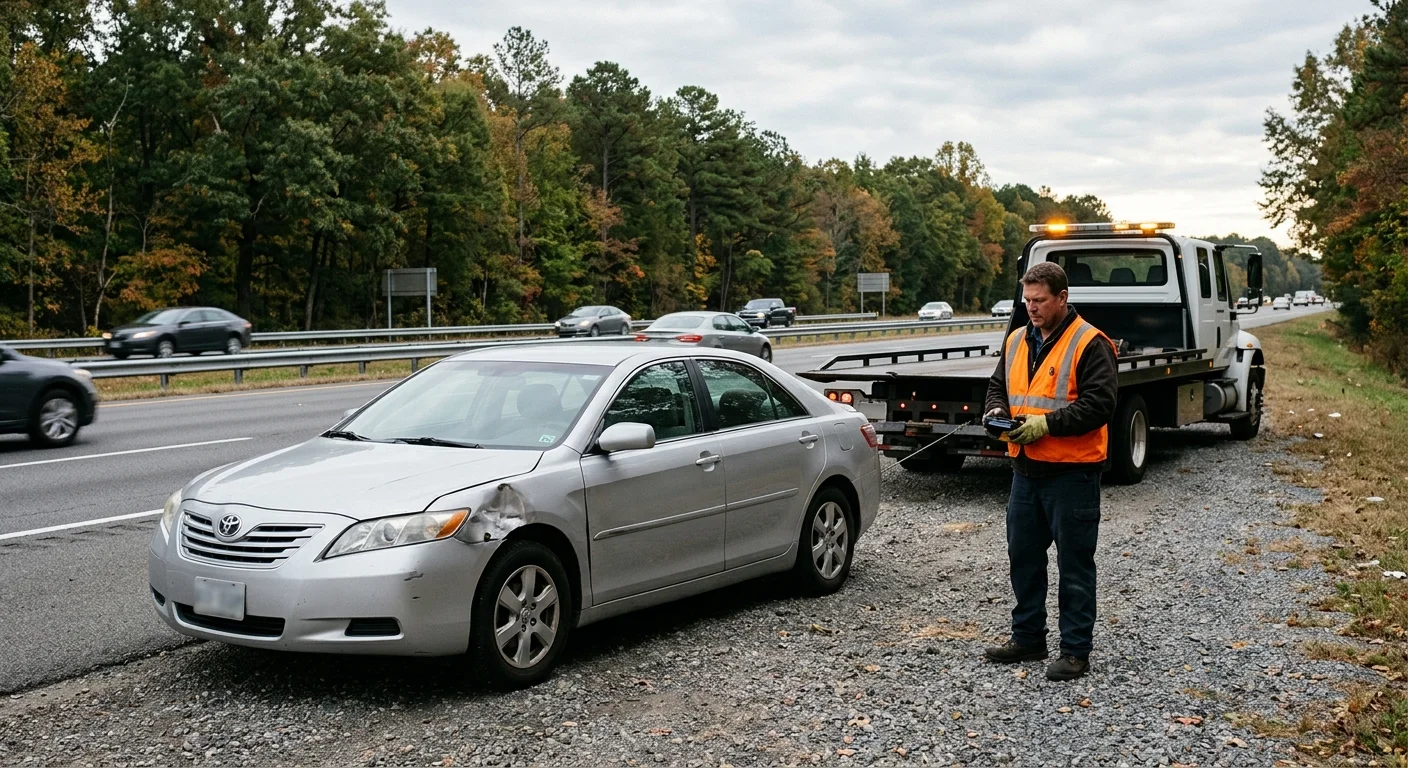
After an I-295 crash near Glen Allen, the first decision is whether the car needs towing, recovery, or both. Glen Allen towing and recovery starts with your exact position, visible damage, wheel condition, and planned destination. Give those details before dispatch so the independent operator can assess the request.
Start Glen Allen towing and recovery with scene control
An active crash scene comes before the towing request. Follow directions from law enforcement or roadside personnel already managing traffic. If responders have arranged a tow, record the operator’s name and the vehicle’s destination.
Tell the referral line where the vehicle sits now. Useful descriptions include the shoulder, median, ramp, ditch, or travel lane. Mention whether it’s against a barrier, facing across the roadway, or resting on uneven ground. Don’t move closer to traffic just to inspect something. Report only what you can see from a safer position.
Give the route and travel direction first. Then add the nearest exit, mile marker, overpass, or ramp. A map pin helps, but it shouldn’t replace those details. The operator needs enough information to approach the correct side of the interstate.
VDOT’s Safety Service Patrol covers I-295 in the Richmond area. It provides free roadside assistance and incident management. Patrol personnel can help move a disabled vehicle away from traffic and help arrange a tow. They don’t perform mechanical repairs or replace a towing company.
You can also check 511 Virginia for official traffic and incident information. If the car is accessible and ready for transport, an emergency towing referral may fit. A vehicle beyond the pavement may need a different assessment.
Tell the operator what the crash changed
A short damage report helps the operator understand the job. You don’t need to diagnose the car or decide what equipment it requires. Describe what changed after the impact and what you can plainly see.
Start with the vehicle’s position and wheel condition. Then report details such as:
- A wheel that looks bent, turned sharply, or pushed inward
- A tire that’s flat, separated, or trapped against bodywork
- Loose body panels near a tire
- Broken glass around the vehicle
- Visible fluid beneath the car
- Airbag deployment
- A door, hood, or trunk that won’t close
- Keys that are missing or locked inside
- A vehicle that won’t shift, steer, or roll
Say whether the car remained upright and whether every wheel is still on pavement. If it crossed a curb, entered soft ground, or stopped against an object, include that too. Report what you already know. You don’t need to start or move the car merely to answer these questions.
Photos can help when they’re taken from your current safe position. Capture the vehicle’s overall position, the damaged wheel area, and the path back to pavement. Avoid close inspection near moving traffic.
These details help distinguish transport from accident recovery and winch-out work. They also reduce the chance of treating a difficult recovery as a routine roadside pickup.
How towing differs from vehicle recovery
Towing generally starts once a vehicle is accessible and ready for transport. Recovery comes first when the vehicle must be moved from a ditch, soft shoulder, slope, obstruction, or awkward position. Some crash scenes involve both steps.
A car can look close to the road while still needing recovery. Its wheels may be unable to roll freely. The approach may be blocked, or the car may sit at an angle that prevents ordinary loading. Visible damage can also change how the operator prepares it for transport.
Don’t assume a standard tow fits every crash. Explain where the vehicle stopped and what happened to its wheels. An independent operator can use that information to evaluate the request. The final approach may depend on the scene once the operator arrives.
If the vehicle left the pavement, note the surface beneath it. Grass, mud, loose gravel, a drainage area, and a paved shoulder present different access conditions. Also mention barriers, trees, signs, or other objects around the car. Our guide to choosing a tow or winch-out after leaving the road explains that decision in more detail.
Quick Tow Richmond refers requests to independent licensed towing operators. The operator contracts with you, performs the work, and bills you directly. Quick Tow doesn’t set the operator’s total. Before agreeing, ask for the full amount with mileage and any recovery work included.
Share your I-295 direction and nearest exit
“I’m on I-295 near Glen Allen” isn’t enough for an accurate pickup location. Start with northbound or southbound. Then say whether you’re before or after the nearest exit.
Add the part of the roadway where the car stopped. It might be on the main interstate, an entrance ramp, an exit ramp, or a shoulder near an overpass. Mention whether the car is inside or outside the travel lanes. If you crossed the median or left the pavement, say that clearly.
A useful location message follows this order:
- I-295 and travel direction
- Nearest exit, mile marker, or overpass
- Before or after that reference point
- Shoulder, median, ramp, ditch, or travel lane
- Vehicle color and type
- Any barrier or object beside the vehicle
Send a location pin when possible. Before sending it, compare the pin with the road signs you can see. Confirm that the map shows the correct carriageway and direction. Separated interstate lanes can place two nearby pins on very different approaches.
Tell the operator if law enforcement has restricted access or directed traffic around the crash. Don’t promise that the vehicle will remain in its current position. If responders relocate it, update the location before dispatch.
Exact directions help the operator assess access without an arrival-time promise. They also prevent a general Glen Allen request from being mistaken for a surface-road pickup.
Choose the destination before dispatch
Pick a destination before the operator begins the trip when you can. Common choices include a repair shop, your home, or another location selected with your insurer. Give the complete address and the business name.
Contact the destination before dispatch. Confirm that it can accept the vehicle in its current condition. Ask where the operator should leave it and what happens if the building is closed. Don’t assume a repair shop can receive a damaged vehicle after hours.
If an insurer is involved, ask whether your policy includes towing or roadside coverage. Towing coverage is optional in Virginia, so the answer comes from your policy rather than a general state requirement. Our guide to who pays for a tow after a Richmond crash covers the main payment questions.
Share the destination before accepting the operator’s quote. Mileage, recovery work, and the final drop-off can change the total. Ask for the complete amount with mileage included. If the destination changes, ask how that affects the price before the vehicle moves.
Keep the operator’s name, destination, and itemized bill. Virginia towing operators must retain towing records, including itemized fees, for one year. Quick Tow Richmond doesn’t perform the tow or set the operator’s charges. Your agreement and payment are directly with the independent operator.
Frequently asked questions
Can VDOT Safety Service Patrol tow my crashed car?
VDOT Safety Service Patrol provides free roadside assistance and incident management on I-295. It can help move a disabled vehicle to safety and help you arrange a tow, but it doesn’t act as a towing company.
What if the car left the pavement?
Describe its position, wheel condition, surrounding surface, and path back to the road. The operator can assess whether recovery is needed before transport.
Who sets the towing total?
The independent operator sets the total and bills you directly. Ask for the full amount, including mileage and recovery work, before agreeing.
When to call us
Call when crash damage, wheel condition, or vehicle position requires assessment by a licensed towing pro. Quick Tow Richmond refers your request to an independent operator, who contracts with you and bills you directly. The recorded line takes calls 24/7 and plays a recording notice before your message. Call us at (804) 701-6752.