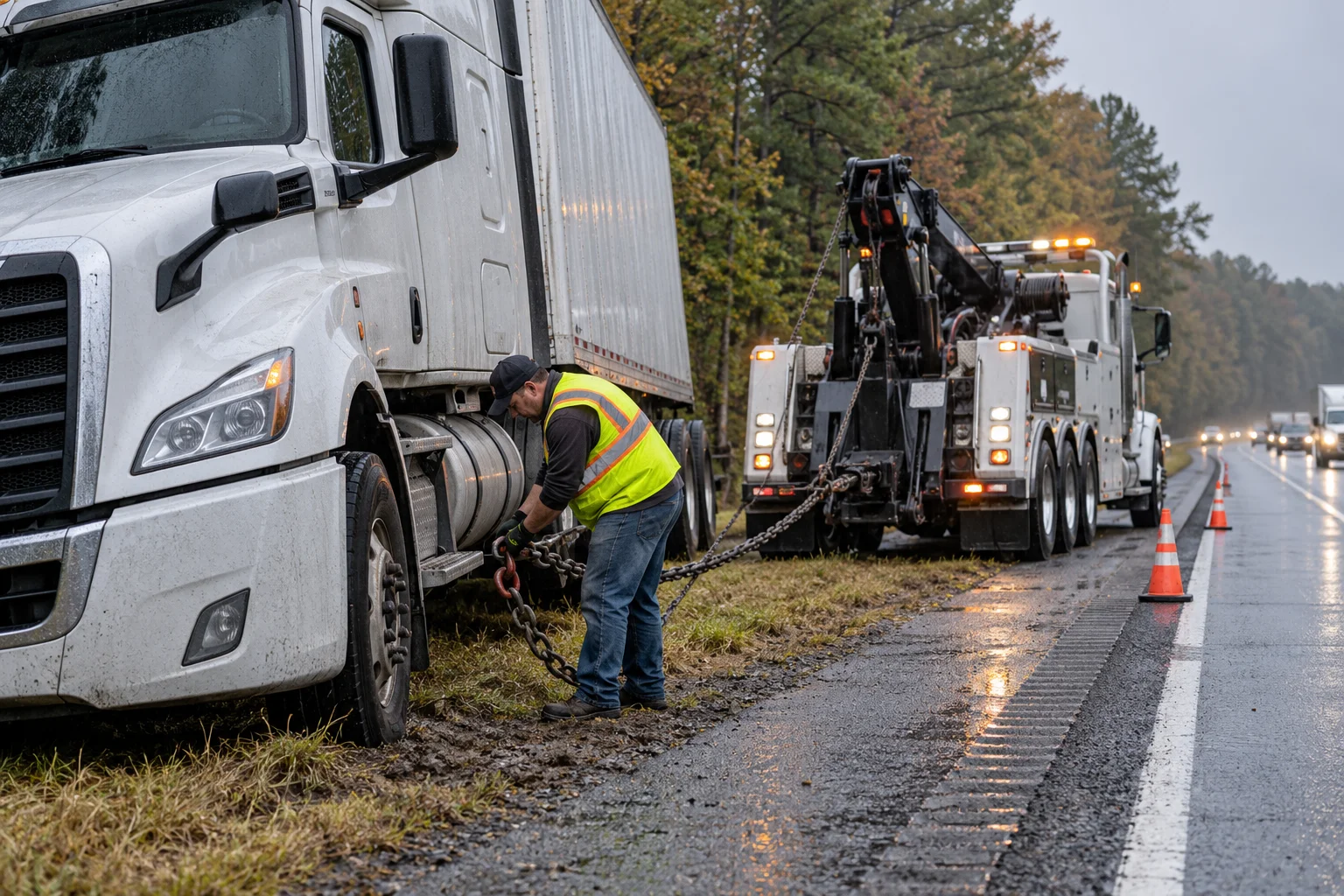
A commercial truck disabled near Ashland needs the right recovery plan. When requesting heavy duty towing Ashland VA, share the truck’s configuration, exact I-95 location, load, condition, and destination. Quick Tow Richmond uses those details to match your request with an independent licensed tow operator.
Don’t guess about equipment, weight, or the cause of the breakdown. Accurate observations help the operator assess the job before traveling toward the truck. If you’re arranging help for someone else, keep the driver available by phone.
Identify the truck and its configuration
Start with the truck’s year, make, and model when known. Share the unit number if your company uses one. Photos can help when records aren’t available or the caller isn’t beside the vehicle.
Describe the truck in plain terms. Say whether it has a separate trailer, how many visible axles it has, and whether anything is attached behind it. Mention sleepers, liftgates, mounted bodies, or other visible features. Don’t choose a towing class or request a specific recovery vehicle unless your company already has verified specifications.
For a tractor and trailer, confirm whether they remain connected. Tell the operator if either unit appears damaged. If the trailer is angled, leaning, or off the pavement, describe its position without approaching an unsafe area.
Share any known height, length, or weight from the truck’s records. If those figures aren’t available, say they haven’t been confirmed. A guess can create a poor recovery plan.
Our heavy-duty towing referral service connects the caller with an independent operator who owns and selects the recovery equipment. Quick Tow Richmond doesn’t own wreckers or perform the tow.
This page focuses on larger commercial vehicles. A driver with a passenger vehicle can use our separate guide to an I-95 breakdown near Ashland. That distinction keeps the request clear from the first message.
Share the I-95 direction and location for heavy duty towing Ashland VA
“I’m near Ashland” leaves too much ground to search. Start with northbound or southbound I-95. Then provide the mile marker, nearest exit, or another visible reference.
Say whether the truck is on the right shoulder, left shoulder, ramp, parking area, or beyond the pavement. Mention whether any part of the truck or trailer extends into a travel lane. If law enforcement or a highway patrol vehicle is present, include that information.
The I-295 interchange at mile 84 in Hanover County is a useful southern reference. Kings Dominion in Doswell is another recognizable point farther north along I-95. Use the closest confirmed marker instead of assuming the truck is inside Ashland.
A dropped location pin can support the description, but don’t rely on it alone. Ask the driver to read the direction and mile marker from a safe position. If the driver moved away from the truck, explain where both are now.
Check 511 Virginia for official traffic and incident information. That can clarify whether congestion, a closure, or an active incident affects access.
VDOT’s Safety Service Patrol covers I-95 in the Richmond region. Its free services include incident support, tire changes, fuel delivery, jump starts, and help arranging a tow. The patrol doesn’t perform mechanical repairs or act as the towing company.
For a breakdown that presents an immediate roadside risk, our emergency towing referral page explains what information to gather before requesting a match.
Report the load without guessing its weight
The operator needs a truthful description of what the truck carries. Start by saying whether it’s loaded, partly loaded, or empty. Then name the cargo only when the driver or shipping records confirm it.
Look for verified weight information in the bill of lading, dispatch record, or vehicle documents. Share the recorded figure and identify its source. If no reliable figure is available, say the load weight couldn’t be confirmed.
Don’t estimate weight from the truck’s appearance. Don’t describe cargo as harmless, stable, or secure unless the driver has confirmed that condition. Report visible movement, leaning, leaking, or damage as an observation.
Tell the operator if the cargo requires special handling, but don’t promise that a tow operator can transfer or protect it. Cargo handling and towing may require separate planning. The matched operator can explain what falls within the proposed recovery work.
For sealed cargo, provide the description carried in the shipping paperwork. Don’t open a sealed trailer solely to answer a towing question. If the contents aren’t known to the person calling, connect the operator with the carrier or dispatcher who has the records.
A moving truck or box-style vehicle may present different facts than a tractor and trailer. Our guide to a box-truck breakdown on I-95 near Chester shows how vehicle condition and destination shape that request. The location differs, but accurate reporting remains essential.
Describe whether the truck rolls and steers
The operator needs to know what the truck can do now. Confirm whether it rolls, steers, and remains upright. Report only what the driver can observe without attempting an unsafe test.
State which wheels appear damaged, blocked, or off the pavement. Mention a missing tire, bent wheel, detached part, or visible underbody contact. If the truck has settled into soft ground, describe the surface and how far it appears to have moved beyond the pavement.
Explain what happened immediately before the stop. The engine may have shut down, a warning may have appeared, or the truck may have stopped after an impact. Those observations are more useful than an unconfirmed diagnosis.
Tell the operator if the keys are available and whether the driver can access the cab. Mention damaged doors, locked steering, or controls that won’t respond. If the truck can’t be placed in its expected operating position, say so plainly.
Photographs should show the full truck, its road position, the damaged area, and the space around it. Take them only from a safe location. Don’t step into a travel lane or crawl beneath the vehicle.
If a collision or roadside departure is involved, say whether the truck remains on pavement. A truck resting against a barrier, down an embankment, or at an angle needs more planning than a straight roadside tow. Let the independent operator decide which equipment and recovery method fit the reported conditions.
Confirm the destination and recovery plan
Choose a destination before the operator begins the trip when possible. Provide the business name, street address, and a contact who can confirm access. The destination might be a repair facility, company property, or another location authorized by the vehicle owner.
Confirm that the destination can receive the truck in its current configuration. Ask about gate access, available space, and after-hours entry. If the receiving location hasn’t accepted the vehicle, tell the operator that approval remains pending.
Quick Tow Richmond doesn’t set the operator’s price. The independent operator contracts with and bills the driver or business directly. Before agreeing, ask for the full proposed total, including mileage and any recovery work discussed.
Explain whether the requested work is a roadside tow or a recovery from another position. Don’t assume those plans are interchangeable. A truck that rolls and steers on a paved shoulder presents different information from one that’s damaged or off the road.
Keep the carrier, driver, vehicle owner, and receiving contact aligned. The person authorizing the work should understand the destination and reported condition. If authorization must come from a company dispatcher or insurer, identify that person before the operator proceeds.
Share any changes immediately. A truck that was moved by highway personnel, separated from its trailer, or redirected to another destination may need a revised plan. Accurate updates reduce confusion between the caller and the independent operator.
When to call us
Call when a disabled commercial truck near Ashland can’t safely continue and needs a licensed towing pro. Our recorded line takes calls 24/7, plays a recording notice, and collects the details needed to match your request with an independent operator. Call us at (804) 701-6752.