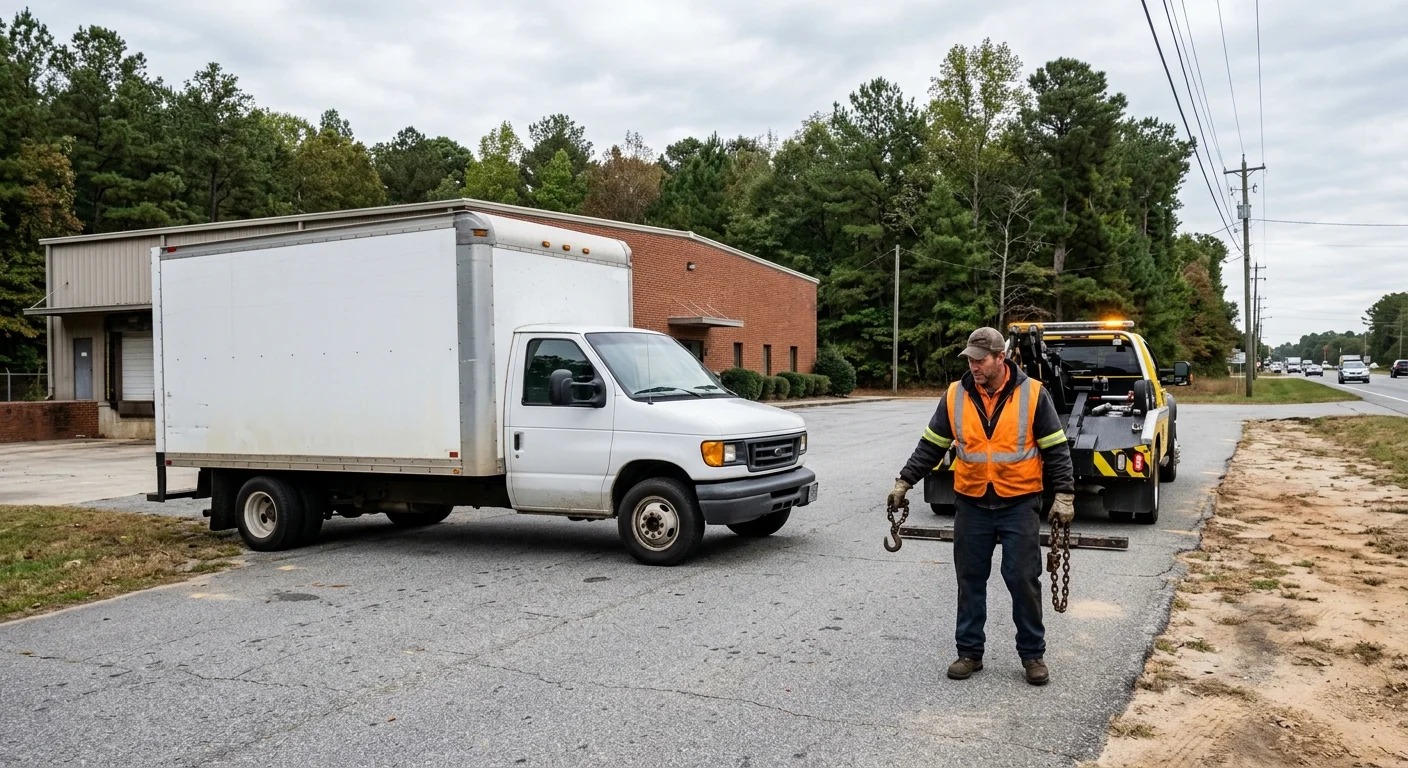
A search for heavy duty towing Sandston VA often starts with a delivery truck that can’t finish its route. Give the referral line the truck’s configuration, load details, rolling condition, pickup access, and destination. Quick Tow Richmond can then match the request with an independent licensed operator who contracts with and bills you directly.
Identify the truck and its configuration
Start with the vehicle in front of you, not its usual nickname. “Delivery truck” can describe several different configurations. The assigned operator needs a clear description before choosing towing equipment.
Share the manufacturer and model when you can confirm them. Then describe the body and cab. Say whether it’s a step van, cab-over truck, straight truck, or tractor with a trailer. Mention a liftgate, refrigeration body, utility body, or attached trailer when present.
Count the visible axles instead of guessing the truck’s class. Report whether the cab and cargo body remain connected normally. If a trailer is involved, explain whether it’s still coupled. Photos of both sides, the front, and the rear can help the operator assess the overall setup.
Use paperwork or a manufacturer label for any weight figure. If neither is available, say the weight isn’t confirmed. Don’t estimate it from the truck’s appearance or cargo.
The difference between towing categories depends on the actual vehicle and its condition. Our guide to medium-duty and heavy-duty towing in Richmond explains why the operator needs more than a general vehicle name.
A precise description helps prevent a mismatch between the request and the vehicle. It also lets the operator ask focused questions before accepting the job.
Report the load without guessing its weight
Tell the operator whether the delivery truck is empty, partly loaded, or carrying its scheduled load. Describe what’s inside using plain terms. Packages, furniture, food, equipment, and palletized goods create different planning questions.
Use the shipping manifest, scale ticket, or other business record when it gives a weight. Read the figure as written. If the paperwork isn’t available, state that the cargo weight hasn’t been confirmed. An honest gap is more useful than a confident guess.
Report anything visibly different from the start of the route. That includes cargo that appears shifted, a damaged liftgate, an open door, or liquid beneath the truck. Don’t promise that the cargo can remain aboard. The independent operator must assess the truck and decide what the proposed move requires.
If the paperwork identifies regulated material, give the operator the exact description shown. Don’t shorten the name or replace it with a broad label. The same rule applies to temperature-sensitive goods. Explain what the documents say without promising refrigeration or cargo protection during the tow.
Also identify who controls the load. That may be the driver, carrier, shipper, vehicle owner, or another business. Provide the contact who can answer cargo questions and approve decisions.
These details let the operator consider the truck and load together. They also help your business decide whether another party must address the cargo before the vehicle moves.
Describe whether the truck can roll and steer
The truck’s movement condition matters as much as its size. Tell the operator whether the engine starts and whether the transmission can be placed in neutral. Report what happens when the steering wheel turns and whether the wheels appear aligned.
Be specific about anything preventing movement. A locked wheel, damaged axle area, flat tire, displaced driveline component, or truck resting off pavement may change the plan. Describe only what you can observe. You don’t need to diagnose the failed part.
Mention any visible collision damage, leaking fluid, detached body panel, or damaged loading equipment. Say whether the parking brake releases and whether the truck’s normal braking system shows a warning. The operator can then decide which follow-up details are needed.
A commercial breakdown beside moving traffic also differs from a truck stopped in a loading area. For a roadside incident, share the truck’s position relative to travel lanes and barriers. If the situation calls for an immediate roadside referral, review our emergency towing service.
On I-64 or I-295, the VDOT Safety Service Patrol provides free roadside assistance and incident management on covered Richmond-area routes. SSP can help a disabled vehicle get safely off the roadway and assist with arranging a tow. It doesn’t perform mechanical repairs or act as the towing company.
Pinpoint the pickup for heavy duty towing Sandston VA
A street address may identify the property without identifying the truck. Sandston pickups can involve a customer entrance, loading area, gated business lot, or roadside position. Share a map pin when the truck isn’t visible from the main entrance.
For commercial truck towing near Richmond airport, include the business name and the entrance used by delivery vehicles. Explain whether the truck is at a dock, beside a building, behind a gate, or within a marked loading area. Provide a site contact when someone must grant access.
Describe the approach without estimating measurements. Mention low structures, narrow turns, parked trailers, soft ground, slopes, curbs, or blocked lanes when you can see them. If the site has posted clearance or gate dimensions, relay those figures exactly. Otherwise, say they haven’t been confirmed.
For an interstate pickup, give the route, direction of travel, nearest known interchange, and any visible marker. Don’t rely only on a Sandston mailing address. The Virginia traffic and incident map can help confirm current road conditions before the move is arranged.
Also explain where the driver and keys will be. If the truck is unattended, identify the person authorized to meet the operator. Share gate instructions and access restrictions supplied by the property.
Good pickup information reduces avoidable searching around a large site. It also gives the operator a clearer picture of the working space before accepting the request.
Confirm the equipment and destination
You don’t need to select the towing equipment yourself. Ask the independent operator to repeat the truck configuration, movement condition, and load details. Then confirm what equipment the operator plans to bring for that specific request.
Our heavy-duty towing referral service helps connect commercial callers with an operator suited to the reported job. Quick Tow Richmond doesn’t perform the tow, own the equipment, or set the operator’s total price.
Confirm the destination before dispatch. Give the facility name, full address, receiving contact, and the entrance intended for commercial vehicles. Ask the receiving location whether it can accept the disabled truck in its current condition. Pass along any instructions it provides.
The destination might be a repair facility, carrier property, customer-approved storage location, or another authorized site. Don’t assume a shop will accept the truck merely because it’s nearby. A named contact helps resolve access questions before arrival.
Ask the operator for the full proposed total, including mileage, before agreeing. The operator contracts with your business or the authorized customer and bills that party directly. Keep the operator’s name, contact details, destination, and quoted terms with the delivery record.
A different roadside situation may call for different information. The Chester box-truck breakdown guide covers an I-95 box-truck stop, while this Sandston process focuses on delivery access, load reporting, and destination coordination.
Frequently asked questions
Is every delivery truck handled as a heavy-duty tow?
Not necessarily. Give the operator the exact configuration and condition. The operator decides what equipment the reported vehicle requires. Don’t assign a class from the words “delivery truck” alone.
What should I say if the truck’s weight is unknown?
Say that the weight hasn’t been confirmed. Provide a documented figure only when it appears on reliable vehicle or shipping paperwork. You can still report the body style, axle count, load status, and visible condition.
Can VDOT tow the delivery truck from an interstate?
VDOT’s Safety Service Patrol isn’t a towing company. It provides free roadside assistance and incident management on covered routes. It can help move a disabled vehicle away from traffic and help the driver arrange a tow.
Does Quick Tow Richmond provide the final price?
No. Quick Tow Richmond is a referral service. The independent operator contracts with the customer, sets the proposed charge, and bills the customer directly. Ask that operator for the full total with mileage included before accepting.
What information should the receiving facility confirm?
Ask for the correct entrance, receiving contact, and any instructions for a disabled commercial vehicle. Relay those details to the operator. Don’t assume the address alone identifies the right drop-off point.
When to call us
Call when a disabled delivery truck can’t roll or steer normally, its load affects the plan, or the pickup and destination need commercial coordination. Our recorded line takes calls 24/7 and plays a notice before recording your message. Call us at (804) 701-6752.